バッカスとアリアドネ
ティツィアーノ・ヴェチェッリオ · 1520s
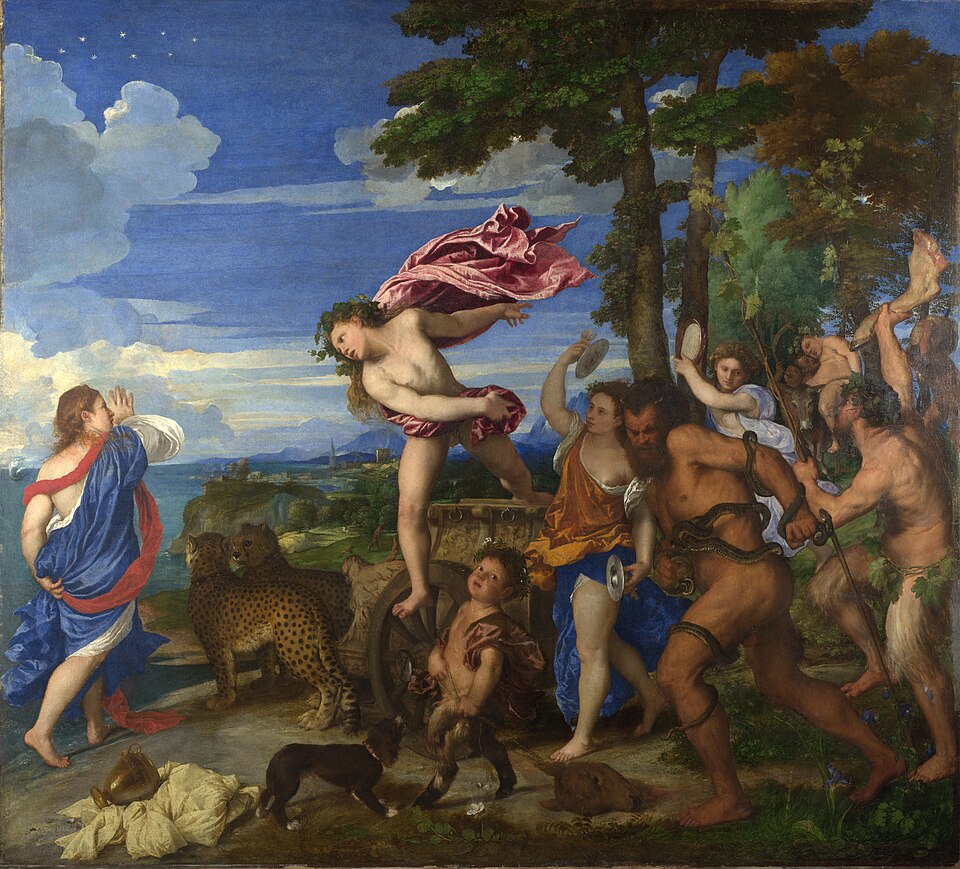
On a lonely shore, Ariadne turns in alarm as the god Bacchus leaps from his cheetah-drawn chariot toward her, mid-air, in love at first sight. Above her head, the stars that will become her crown already shine.
The story behind the painting
Titian painted Bacchus and Ariadne in 1520-1523 for Alfonso I d'Este, Duke of Ferrara, as part of a cycle of mythological pictures for the Camerino d'Alabastro, a private room in his palace decorated with paintings based on classical texts. The commission for a Triumph of Bacchus had first gone to Raphael, but when Raphael died in 1520 only a preliminary drawing existed, and the work passed to Titian. The cycle's other major paintings are The Feast of the Gods, mostly by Giovanni Bellini, now in Washington, and Titian's Bacchanal of the Andrians and Worship of Venus, now in the Prado. The series was a very early treatment of classical myths on a heroic scale, and very influential. This canvas, considered one of Titian's greatest works, is in the National Gallery, London.
What to look for
Ariadne has been abandoned on the island of Naxos by Theseus, whose ship sails away at the far left. Bacchus, god of wine, leaps from his chariot, drawn by two cheetahs perhaps modelled on animals in the Duke's menagerie; in Ovid they were tigers. The picture is split diagonally: a still triangle of blue sky, painted with costly ultramarine, and a crowded, moving triangle of green and brown. Look for the follower wrapped in snakes, sometimes linked to the ancient Laocoön sculpture, though here he simply girds himself with them as in Catullus. Find the small dog barking at a boy satyr, the golden urn signed TICIANVS, and above Ariadne the constellation Corona Borealis.
Meaning and intent
Scholars still debate Titian's literary sources. Catullus' 64th poem was long seen as the inspiration, with its tambourines, cymbals and snake-girded satyr. In 1948 Edgar Wind argued for Ovid's Fasti, which explains Bacchus leaping from the chariot, the constellation, and Ariadne being awake. Others point to Ovid's Metamorphoses or Ars Amatoria. Fern Luskin proposes Nonnos' Dionysiaca too: she reads the boy satyr as Ampelos, Bacchus' earlier love, whose transformation into a grapevine first gave the god wine, and notes that anemones once painted in his hair were replaced with jasmine. On her reading, Titian telescopes time, showing Ariadne now and as a future constellation. The National Gallery describes the scene simply as Bacchus falling in love at first sight, and Ariadne's initial fear.
Legacy
The painting's physical life has been eventful. The canvas was rolled up twice in its first century, and from about 1800 it was frequently restored to stop paint flaking; the source notes that the most controversial restoration took place at the National Gallery from 1967. Scientists there have also analysed Titian's pigments. Measuring 176.5 by 191 centimetres, the picture remains one of the high points of a cycle that helped bring classical mythology into painting at heroic scale, and it still invites viewers to unpick its many stories, from the departing ship at the edge to the stars above Ariadne's head.
豆知識
- Painted 1520-1523 for Alfonso I d'Este.
- Commission passed to Titian after Raphael's death in 1520.
- Size: 176.5 x 191 cm.
- National Gallery, London.
画家について
ティツィアーノ・ヴェチェッリオ (1488-1576)
神話画 · 盛期ルネサンス · ナショナル・ギャラリー · ロングヘア · 裸 · バックス · 田舎
同じ画家の作品: ティツィアーノ・ヴェチェッリオ
.jpg) ウルビーノのヴィーナス - Titian (1538)
ウルビーノのヴィーナス - Titian (1538)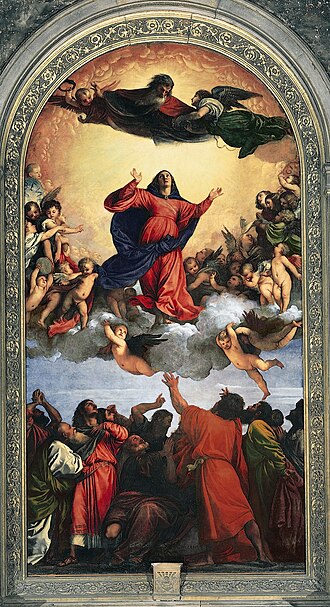 聖母被昇天 - Titian (1510s)
FXD.jpg) 聖愛と俗愛 - Titian (1510s)
聖愛と俗愛 - Titian (1510s)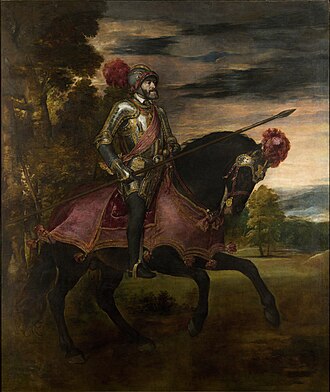 騎乗像 - Titian (1548)
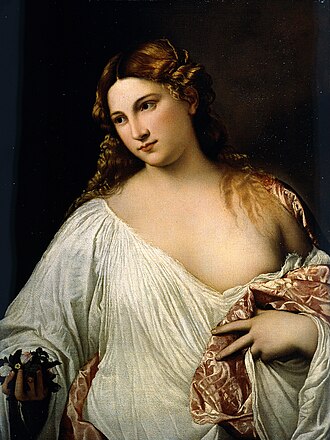 フローラ - Titian (1517)
 賢明の寓意 - Titian (1550)
%20nave%20left%20-%20Altar%20of%20Madona%20di%20Ca'Pesaro.jpg) ペーザロ家の祭壇画 - Titian
ペーザロ家の祭壇画 - Titian エウロペの略奪 - Titian
 モナ・リザ
モナ・リザ 白貂を抱く貴婦人
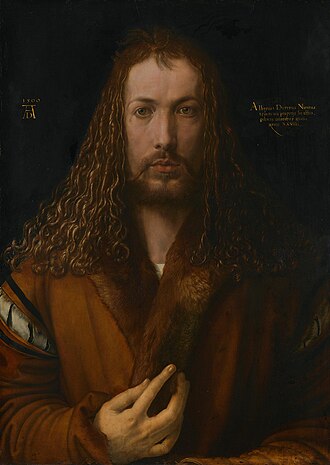 自画像
自画像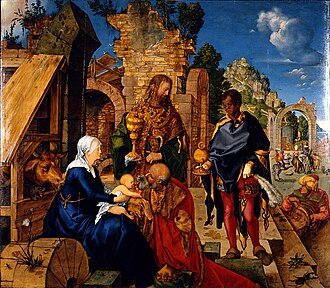 東方三博士の礼拝
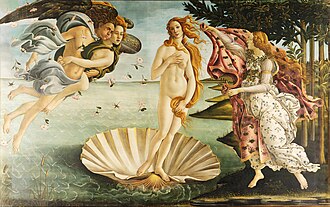 ヴィーナスの誕生
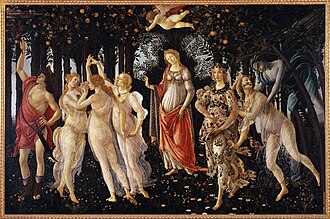 プリマヴェーラ