Temple of Juno in Agrigento
Caspar David Friedrich · 1828
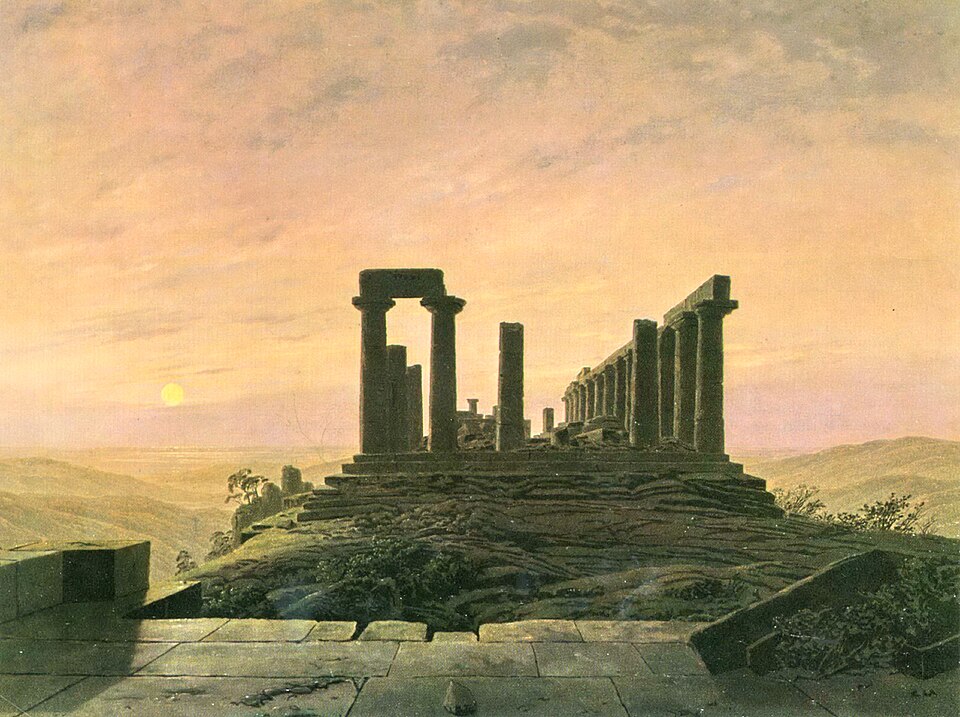
A Greek temple stands in ruins in a barren Sicilian landscape. Caspar David Friedrich never went to Italy and painted it from another artist's print, at the very moment his German colleagues were flocking to Rome.
The story behind the painting
The painting dates from 1828 to 1830; Wikidata gives 1828. It shows the temple traditionally called the Temple of Juno, the Temple of Hera Lacinia built around 460 to 450 BC in the Valley of the Temples at Agrigento in Sicily. Sacked by the Carthaginians around 406 BC and rebuilt by the Romans, it drew fresh interest from classicists from the mid eighteenth century. Jacob Philipp Hackert and Goethe both visited it. Friedrich never did. He produced the work from a print by another artist, though he had refused invitations to Rome, as early as 1816.
What to look for
Look at the temple set in a bare, empty landscape, the ruin isolated rather than celebrated. Goethe had written that the present view of the temple was as gritty as one could wish for, and Friedrich's picture keeps that sense of desolation. The canvas is small, about 54 by 72 cm. Unusually for him, the subject is classical: most of Friedrich's work rejects neoclassicism and its idealised Greek and Roman architecture in favour of the Gothic. Its attribution was once questioned too. Hermann Beenken published it as a Friedrich in 1943, later gave it to Carl Gustav Carus, and Helmut Borsch-Supan argues it is a Friedrich.
Meaning and intent
German enthusiasm for Italian art had peaked. In 1828 an exhibition of Nazarene art in Rome honoured the Crown Prince's visit. Friedrich mocked painters who seemed to see through coloured glass and who were no longer satisfied with our German sun, moon and stars. Interpretations differ. Borsch-Supan reads the temple in its barren setting as the death of ancient pagan religion, like Friedrich's megalithic tombs. Jens Christian Jensen thinks it was painted to prove an artist could create profound Italian subjects without travelling. Detlef Stapf sees a melancholy architectural work, perhaps made in the hope it would sell more easily than his Gothic pictures.
Legacy
His reason for refusing Italy is unknown; it was not lack of money. Writing to his friend Frederik Christian Lund, he said his mind had never gone to Rome, and that going back north afterwards would feel like burying himself alive. Jensen argues that Friedrich deliberately kept both his travels and his subjects narrow. Ironically, his friend Johan Christian Clausen Dahl put a figure of him into his painting Eruption of Vesuvius, taking him to Naples on canvas. The Museum fur Kunst und Kulturgeschichte in Dortmund bought this picture from a Cologne dealer in 1951.
豆知識
- Painted 1828 to 1830; Wikidata gives 1828.
- Friedrich never visited Italy and worked from a print.
- Once attributed to Carl Gustav Carus.
- Held in the Museum fur Kunst und Kulturgeschichte, Dortmund.
画家について
Caspar David Friedrich (1774-1840)
同じ画家の作品: Caspar David Friedrich
 雲海の上の旅人 - Caspar David Friedrich (c. 1818)
 楡の木のある僧院 - Caspar David Friedrich (1800s)
 氷の海 - Caspar David Friedrich (1820s)
 リューゲン島の白亜岩 - Caspar David Friedrich (1818)
 海辺の僧侶 - Caspar David Friedrich (1808)
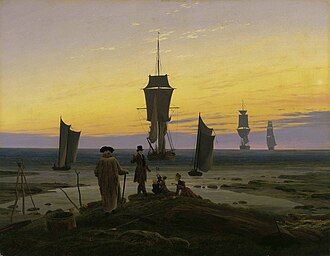 Life stages - Caspar David Friedrich (1834)
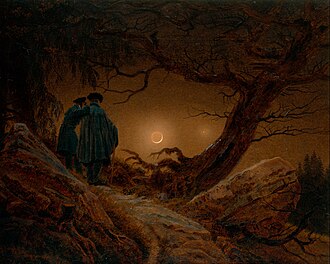 月を眺める2人の男 - Caspar David Friedrich (1810s)
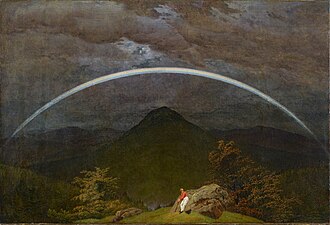 Mountain Landscape with Rainbow - Caspar David Friedrich (1809)
関連する画家の作品
 1808年5月3日 - Francisco Goya (1814)
 裸のマハ - Francisco Goya (1800)
 民衆を導く自由の女神 - Eugène Delacroix (1830)
 サルダナパールの死 - Eugène Delacroix (1827)
 戦艦テメレール号 - J. M. W. Turner (1839)
 雨、蒸気、速度 - グレート・ウェスタン鉄道 - J. M. W. Turner (1844)
 青衣の少年 - Thomas Gainsborough (1770)
 アンドリューズ夫妻 - Thomas Gainsborough (1748)