Reception of the Siamese ambassadors by the Emperor Napoleon III at the Palace of Fontainebleau, 27 June 1861
ジャン=レオン・ジェローム · 1864
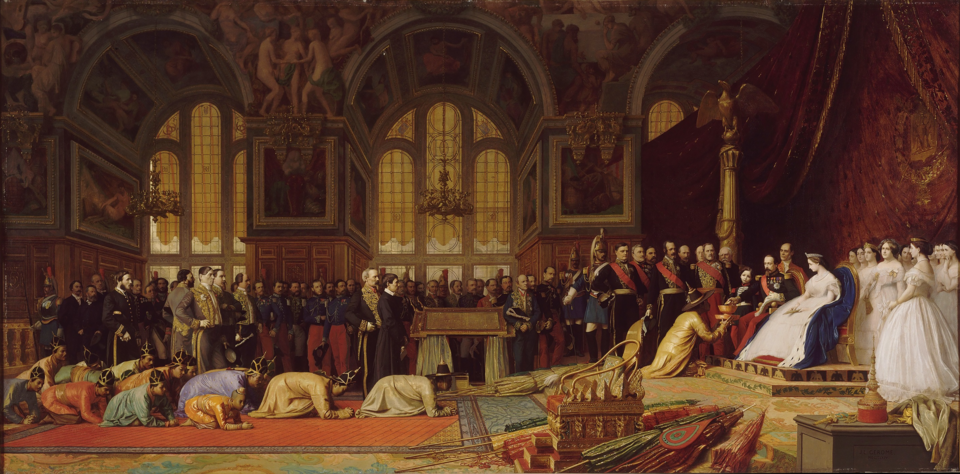
About fifteen Siamese envoys advance on their knees across the ballroom at Fontainebleau toward Napoleon III and Empress Eugénie. Gérôme spent three years on the scene and packed it with more than eighty portraits.
The story behind the painting
King Rama IV of Siam, who reigned from 1851, signed a treaty with France on 15 August 1856 guaranteeing peace, religious freedom and free trade. Unhappy that France was negotiating similar terms with Cambodia, he sent an embassy, received by Napoleon III at the Palace of Fontainebleau on 27 June 1861. The French state commissioned Gérôme, a recognised academic painter known for orientalist pictures, to record it for the historical museum at Versailles, all the more fitting because the event recalled Siam's embassy to Louis XIV. The work was finished in 1864 and shown at the Salon of 1865.
What to look for
The scene is the great ballroom, 30 m long and 10 m wide. The imperial couple and the young Prince Imperial sit at right on a double dais before a velvet canopy and a column topped by the imperial eagle. The envoys, in golden hats and silk robes, crawl forward on all fours. At the moment shown, the kneeling first ambassador presents the King of Siam's golden letter on a tray. Eugénie wears white with a blue and ermine court mantle and a diadem set with the Regent diamond. Gérôme painted himself at the far left, beside a guard.
Meaning and intent
The source names the envoys: the first ambassador, Rajikosa Thipusi, with his son and brother; the second, Phra Navai, head of King Mongkut's council, with his twelve-year-old son; the third, Phra Sarong, for the second king. Abbé Larnaudie stands by as interpreter. Among the courtiers are Count Walewski, the Duke of Bassano, the Duke of Cambacérès and Mérimée. For Napoleon III, seeking legitimacy in the old monarchic tradition, such an imperial festival was effective propaganda. Gérôme drew on David's Coronation of Napoleon for his composition.
Legacy
Gérôme worked from Nadar's portraits and sketches made on the spot, and aimed to render both people and setting faithfully: the Renaissance frescoes by Nicolò dell'Abbate after Primaticcio can be recognised, though he replaced the wooden windows with stone tracery. Rich gifts, a crown, palanquins and tiered parasols, surround the dais; replicas of objects of the King of Siam are kept in Empress Eugénie's Chinese museum. Gérôme signed alone, but had help with the architecture from the painter Victor Navlet. The canvas belongs to the Musée de l'Histoire de France at Versailles and is on deposit at Fontainebleau.
豆知識
- The reception took place on 27 June 1861 at Fontainebleau.
- Commissioned by the French state, finished in 1864, shown at the 1865 Salon.
- Contains more than eighty portraits.
- Gérôme included himself at the far left.
画家について
ジャン=レオン・ジェローム (1824-1904)
同じ画家の作品: ジャン=レオン・ジェローム
 指し降ろされた親指 - Jean-Léon Gérôme (1872)
 奴隷市場 - Jean-Léon Gérôme (1866)
 アレオパゴス会議のフリュネ - Jean-Léon Gérôme (1861)
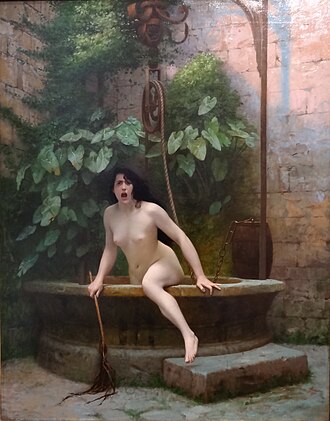 人類に恥を知らせるため井戸から出てくる〈真実〉 - Jean-Léon Gérôme (1896)
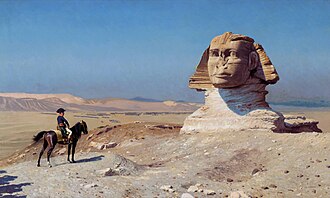 Bonaparte Before the Sphinx - Jean-Léon Gérôme (1867)
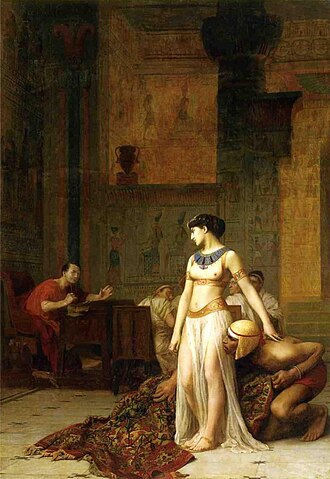 Cleopatra and Caesar - Jean-Léon Gérôme (1866)
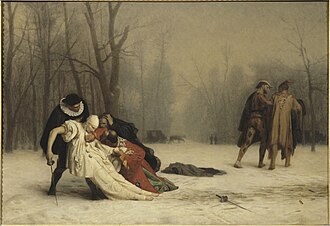 仮面舞踊会の後の決闘 - Jean-Léon Gérôme (1857)
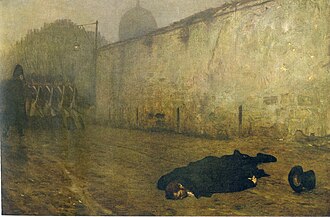 The Execution of Marshal Ney - Jean-Léon Gérôme (1868)
関連する画家の作品
 草上の昼食 - Édouard Manet (1863)
 オランピア - Édouard Manet (1863)
 世界の起源 - Gustave Courbet (1866)
 オルナンの埋葬 - Gustave Courbet (2020)
 カーネーション、リリー、リリー、ローズ - John Singer Sargent (1885-1886)
 マダムXの肖像 - John Singer Sargent (1884)
 民衆を導く自由の女神 - Eugène Delacroix (1830)
 サルダナパールの死 - Eugène Delacroix (1827)
 ソクラテスの死 - Jacques-Louis David (1787)
 ホラティウス兄弟の誓い - Jacques-Louis David (1784)
 ウォルドグレイヴ家の貴婦人たち - Joshua Reynolds (1780)
 ジョージ K. H. クースメイカー大尉 - Joshua Reynolds (1782)