Portrait of a Elderly Lady
ハンス・メムリンク · 1470
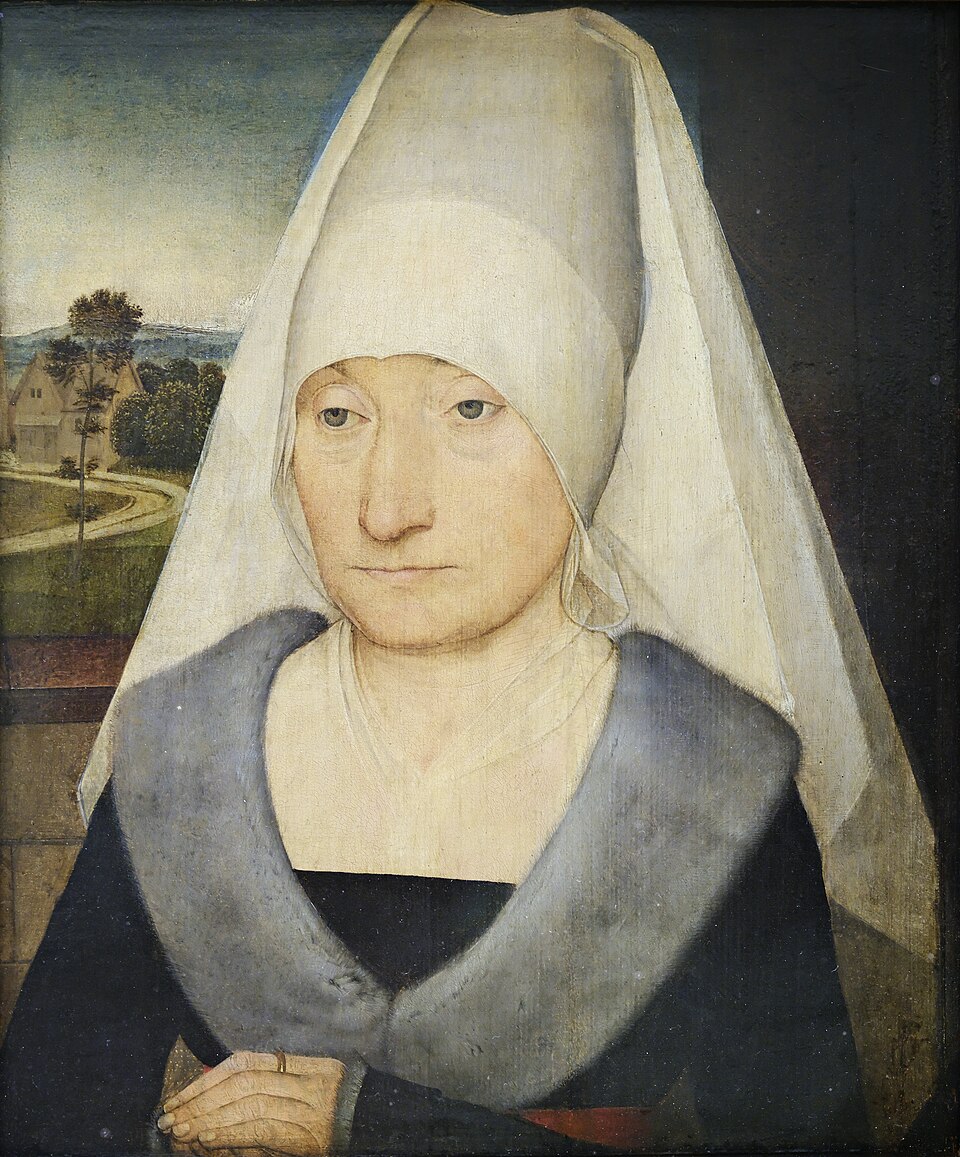
An old woman turns gently toward someone who is no longer beside her. Her husband once shared the same panel and the same landscape, until the painting was split in two. Today she lives in Paris and he in Berlin.
The story behind the painting
Hans Memling painted an elderly man and his wife side by side in an open loggia looking onto a landscape. The two parts were separated at an unknown date. For a long time they were thought to be two distinct companion pictures, but it has been shown that they began as one continuous double portrait, the two panels pegged together. The back of the woman's portrait was planed and fitted with a parquet, but the peg holes can still be seen on the man's portrait. Who the two sitters were is unknown.
What to look for
The woman is painted half-length, turned toward the place where her husband once was, her hand with its ring resting on an invisible ledge, a pose typical of Memling. A red column marks the loggia on the left, and beyond it a wide panoramic landscape opens out. A road crosses the whole country. On the man's side a fortified castle appears, cut off on its right, and on her side it is answered by a manor house. The panel measures about 35 by 29.2 cm and is now in the Louvre.
Meaning and intent
A continuous double portrait was practically unknown in the Netherlands at the time; married couples usually appeared within devotional diptychs or triptychs. Such double portraits grew popular in southern Germany from the last third of the fifteenth century, but on neutral backgrounds. The double portrait was probably the painter's own invention, though a continuous landscape behind several figures can already be seen in Rogier van der Weyden's Braque Triptych in the Louvre. The aerial perspective Memling used from 1475 is absent here, which, with the lead white modelling, the polished paint and tree-ring dating, points to shortly after 1470.
Legacy
The two portraits were still together when the collector Meazza put them up for sale in Milan on 15 April 1884. The man's portrait was bought in 1896 by the Kaiser-Friedrich-Museum in Berlin, now the Bode Museum. The woman's passed through the dealer Warneck and the painter Leo Nardus and was acquired by the Louvre in 1908 from the dealer François Kleinberger. Bode, director of the Berlin museum, was blamed for letting her go and answered that the dealer's demand was exorbitant. A 1521 note by Marcantonio Michiel of a Memling double portrait of a husband and wife in Cardinal Grimani's collection in Venice might refer to this work, which would suggest Italian sitters.
豆知識
- Once half of a continuous double portrait by Hans Memling.
- Dated shortly after 1470.
- The woman is in the Louvre (since 1908), the man in Berlin (since 1896).
- The sitters are unidentified.
画家について
ハンス・メムリンク (1435-1494)
女性 · 肖像 · ルーヴル美術館絵画部門 · 初期フランドル派 · コアフ
同じ画家の作品: ハンス・メムリンク
 受胎告知 - Hans Memling (1480s)
 キリストの受難の場面 - Hans Memling (1470)
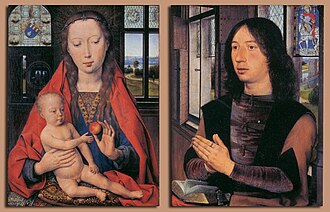 マールテン・ファン・ニューウェンホーフェの二連祭壇画 - Hans Memling (1487)
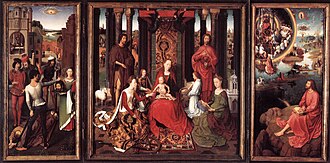 聖ヨハネ祭壇画 - Hans Memling (1479)
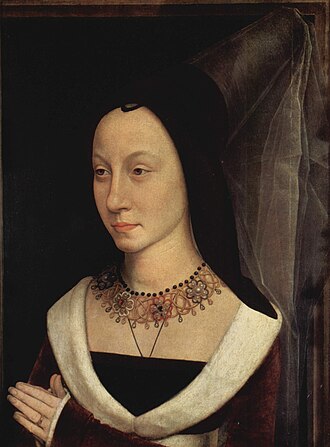 マリア・ポルティナーリの肖像 - Hans Memling (1470)
 奏楽の天使たちに囲まれたキリスト - Hans Memling (1480s)
 モレール三連祭壇画 - Hans Memling (1484)
 聖母子と聖ヤコブ、聖ドミニクス - Hans Memling (1485)
 十字架降架
 女性の肖像
 アルノルフィーニ夫妻像
 ヘントの祭壇画
 快楽の園
 愚者の船
 雪中の狩人
 ネーデルラントの諺