O pti cien
ジャン=レオン・ジェローム · 1902
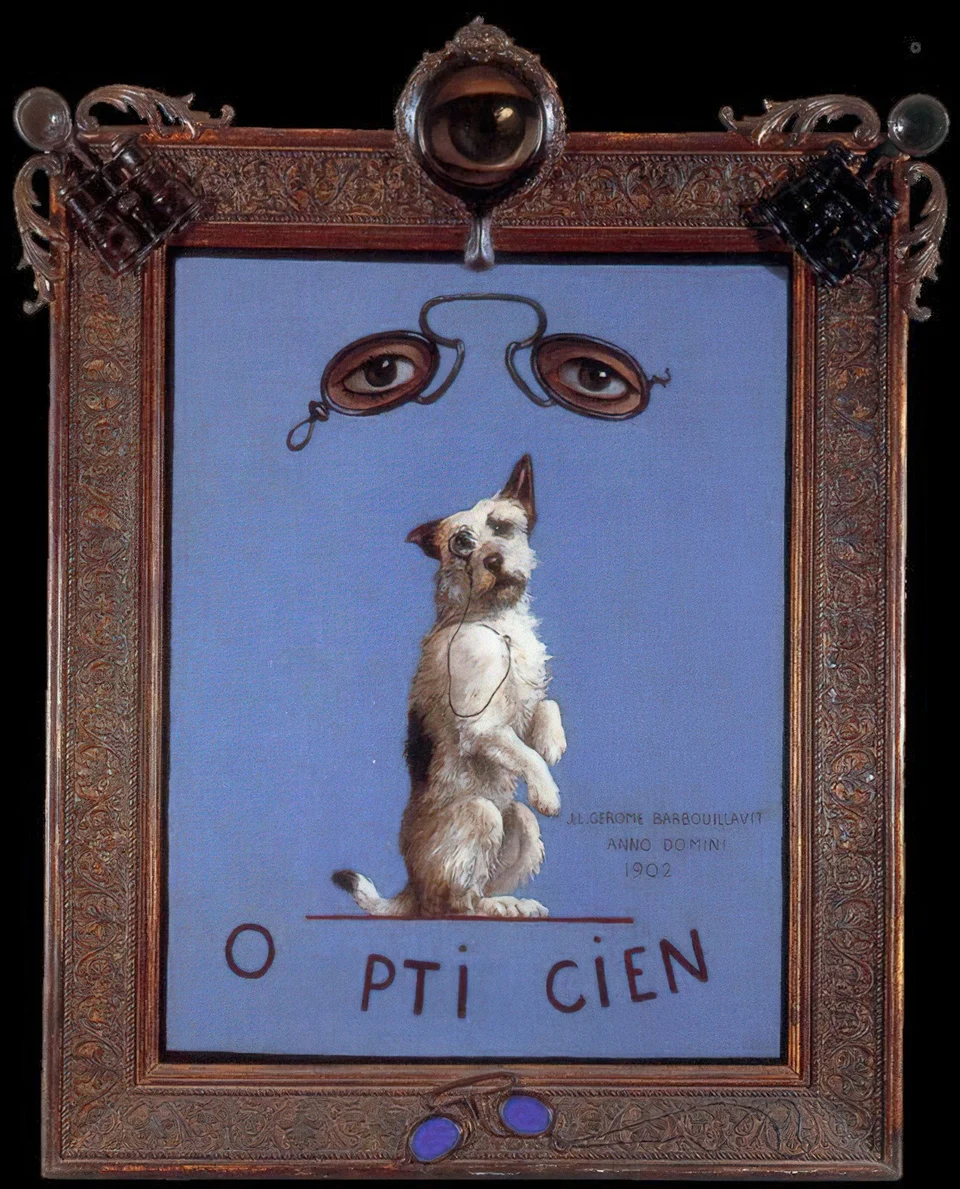
A small white fox terrier stands on its hind legs, a monocle in its eye, staring straight back at you. Gérôme painted it in 1902, about two years before his death, as a shop sign for an optician, and signed it with a mock Latin joke.
The story behind the painting
O pti cien was conceived as a design for an optician's advertising sign. Gérôme, then near the end of a long career, sent it in 1902 to a shop sign competition organised by the City of Paris, and it was reproduced in the portfolio of rewarded works. He played with the conventions of an artist's signature too, writing on the canvas a pseudo-Latin formula that translates as J.-L. Gérôme daubed it in the year of our Lord 1902. The joke was not a one-off: for the Universal Exhibition of 1900 he had already designed a toy shop sign, a heart-shaped metal sheet showing a naked Venus rising from a wave.
What to look for
The canvas is upright, 87 by 66 cm, and shows a mostly white fox terrier against a plain light blue background. The dog wears a monocle, sits up on its hind legs with its ears raised, and tilts its head slightly as if studying you as an equal. Above it, two human eyes peer through spectacles, set like peepholes cut into the background. The original frame continues the game: opera glasses at the upper corners, a magnifying glass in the centre with a single eye looking out like a cyclops, and a pair of old spectacles along the lower edge.
Meaning and intent
The humour rests on a deliberate absurdity. A monocle is an accessory of social distinction, and Gérôme suggests, with a smile, that corrective lenses lend dignity and even humanity to a dog. The title is a sound pun: read aloud, O pti cien, the little dog, sounds like opticien, optician, the trade the image was meant to advertise. The staging also creates a chain of looks: you are watched by the dog, and the dog is watched by anonymous eyes. The art historian Robert Rosenblum saw in these details hints that are both bizarre and disturbing.
Legacy
Salvador Dalí stressed the macabre and surreal side of the whole ensemble, which he saw as announcing the spirit of Dada. He placed Gérôme's dog among the forerunners of L.H.O.O.Q., Marcel Duchamp's 1919 parody of Leonardo's Mona Lisa. For a painter usually remembered for polished academic scenes, it is a surprising afterlife: a late shop sign read as a step towards the avant-garde. The painting passed through a Sotheby's sale in New York on 10 November 1998 and is today in a private collection.
豆知識
- Painted in 1902 as a design for an optician's shop sign.
- The title is a pun: O pti cien sounds like opticien.
- Signed in mock Latin: J.-L. Gérôme daubed it.
- Dalí saw it as a forerunner of Dada.
画家について
ジャン=レオン・ジェローム (1824-1904)
同じ画家の作品: ジャン=レオン・ジェローム
 指し降ろされた親指 - Jean-Léon Gérôme (1872)
 奴隷市場 - Jean-Léon Gérôme (1866)
 アレオパゴス会議のフリュネ - Jean-Léon Gérôme (1861)
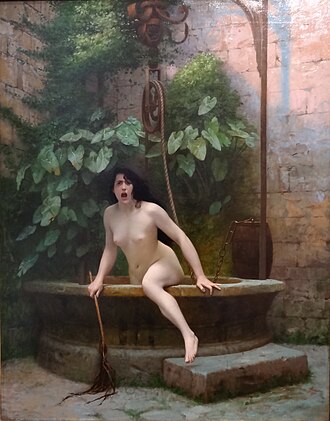 人類に恥を知らせるため井戸から出てくる〈真実〉 - Jean-Léon Gérôme (1896)
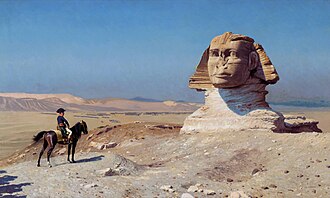 Bonaparte Before the Sphinx - Jean-Léon Gérôme (1867)
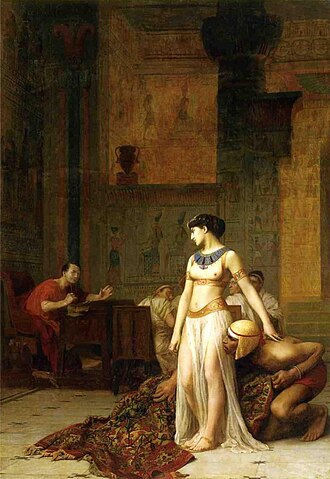 Cleopatra and Caesar - Jean-Léon Gérôme (1866)
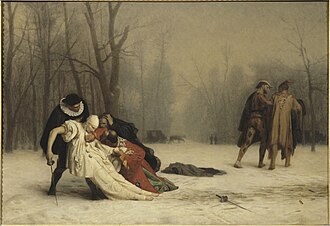 仮面舞踊会の後の決闘 - Jean-Léon Gérôme (1857)
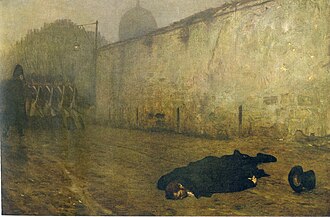 The Execution of Marshal Ney - Jean-Léon Gérôme (1868)
関連する画家の作品
 草上の昼食 - Édouard Manet (1863)
 オランピア - Édouard Manet (1863)
 世界の起源 - Gustave Courbet (1866)
 オルナンの埋葬 - Gustave Courbet (2020)
 カーネーション、リリー、リリー、ローズ - John Singer Sargent (1885-1886)
 マダムXの肖像 - John Singer Sargent (1884)
 民衆を導く自由の女神 - Eugène Delacroix (1830)
 サルダナパールの死 - Eugène Delacroix (1827)
 ソクラテスの死 - Jacques-Louis David (1787)
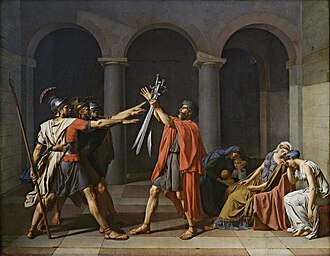 ホラティウス兄弟の誓い - Jacques-Louis David (1784)
 ウォルドグレイヴ家の貴婦人たち - Joshua Reynolds (1780)
 ジョージ K. H. クースメイカー大尉 - Joshua Reynolds (1782)