Miracle of Saint Ignatius of Loyola
ピーテル・パウル・ルーベンス · 1618
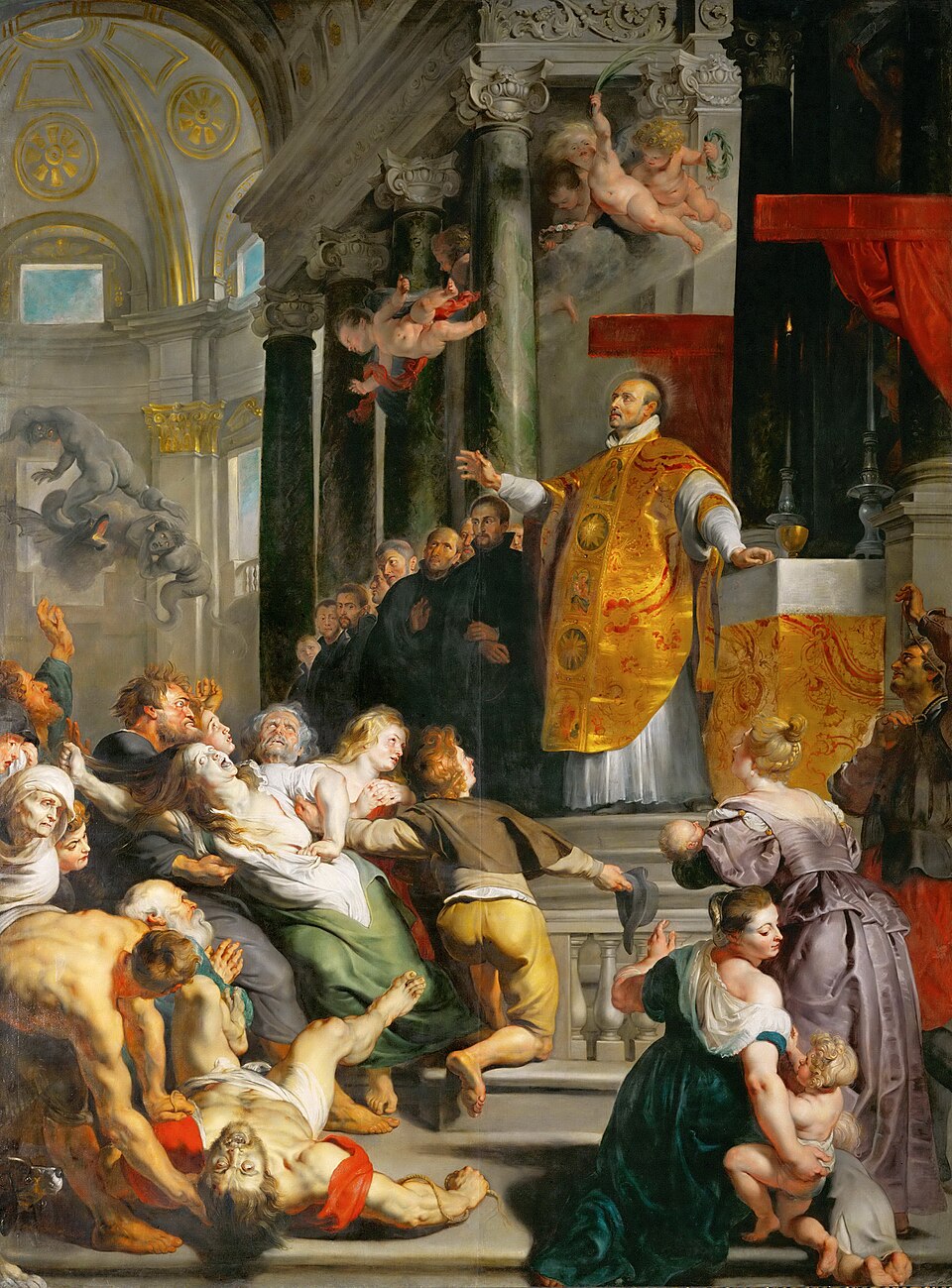
A priest in gold vestments raises his hand, and a man and a woman are thrown to the floor as demons flee from them. Rubens painted this vast altarpiece, more than five metres tall, for the Jesuits of Antwerp.
The story behind the painting
For the interior of their great Baroque church in Antwerp, finished in 1621 and now called Saint Charles Borromeo, the Jesuits chose the local artist Rubens, then at the height of his fame. He painted two huge altarpieces in honour of the order's two founding saints, Ignatius of Loyola and Francis Xavier. Thanks to an ingenious system of pulleys, found in several Jesuit churches, the two canvases could be shown in turn. The French Wikipedia article dates this one to 1618 or 1619, while Wikidata gives 1618.
What to look for
Ignatius stands in gold-woven vestments, his left hand on the altar where he has just said Mass, turned toward the crowd. A halo circles his head and his eyes, red from weeping, look to heaven. His right hand sits exactly at the centre of the canvas, driving out the demons from a man and a woman who fall with open mouths. At the back of the nave, upper left, the expelled demons, one a dragon, one horned, fade into grey. Little angels above carry a palm and crowns, and six Jesuits in black stand before four tall columns.
Meaning and intent
The painting stages a classic Rubens contrast. On the left and lower part, bodies twist with tormented physical force; on the right and upper part reigns the calm, victorious power of the spiritual world. The communion rail divides them, the profane from the sacred. The six black-robed Jesuits lined up against the columns express solid order and the serenity of Ignatius's followers. The angels' palm and crowns may anticipate the saint's canonisation, which came a few years later.
Legacy
When the Society of Jesus was suppressed in 1773, the church was stripped of its masterpieces and plundered of anything valuable. At the end of the eighteenth century Antwerp and the southern Netherlands were under Austrian rule, and in 1776 this canvas and other works by Rubens were acquired by the imperial museum in Vienna. It remains there today, in the Kunsthistorisches Museum, alongside its companion, the Miracles of Saint Francis Xavier, measuring 535 by 395 cm.
豆知識
- Painted in 1618 or 1619 for the Jesuit church in Antwerp.
- Shown in alternation with its companion piece through a pulley system.
- Acquired for the imperial collection in Vienna in 1776.
- Measures 535 by 395 cm.
画家について
ピーテル・パウル・ルーベンス (1577-1640)
同じ画家の作品: ピーテル・パウル・ルーベンス
 キリスト昇架 - Peter Paul Rubens (1609)
 レウキッポスの娘たちの略奪 - Peter Paul Rubens (1618)
 ルーベンスとイザベラ・ブラント - Peter Paul Rubens (1600s)
 サムソンとデリラ - Peter Paul Rubens (1600s)
 キリスト降架 - Peter Paul Rubens (1611)
 メドューサの頭部 - Peter Paul Rubens (1618)
 毛皮をまとったエレーヌ・フールマン - Peter Paul Rubens (1638)
 愛の園 - Peter Paul Rubens (1632)
関連する画家の作品
 星月夜 - Vincent van Gogh (1889)
 夜のカフェテラス - Vincent van Gogh (1888)
 エマオの晩餐 - Caravaggio (1601)
 聖マタイの召命 - Caravaggio (1609)
 ラス・メニーナス - Diego Velázquez (1656)
 ブレダの開城 - Diego Velázquez (1635)
 Saint Francis in Meditation - Francisco de Zurbarán (1639)
 The Immaculate Conception - Francisco de Zurbarán (1661)
 チャールズ1世の三面肖像画 - Anthony van Dyck (1635)
 馬上のチャールズ1世とサン・アントワーヌの領主の肖像 - Anthony van Dyck (1636)
 夜警 - Rembrandt van Rijn (1642)
 自画像 - Rembrandt van Rijn (1659)