ルーベンスとイザベラ・ブラント
ピーテル・パウル・ルーベンス · 1600s
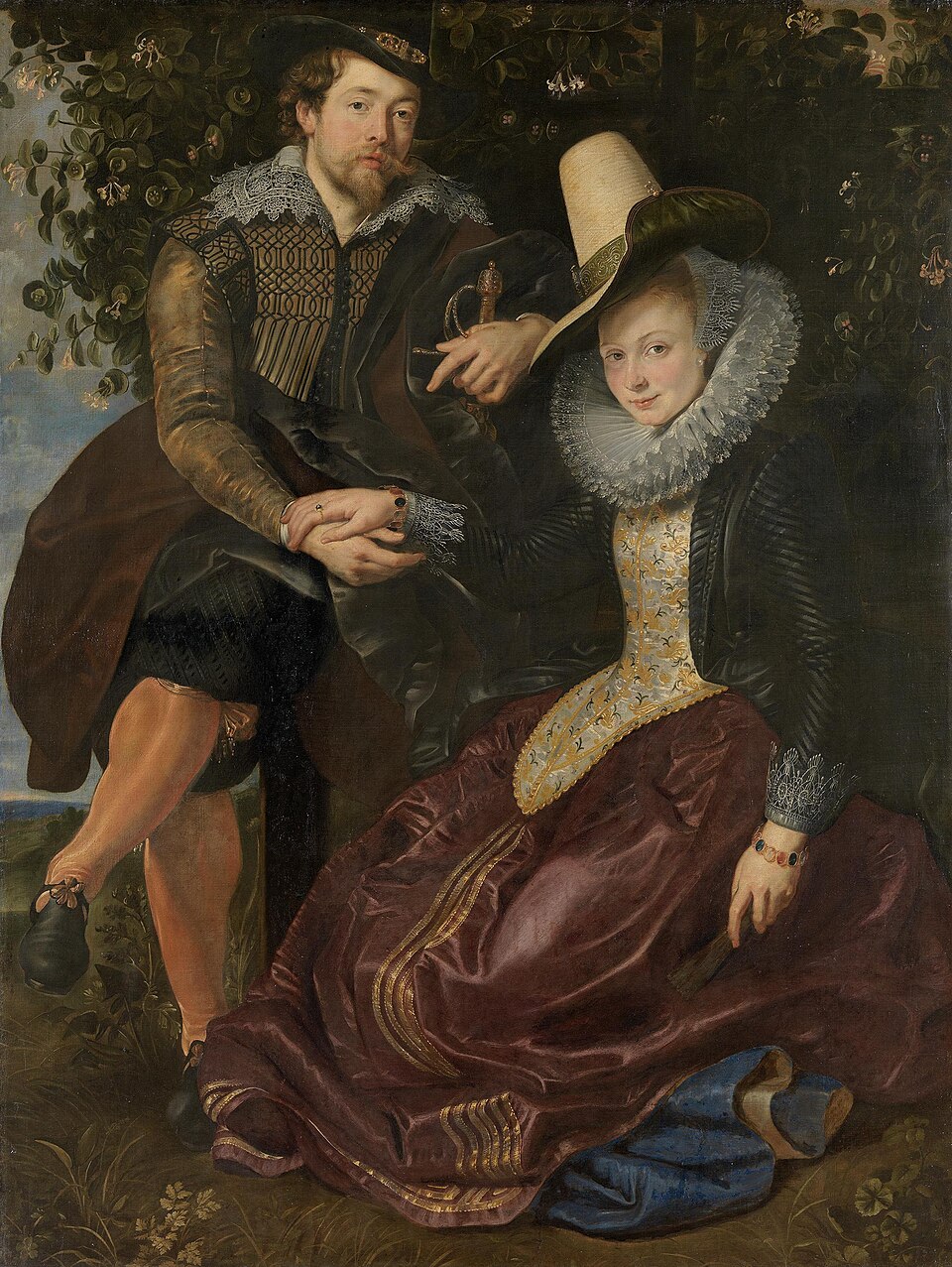
A newly married painter sits beside his young bride under a canopy of honeysuckle, their right hands joined. Rubens painted himself and Isabella Brant in the year of their wedding, and the picture still glows with the promise of a shared life.
The story behind the painting
On 3 October 1609 Peter Paul Rubens married Isabella Brant in St. Michael's Abbey in Antwerp, shortly after he came home from eight years in Italy. He was thirty-two and she was eighteen. In the same year he painted this full-length double portrait of the two of them. The picture was given to Isabella's father, Jan Brant. The couple were married for seventeen years and had three children before Isabella died in 1625, most likely of the bubonic plague. Wikidata dates the work simply to the 1600s, while Wikipedia gives about 1609.
What to look for
The couple sit in fine, aristocratic clothes inside a bower of honeysuckle, yet their poses are relaxed and tender. Rubens rests his left hand on the hilt of his sword, a privilege of the elite that he gained as court painter to the governors of the Netherlands. Notice his orange silk stockings, the jewelled hat and the collar, which is left unbuttoned. Isabella holds a fan in her left hand. She sits low on the ground, a pose that recalls the Madonna of Humility, and her right hand lies in his.
Meaning and intent
The joined right hands follow the ancient Roman gesture of dextrarum iunctio, a sign of union and harmony in marriage. Honeysuckle stood for lasting pleasure, steadfastness and permanence, and the garden echoes the popular idea of the Garden of Love. The fine dress shows Rubens fashioning his own image as a gentleman. Wikipedia links the picture to the Netherlandish idea that love begets art, and to the emblem book Amorum Emblemata of 1608 by Otto van Veen, who had been Rubens' teacher, as well as to Andrea Alciato's emblem on conjugal fidelity.
Legacy
After Isabella's death Rubens wrote to Pierre Dupuy in July 1626 that he had lost an excellent companion whom he must love and cherish as long as he lived, and he painted a posthumous portrait of her. The honeysuckle portrait itself passed around the 18th century into the gallery of Johann Wilhelm II von der Pfalz in Düsseldorf. In 1805 it went, with other Rubens paintings from the Düsseldorf collection, to the Alte Pinakothek in Munich as part of an inheritance. It measures 178 by 136.5 cm.
豆知識
- Painted around 1609, the year Rubens married Isabella Brant.
- The joined right hands are a Roman sign of marriage.
- Isabella died in 1625 after seventeen years of marriage.
- Moved from Düsseldorf to Munich in 1805.
画家について
ピーテル・パウル・ルーベンス (1577-1640)
自画像 · 観察者の方向を見つめる · 剣 · ピーテル・パウル・ルーベンス
同じ画家の作品: ピーテル・パウル・ルーベンス
.jpg) キリスト昇架 - Peter Paul Rubens (1609)
キリスト昇架 - Peter Paul Rubens (1609) レウキッポスの娘たちの略奪 - Peter Paul Rubens (1618)
 サムソンとデリラ - Peter Paul Rubens (1600s)
 キリスト降架 - Peter Paul Rubens (1611)
 メドューサの頭部 - Peter Paul Rubens (1618)
 毛皮をまとったエレーヌ・フールマン - Peter Paul Rubens (1638)
.jpg) 愛の園 - Peter Paul Rubens (1632)
愛の園 - Peter Paul Rubens (1632) 天の川の誕生 - Peter Paul Rubens (1630s)
関連する画家の作品
 星月夜 - Vincent van Gogh (1889)
.jpg) 夜のカフェテラス - Vincent van Gogh (1888)
夜のカフェテラス - Vincent van Gogh (1888) エマオの晩餐 - Caravaggio (1601)
 聖マタイの召命 - Caravaggio (1609)
 ラス・メニーナス - Diego Velázquez (1656)
 ブレダの開城 - Diego Velázquez (1635)
%20-%20Google%20Art%20Project.jpg) チャールズ1世の三面肖像画 - Anthony van Dyck (1635)
チャールズ1世の三面肖像画 - Anthony van Dyck (1635)%20with%20M.%20de%20St%20Antoine%20-%20Google%20Art%20Project.jpg) 馬上のチャールズ1世とサン・アントワーヌの領主の肖像 - Anthony van Dyck (1636)
馬上のチャールズ1世とサン・アントワーヌの領主の肖像 - Anthony van Dyck (1636) 夜警 - Rembrandt van Rijn (1642)
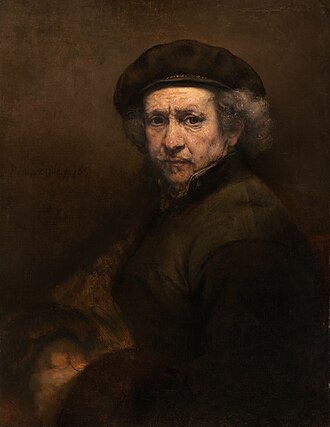 自画像 - Rembrandt van Rijn (1659)
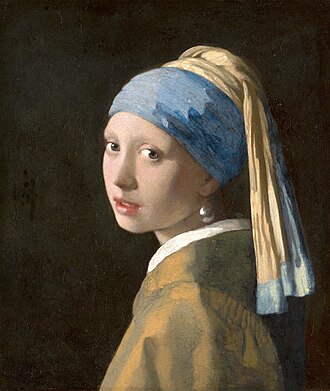 真珠の耳飾りの少女 - Johannes Vermeer (1665)
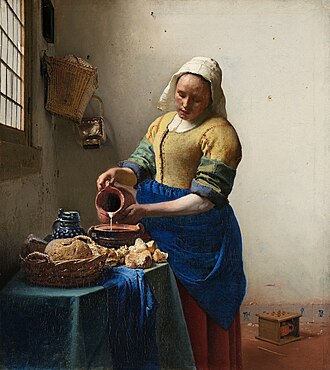 牛乳を注ぐ女 - Johannes Vermeer (c. 1658)