聖母子
アルブレヒト・デューラー · 1512
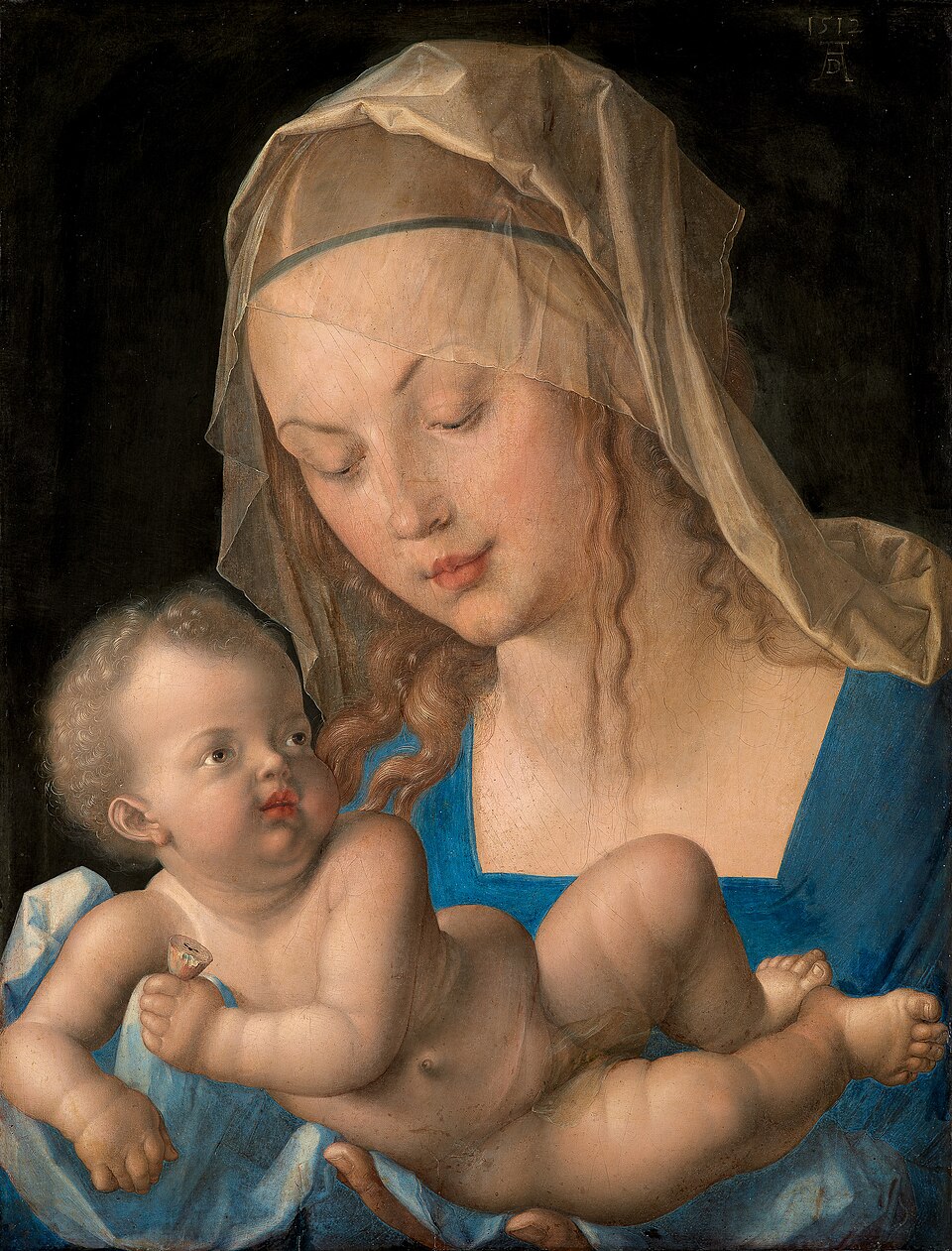
A baby holds a slice of pear, and if you look closely you can see the marks of his tiny teeth in it. His mother smiles, but her thoughts seem to be somewhere far away.
The story behind the painting
Dürer painted this small panel in Nuremberg in 1512. It is also known as the Madonna with the Pear Slice, and it is kept in the Kunsthistorisches Museum in Vienna. Who ordered it is unknown. Dürer did sometimes paint such images of Mary without a commission, but the care lavished on the Virgin suggests this was no casual piece; it probably served as a private devotional image. In 1600 Emperor Rudolf II acquired two unspecified images of the Virgin from the collection of Antoine Perrenot de Granvelle for his residence in Prague. This may have been one of them, reaching Vienna later through his collection.
What to look for
Mary is shown half-length against a dark background, holding her child with both hands on a cloth that was probably once violet and has now faded. She wears a blue dress and a light headscarf over a transparent veil. She turns slightly and tilts her head toward the Child, smiling softly with closed lips. The boy looks up to the right, cheerful, his mouth slightly open to show small front teeth. In his left hand he holds the bitten slice of pear. Neither figure has a halo. Dürer often shaped the paint with his fingers or palm, and used more black pigment in the Child's skin than in his mother's.
Meaning and intent
The source offers several readings. Mary's inward gaze and the once-violet cloth may point to Christ's coming death; she seems already to sense the Passion. The sweet pear can be seen as a symbol of love, and its visible seeds as the seed of a sacrifice that promises redemption, with Mary like a pear tree giving the world its fruit. The missing haloes stress a humanist idea, and the picture can simply be read as a mother and child bound by love. One medical reading even notes signs of vitamin D deficiency in the Child's body. These interpretations are offered as possibilities, not certainties.
Legacy
Under the paint, Dürer drew Mary very finely, with dense hatching, but sketched the Child only in sparse outlines and departed from that drawing as he painted. He reused the leg position from a drawing of the Child holding a crown, which he had had to abandon in his Venetian Feast of the Rosary of 1506. In 1519 he developed the idea further in his Virgin and Child with Saint Anne. Copies and interpretations followed in Italy and Germany, including works attributed to Daniel Fröschl and others by Giovanni Battista Salvi, and in 1983 the artist Lea Lublin reproduced the Child in a triptych.
豆知識
- Oil on limewood panel, 1512, painted in Nuremberg
- Kunsthistorisches Museum, Vienna; 49 x 37 cm
- The Child holds a pear slice with visible tooth marks
- Neither Mary nor the Child is shown with a halo
画家について
アルブレヒト・デューラー (1471-1528)
宗教美術 · 女性 · 盛期ルネサンス · 聖母マリア · イエスの幼少時代 · 少年 · 美術史美術館 · 母 · ドイツのルネサンス期
 自画像
自画像 東方三博士の礼拝
.jpg) 薔薇冠の祝祭
薔薇冠の祝祭 自画像
自画像 自画像
自画像 ヘラー祭壇画
 一万人のキリスト教徒の殉教
%20-%20Google%20Art%20Project.jpg) 聖三位一体の礼拝
聖三位一体の礼拝