聖三位一体の礼拝
アルブレヒト・デューラー · 1511
%20-%20Google%20Art%20Project.jpg)
Heaven and earth crowd together in worship of the Trinity, and far below, in a calm landscape at dawn, Albrecht Dürer stands quietly holding his own signature.
The story behind the painting
This altarpiece, also called the Landauer Altarpiece, was commissioned in 1508 by Matthäus Landauer, a rich Nuremberg merchant. It was meant for a chapel dedicated to the Holy Trinity and All Saints in the Zwölfbrüderhaus, the House of Twelve Brothers, a charitable home that Landauer had founded in 1501 with Erasmus Schiltkrot. The house could shelter up to twelve artisans who could no longer support themselves by their work, and Landauer himself lived there from 1510 until his death. Dürer delivered the painting three years after the commission, in 1511, and it was placed in the church. He also designed its rich frame, which had no movable wings and was topped by a carved Last Judgement and the donors' coats of arms. The panel is now in the Kunsthistorisches Museum, Vienna.
What to look for
At the centre, God the Father, wearing an imperial crown and a wide gilt cloak lined in green and held up by angels, presents the crucified Christ to the viewer. Above them the Holy Spirit appears as a dove in a cloud of light ringed with cherubim. Hierarchical scale places God and the angels high above the earth. Around them, saints of Heaven gather, the men led by John the Baptist and the women by the Virgin Mary. Lower down, earthly multitudes divide into clergy and religious on the left, led by the pope, and lay people on the right, led by the emperor. Look for the aged Landauer in rich clothes, lowering his hat near a cardinal; a peasant with a tool; and a mysterious queen veiled so that only her eyes show.
Meaning and intent
The painting gathers everyone into a single act of worship, from emperor and pope to a peasant who stands for the poor. The arrangement of saints draws on Augustine, and the division of religious and lay people repeats a scheme Dürer had used in his Feast of the Rosary of 1506. Placing the donor among the crowd, perhaps with a cardinal interceding for him, fits a chapel built for a charitable house where Landauer himself spent his last years. Beneath all this splendour lies a broad, peaceful landscape: dawn over a lake among hills, inspired by the landscapes of Albrecht Altdorfer and Joachim Patinir.
Legacy
In that landscape Dürer added a self-portrait. He stands alone, holding a cartouche with a Latin inscription stating that Albrecht Dürer of Nuremberg made the work in the year 1511 after the Virgin's childbirth. The gesture links the painter to the vast company above, a modest figure on earth signing a vision of heaven. Today the painting, 135 by 123.4 centimetres, hangs in the Kunsthistorisches Museum in Vienna, while the source records that its frame, also designed by Dürer, displayed the Last Judgement and the donors' arms. Standing before it, it is worth finding that small figure first, then letting the eye climb toward the light.
豆知識
- Commissioned 1508, delivered 1511.
- Painted for Matthäus Landauer's Zwölfbrüderhaus chapel in Nuremberg.
- Size: 135 x 123.4 cm.
- Kunsthistorisches Museum, Vienna.
画家について
アルブレヒト・デューラー (1471-1528)
宗教美術 · 男性 · イエス・キリスト · 美術史美術館 · アルブレヒト・デューラー
同じ画家の作品: アルブレヒト・デューラー
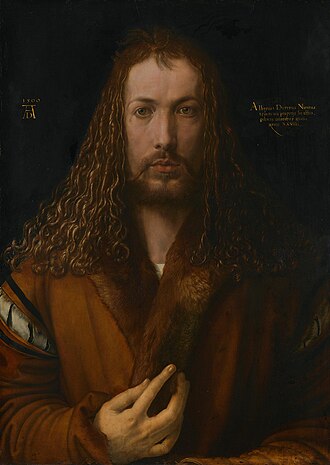 自画像 - Albrecht Dürer (1500)
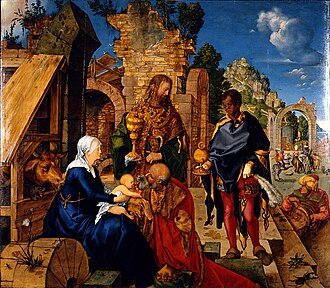 東方三博士の礼拝 - Albrecht Dürer (1504)
.jpg) 薔薇冠の祝祭 - Albrecht Dürer (1506)
薔薇冠の祝祭 - Albrecht Dürer (1506)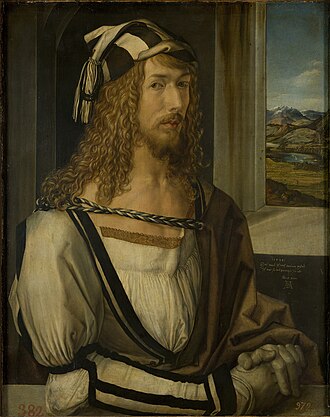 自画像 - Albrecht Dürer (1498)
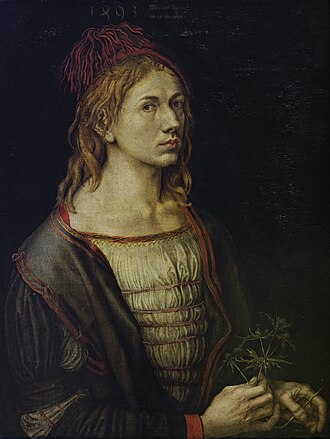 自画像 - Albrecht Dürer (1493)
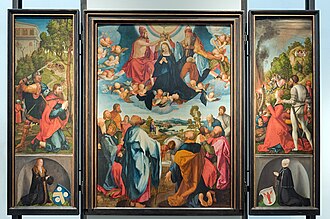 ヘラー祭壇画 - Albrecht Dürer (1500s)
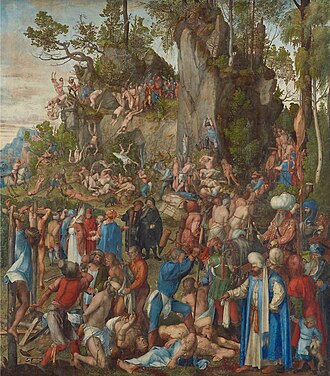 一万人のキリスト教徒の殉教 - Albrecht Dürer (1508)
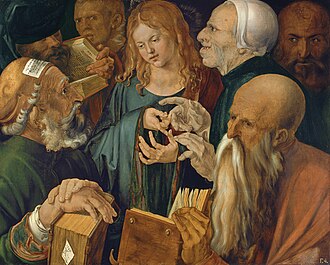 博士たちの間のキリスト - Albrecht Dürer (1506)
 モナ・リザ
モナ・リザ 白貂を抱く貴婦人
.jpg) ウルビーノのヴィーナス
ウルビーノのヴィーナス 聖母被昇天
聖母被昇天 ヴィーナスの誕生
 プリマヴェーラ