Man reading letter to a woman
ピーテル・デ・ホーホ · 1675
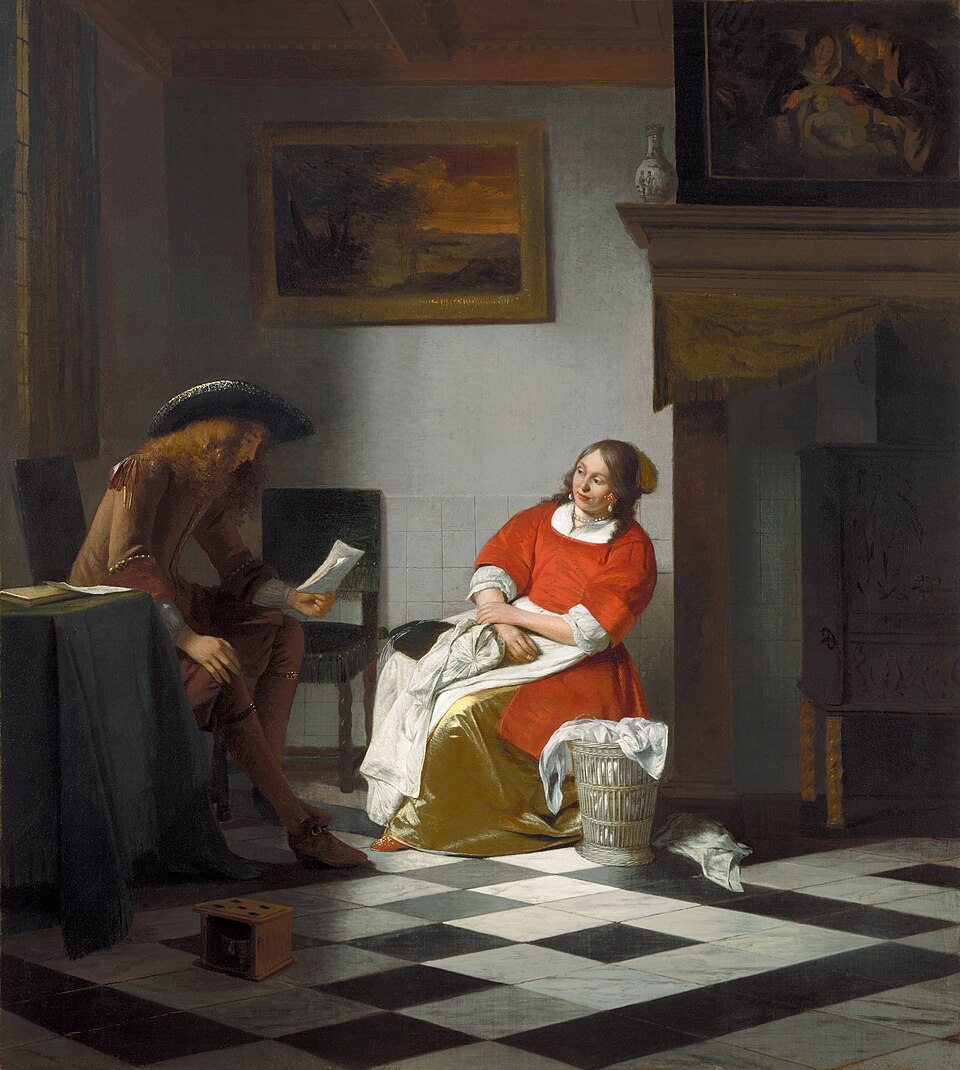
A woman in a bright red jacket sits in a pool of sunlight, her sewing still on her lap, while a man in shadow reads her a letter. What the letter says, and who they are to each other, Pieter de Hooch never tells us.
The story behind the painting
Pieter de Hooch painted this interior around 1670 to 1674, according to Wikipedia; Wikidata gives 1675. He began with guardroom scenes of soldiers and peasants in stables and taverns, which sharpened his skill with light, colour and perspective. After moving from Leiden to Amsterdam around 1660 he turned often to interiors, regularly including figures reading letters. Letters were a favourite subject of Dutch painters of the time, from Vermeer and Metsu to Gerard ter Borch, whose delicate textures influenced de Hooch. It was the great age of letter writing, with rising literacy, better post and letter-writing manuals.
What to look for
In the centre the woman is fully lit by sunlight, which makes her satin dress, her red jacket and the wicker basket of linen glow. She had been sewing until a moment before, and the work still lies on her lap. The man who has just come in sits on a chair to her left, bending slightly forward, and de Hooch keeps him deliberately in shadow so our eye goes to her. The couple sit back, almost hidden in a corner, but the marble tiled floor opens up space and depth. In the upper right hangs a painting of Mary, Joseph and the Christ Child.
Meaning and intent
She leans back a little, perhaps to listen and watch better, perhaps to keep a certain distance, and that small tension gives the scene its charge. The nature of the letter is unclear, and so is their relationship; her clothes are too costly for a servant. De Hooch leaves the story to the viewer. The painting has been seen as a tribute to the simplicity and intimacy of domestic life, with the woman at its centre, and the picture of the Holy Family may point to tenderness within the family. The theorist Gerard de Lairesse argued such scenes of elegant leisure ennobled painting.
Legacy
Around 1800 Willem Joseph van Brienen van de Groote Lindt bought the painting on the London art market and hung it in his house on the Herengracht in Amsterdam, where it stayed for two generations. Its 20th-century history is unknown. In 1997 the collectors George and Ilone Kremer bought it at Christie's for their private collection, which lends it regularly to exhibitions; Wikidata also lists the Mauritshuis. It is widely regarded as one of the best works of de Hooch's later period and is often praised for its excellent condition.
豆知識
- Painted around 1670 to 1674.
- Part of the Dutch fashion for letter scenes.
- Owned by the van Brienen family in Amsterdam from about 1800.
- In the Kremer Collection since 1997.
画家について
ピーテル・デ・ホーホ (1629-1684)
同じ画家の作品: ピーテル・デ・ホーホ
 デルフトの家の中庭 - Pieter de Hooch (1658)
 リンゴの皮を剥く女性 - Pieter de Hooch (1663)
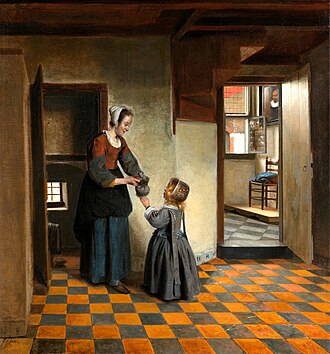 食料貯蔵室の召使と子供 - Pieter de Hooch
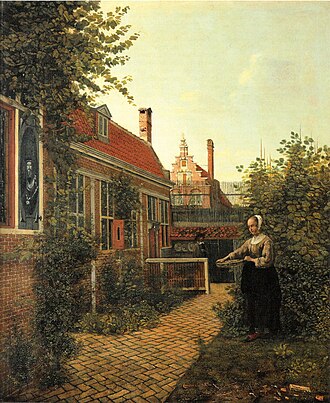 A Woman with a Basket of Beans in a Garden - Pieter de Hooch (1651)
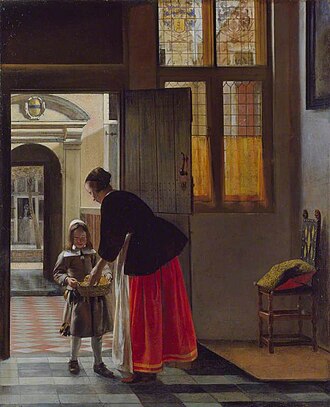 パンを持ってくる少年 - Pieter de Hooch (1663)
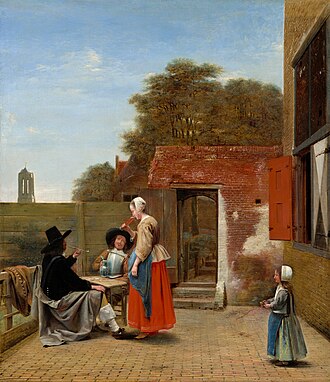 オランダの中庭 - Pieter de Hooch (1658)
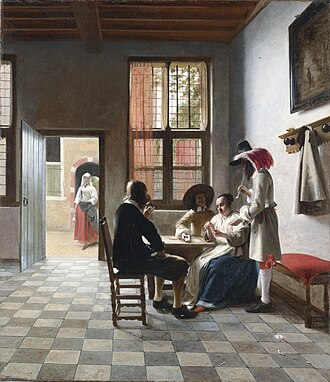 陽の当たる部屋でトランプをする人々 - Pieter de Hooch (1658)
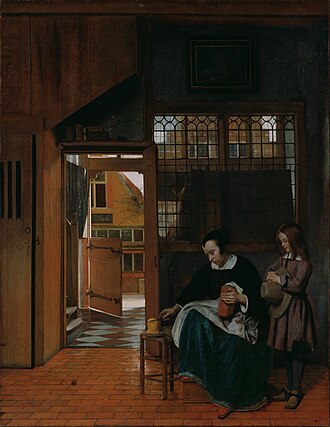 男の子のためにパンとバターを用意する女性 - Pieter de Hooch (1661)