聖ペテロと教皇アレクサンデル6世、ペーザロ司教
ティツィアーノ・ヴェチェッリオ · 1500s
%2C%20Koninklijk%20Museum%20voor%20Schone%20Kunsten%20Antwerpen%2C%20357.jpg)
A bishop who commanded a fleet kneels before Saint Peter, his helmet set aside, the Borgia pope's banner in his hand, and war galleys fight on the sea behind him. Titian painted this thanksgiving for a rare Venetian victory.
The story behind the painting
Bishop Jacopo Pesaro, born in 1460, commissioned the painting as an ex-voto for the naval victory that retook Santa Maura, today Lefkada, from the Ottoman Turks in August 1502, a rare win in the Ottoman-Venetian War of 1499 to 1503. Pope Alexander VI, a Borgia, had made Pesaro papal legate, commander of the papal fleet and bishop of Paphos on Cyprus. Alexander had sent 13 galleys, and the mainly Venetian fleet was led by Jacopo's cousin Benedetto Pesaro. The victory proved short, since the war ended with Santa Maura returned.
What to look for
Saint Peter sits enthroned at left with a book, his gold and silver keys on a dais made of stone, petra. The pope presents the kneeling Pesaro, who carries a standard with Alexander's arms and has taken off his helmet. Between Pesaro's head and Peter, war galleys fight; to the right of the pope the sea reaches a town, Lefkada or perhaps Paphos. Classical reliefs below the saint seem to show Venus and Cupid, perhaps alluding to Paphos, sacred to Venus. The pope's features were copied from a medal, so he looks stiffer than the bishop, likely painted from life. The tablet at the bottom was added later.
Meaning and intent
The scene adapts the Venetian formula of a donor presented by a patron saint, as developed by Giovanni Bellini, in whose studio Titian spent time; the museum suggests Bellini designed it and left the painting to Titian. Its date is disputed. Some placed it as early as 1503, which would make it Titian's earliest surviving work, but that would mean a painter of 13 or 14. Others proposed 1515 or 1512 to 1520. X-rays show a uniform paint texture, and restoration shortly before 2003 linked it to the monumental style of around 1510 to 1511. Pesaro returned to Venice only in 1506.
Legacy
Though Alexander was widely despised after his death in 1503, Pesaro stayed loyal and his will of 1542 paid for masses for the pope's soul. Pleased enough with the work, he later commissioned Titian's Pesaro Altarpiece of 1518 to 1519 in the Frari church, which again recalls the 1502 victory. The painting stayed with the family until the early seventeenth century; Anthony van Dyck drew it in Venice in 1623. It passed to Charles I of England, then to the Spanish royal collection in 1652, and by 1823 William I of the Netherlands owned it and gave it to the museum in Antwerp.
豆知識
- An ex-voto for the retaking of Santa Maura from the Ottomans in 1502.
- Its date is disputed; restoration points to around 1510 to 1511.
- Pesaro later commissioned Titian's Pesaro Altarpiece in the Frari.
- In the Royal Museum of Fine Arts, Antwerp.
画家について
ティツィアーノ・ヴェチェッリオ (1488-1576)
宗教美術 · 盛期ルネサンス · ヴェネツィア派 · ボート · ペトロ · アントワープ王立美術館 · 旗 · ヘルメット
同じ画家の作品: ティツィアーノ・ヴェチェッリオ
.jpg) ウルビーノのヴィーナス - Titian (1538)
ウルビーノのヴィーナス - Titian (1538)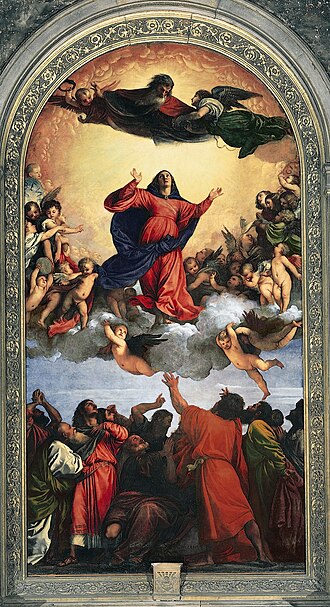 聖母被昇天 - Titian (1510s)
FXD.jpg) 聖愛と俗愛 - Titian (1510s)
聖愛と俗愛 - Titian (1510s)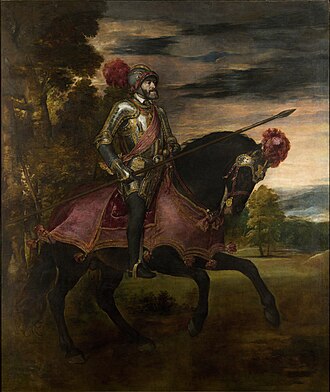 騎乗像 - Titian (1548)
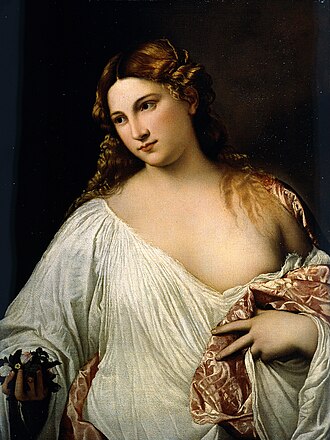 フローラ - Titian (1517)
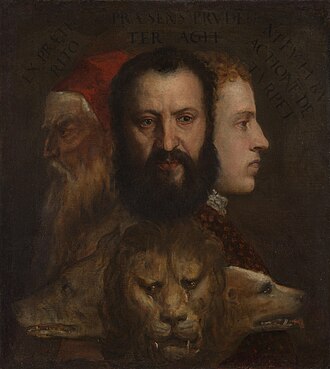 賢明の寓意 - Titian (1550)
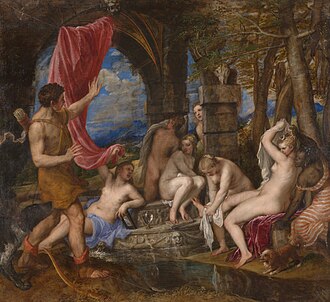 ディアナとアクタイオン - Titian (1550s)
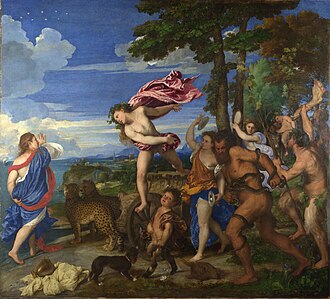 バッカスとアリアドネ - Titian (1520s)
関連する画家の作品
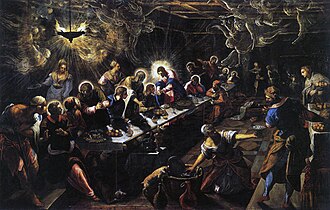 最後の晩餐 - Jacopo Tintoretto (1563)
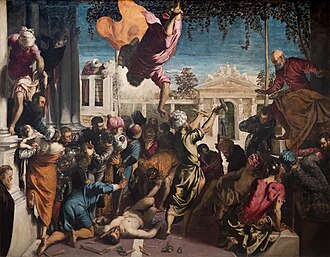 奴隷を解放する聖マルコ - Jacopo Tintoretto (1540s)