Gynaeceum or ancient Greek Interior
ジャン=レオン・ジェローム · 1850s
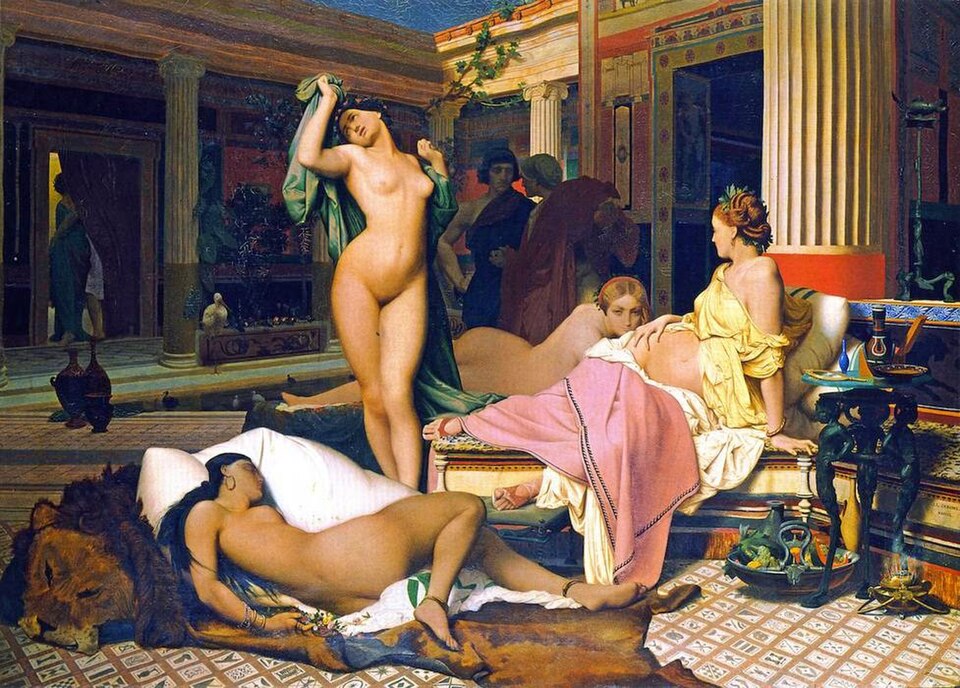
Women lie and stand at ease in a sunlit ancient room while two men wait in the shadows. The young Gérôme called it a Greek interior, but the room he painted looks far more like Pompeii.
The story behind the painting
Jean-Léon Gérôme made a first oil sketch of this subject in 1848, a small panel of about 15.5 by 21 cm now in the Musée d'Orsay, dedicated in red to his friend Douillard. Three preparatory studies of figures are also known, two in private collections and one in the Museum of Fine Arts in Nancy. The finished canvas, about 67 by 99 cm, is dated 1850 by French Wikipedia, while Wikidata only says the 1850s. It was shown at the Salon of 1850 to 1851. The signature and date are at the lower right, on the couch.
What to look for
The composition centres on four women. In front, a nude woman wearing only jewellery lies on a lion skin covered with a white quilt. In the centre a second nude woman stands and seems to wrap herself in a rich green cloth. On the right, the only clothed woman reclines on a couch, and behind her a fourth lies with her back to us, turning to look out. In the dim background stand two men, and a third figure appears at a doorway on the left, half hidden by a hanging. A basin with birds and climbing plants on walls and columns suggest an atrium open to the sky.
Meaning and intent
Despite its title, the room is closer to a Roman house inspired by the discoveries at Pompeii than to a Greek gynaeceum, the women's quarters. Like several of his early works, Gérôme paid great attention to the accuracy of the setting, furniture and objects, in line with the antiquarian taste of the 19th century. Yet the subject stays an anecdotal genre scene, far from the grand themes of history painting. This tension between archaeological precision and imagination marks a number of his paintings from the start of his career.
Legacy
The painting shows Gérôme's early interest in female sensuality and idle leisure. The languid figures announce the Orientalist scenes of harems, baths and slave markets that brought him international fame from the 1870s. For that reason the work is seen as an important step in his path towards Orientalism, the movement with which he remained associated through the second half of the 19th century. The finished picture belongs to a private collection in the United States; French Wikipedia names its owner as Lady Micheline Connery.
豆知識
- A sketch dated 1848 is in the Musée d'Orsay.
- Shown at the Salon of 1850-1851.
- Despite the Greek title, the setting is closer to a Roman house of Pompeii.
- Foreshadows Gérôme's later Orientalist scenes.
画家について
ジャン=レオン・ジェローム (1824-1904)
女性 · 風俗美術 · ヌード · 座法 · 裸 · 直立姿勢 · アカデミック美術 · 臥位 · ヒトの集団
同じ画家の作品: ジャン=レオン・ジェローム
 指し降ろされた親指 - Jean-Léon Gérôme (1872)
 奴隷市場 - Jean-Léon Gérôme (1866)
 アレオパゴス会議のフリュネ - Jean-Léon Gérôme (1861)
 人類に恥を知らせるため井戸から出てくる〈真実〉 - Jean-Léon Gérôme (1896)
 Bonaparte Before the Sphinx - Jean-Léon Gérôme (1867)
 Cleopatra and Caesar - Jean-Léon Gérôme (1866)
 仮面舞踊会の後の決闘 - Jean-Léon Gérôme (1857)
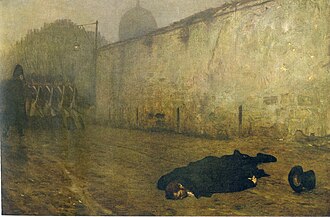 The Execution of Marshal Ney - Jean-Léon Gérôme (1868)
関連する画家の作品
 草上の昼食 - Édouard Manet (1863)
 オランピア - Édouard Manet (1863)
 世界の起源 - Gustave Courbet (1866)
 オルナンの埋葬 - Gustave Courbet (2020)
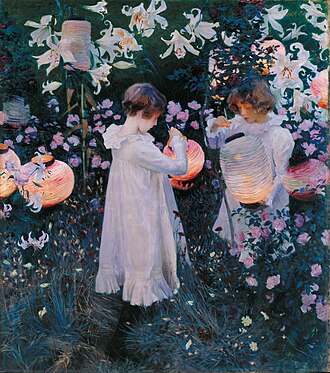 カーネーション、リリー、リリー、ローズ - John Singer Sargent (1885-1886)
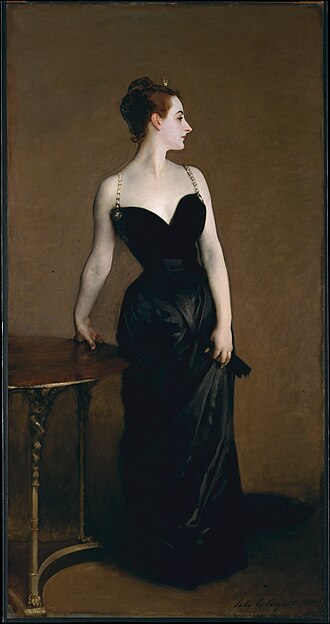 マダムXの肖像 - John Singer Sargent (1884)
 民衆を導く自由の女神 - Eugène Delacroix (1830)
 サルダナパールの死 - Eugène Delacroix (1827)
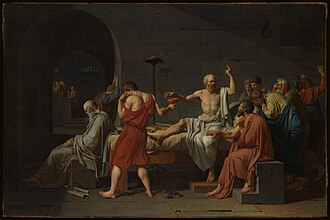 ソクラテスの死 - Jacques-Louis David (1787)
 ホラティウス兄弟の誓い - Jacques-Louis David (1784)
 ウォルドグレイヴ家の貴婦人たち - Joshua Reynolds (1780)
 ジョージ K. H. クースメイカー大尉 - Joshua Reynolds (1782)