Diptych with two donors
ハンス・メムリンク · 1470
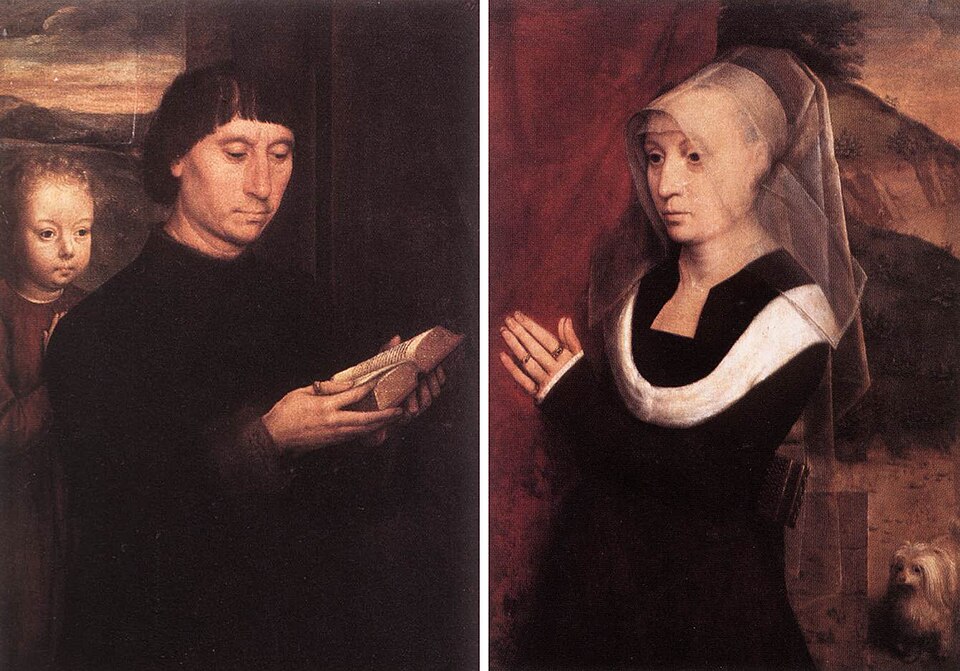
A husband and wife kneel in prayer toward a Virgin who is no longer there. These two Memling panels were once the wings of a triptych, and their missing centre was traced only through an art dealer's archive.
The story behind the painting
The Portraits of Two Donors are two fragments by Hans Memling that once formed the wings of a triptych, with a Virgin and Child in the centre. By the middle of the 17th century the three panels were in the collection of Archduke Leopold Wilhelm of Habsburg, whose seal can still be seen on the back. He left Brussels in 1656, but the Memlings did not reach Austria with the rest of his collection and are missing from the 1659 inventory. They were not lost: in February 1676 the Antwerp dealer Gilliam Forchondt sold them to Prince Karl II of Liechtenstein.
What to look for
A man and his wife kneel toward the Virgin, painted partly against a plain ground and partly before a landscape. Some of the landscape is painted on pieces of wood added later. Their patron saints, who would have presented them, once stood behind them, and traces of their clothing remain, especially on the right panel. Above the hands of the child behind the donor a cross is sketched, a sign of early death, probably added later by Memling's workshop. In the lower right corner a little dog closely resembles those in other Memling works.
Meaning and intent
The panels were made so that a family could kneel forever before the Virgin, with saints to plead for them. The small cross over a child's hands turns the portrait into a quiet memorial as well. The dating is disputed. Tree-ring study gives a felling date around 1446, and while Memling could have used a fifty-year-old panel, a date around 1475 to 1480 seems more likely; Wikidata gives 1470. The donors' clothes recall the Portinari portraits and Memling's portrait of an elderly couple, both from the early 1470s.
Legacy
The Virgin and Child that was probably the central panel was identified by De Vos in the Forchondt archives; it came from the Liechtenstein collection and is now in a private collection. In the 18th century the two wings entered the collection of Baron Samuel von Brukenthal in Sibiu, and from 1817 they were in the Brukenthal Museum. In 1948 they were moved to the National Museum of Art of Romania in Bucharest. The male donor has been recognised as the same man who appears in a Lamentation of Christ in the Galleria Doria in Rome.
豆知識
- Two wings of a dismembered Memling triptych.
- Dated around 1475-1480 by most, 1470 by Wikidata.
- A cross over a child's hands marks an early death.
- In the National Museum of Art of Romania since 1948.
画家について
ハンス・メムリンク (1435-1494)
同じ画家の作品: ハンス・メムリンク
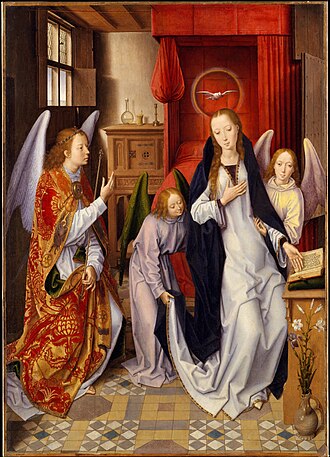 受胎告知 - Hans Memling (1480s)
 キリストの受難の場面 - Hans Memling (1470)
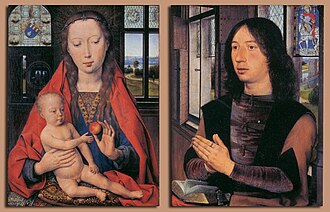 マールテン・ファン・ニューウェンホーフェの二連祭壇画 - Hans Memling (1487)
 聖ヨハネ祭壇画 - Hans Memling (1479)
 マリア・ポルティナーリの肖像 - Hans Memling (1470)
 奏楽の天使たちに囲まれたキリスト - Hans Memling (1480s)
 モレール三連祭壇画 - Hans Memling (1484)
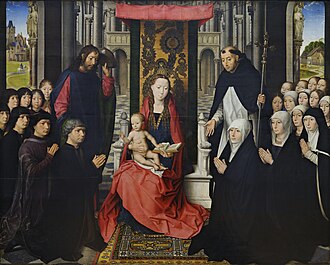 聖母子と聖ヤコブ、聖ドミニクス - Hans Memling (1485)
 十字架降架
 女性の肖像
 アルノルフィーニ夫妻像
 ヘントの祭壇画
 快楽の園
 愚者の船
 雪中の狩人
 ネーデルラントの諺