マグダラのマリアの回心
アルテミジア・ジェンティレスキ · 1616
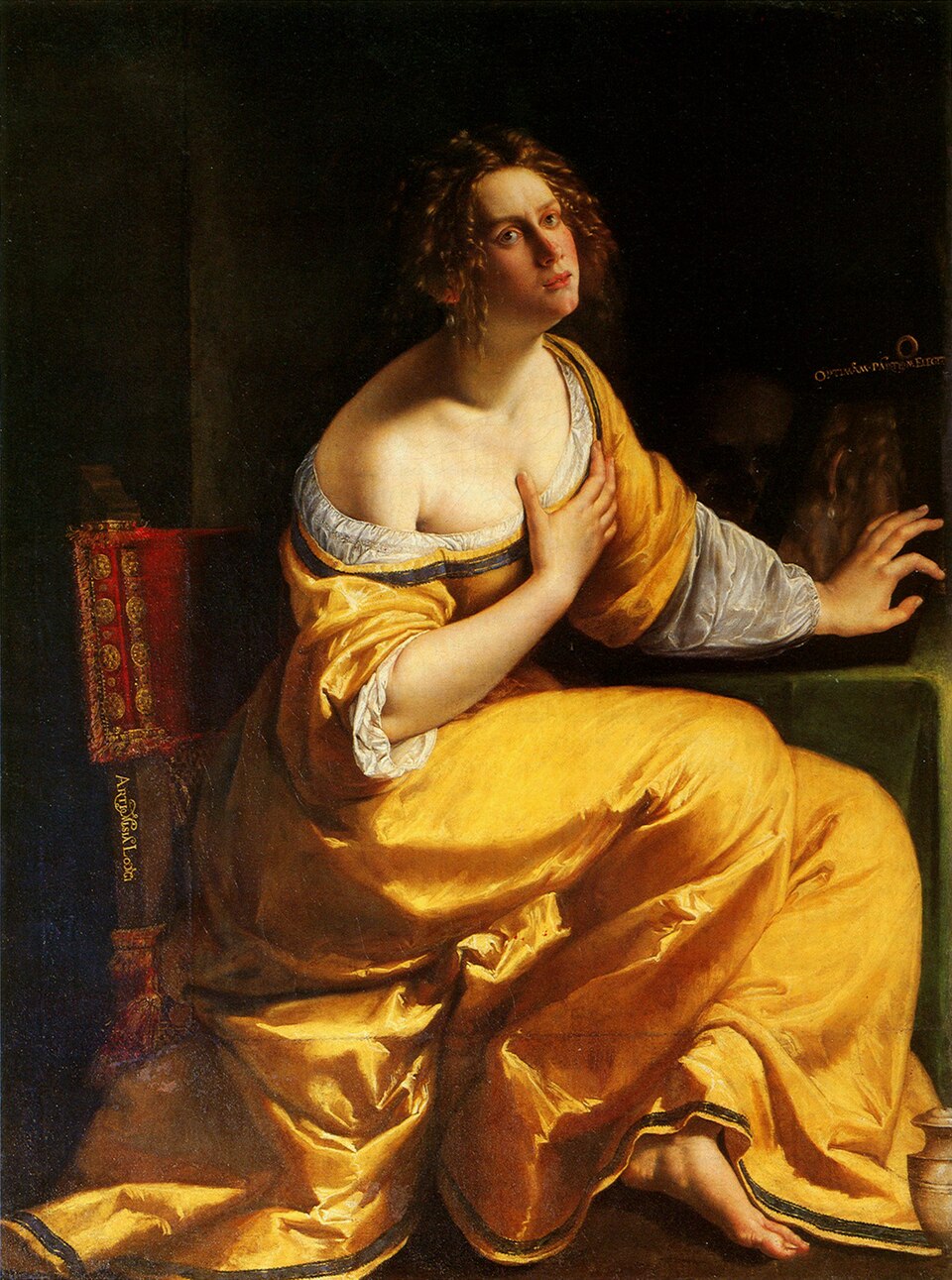
A woman in shimmering yellow silk pushes away a mirror and lifts her eyes to heaven. Artemisia Gentileschi painted the very moment Mary Magdalene turns from her old life, during the Florentine years when she signed herself Artemisia Lomi.
The story behind the painting
Gentileschi painted this Magdalene in Florence. Wikipedia dates it 1616 to 1618, while Wikidata gives 1616, the year she became a member of the Accademia delle Arti del Disegno, at a time when women were rarely welcome in workshops or academies. In Florence she used the surname Lomi, perhaps because the painter Aurelio Lomi was better known than Gentileschi or her husband's name, Stiattesi. The work was probably commissioned by Grand Duchess Maria Maddalena, wife of Cosimo II de' Medici, whose name echoed the saint's, so that piety and penitence would be linked with her too.
What to look for
Mary Magdalene sits in a gown of yellow silk that has slipped off her shoulder without revealing her body. Her left arm makes a wide, exaggerated gesture as she turns away from a jewel box and pushes back a mirror. A jar of ointment rests at her feet. The palette of gold, red and green, the rich fabrics and the dramatic gesture are what Raymond Ward Bissell calls the Florentine Baroque. Note the strong contrast of light and shadow learned from Caravaggio, between figure and background and in the folds of the dress. The chair carries the signature Artemisia Lomi, though this may be by a later hand, and the canvas is made of three pieces.
Meaning and intent
Unusually, there is no landscape and no crucifix. The painting blends two biblical women: the jar marks Mary Magdalene, while the mirror is inscribed Optimam partem elegit, You have chosen the best part, from Luke, where Jesus says that Mary, sister of Lazarus, chose the spiritual life. The words sit in the varnish and were probably added later. Mary Garrard and others have read the saint as Artemisia herself, both women stigmatised, the painter after her rape trial of 1612. More recent writers such as Rebecca Mead challenge seeing her only through that assault, and suggest looking at her as a mother, a businesswoman and an artist with many sources.
Legacy
The painting is first recorded in the Pitti collection in 1826, and it still hangs in the Pitti Palace, in the Galleria Palatina. It was restored in 1970 before an exhibition. Gentileschi returned to the theme with Mary Magdalene in Ecstasy around 1620 to 1622. In 2011 a defaced replica of this painting was found in a cellar in Germany. For many viewers it remains one of the clearest images of her Florentine success, painted by a woman who taught herself to read and later corresponded with patrons and with Galileo.
豆知識
- Painted in Florence, dated 1616-1618 (Wikipedia) or 1616 (Wikidata).
- Signed Artemisia Lomi, possibly by a later hand.
- Probably commissioned by Grand Duchess Maria Maddalena.
- A defaced replica turned up in a German cellar in 2011.
画家について
アルテミジア・ジェンティレスキ (1593-1653)
宗教美術 · 座法 · ロングヘア · ドレス · マグダラのマリア · 椅子 · パラティーナ美術館 · 金髪 · デコルテ
同じ画家の作品: アルテミジア・ジェンティレスキ
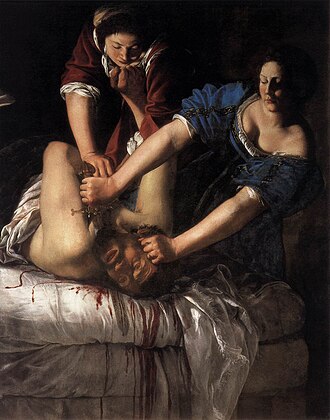 ホロフェルネスの首を斬るユディト - Artemisia Gentileschi (1613)
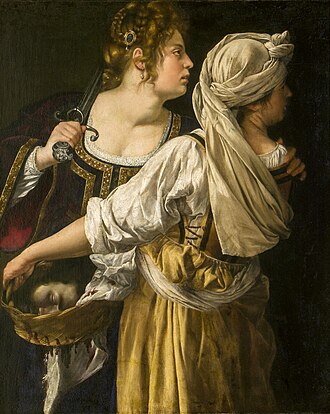 ユディトとその侍女 - Artemisia Gentileschi (1618)
%2C%20Artemisia%20GentileschiFXD.jpg) スザンナと長老たち - Artemisia Gentileschi (1610)
スザンナと長老たち - Artemisia Gentileschi (1610)%20-%20Artemisia%20Gentileschi.jpg) 絵画の寓意としての自画像 - Artemisia Gentileschi (1638)
絵画の寓意としての自画像 - Artemisia Gentileschi (1638)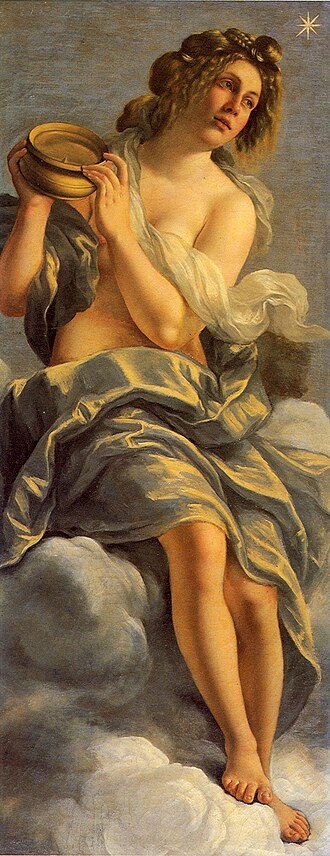 天性の素質の寓意 - Artemisia Gentileschi (1615)
 ダナエ - Artemisia Gentileschi (1612)
 ホロフェルネスの首を斬るユディト - Artemisia Gentileschi (1620)
 アハシュエロス王の前のエステル - Artemisia Gentileschi (1620s)