アルテミジア・ジェンティレスキ
1593-1653
Artemisia Gentileschi was producing professional work at 15 and became the first woman member of the drawing academy in Florence. Her powerful heroines, painted with striking naturalism, have made her one of the most celebrated artists of the 17th century.
Origins
Artemisia Lomi Gentileschi was born in Rome on 8 July 1593, although a birth certificate in the state archive gives 1590. She was the eldest child of Prudenzia Montoni and the Tuscan painter Orazio Gentileschi, whose work drew deeply on Caravaggio. After her mother died in 1605 she was raised mainly by her father and learned in his workshop how to mix colour and paint, showing far more enthusiasm and talent than her brothers. Women were rarely allowed formal apprenticeships or guild membership, so like many female artists she trained within the family. By 1612 her father boasted that after only three years of practice she had no equal. Her earliest surviving work, Susanna and the Elders of 1610, was painted at 17.
Life and turning points
In 1611 she was raped by the painter Agostino Tassi, who worked with her father. During the seven-month trial that followed she was tortured with cords tightened around her fingers to test her testimony. Tassi was convicted and sentenced to exile from Rome, but the sentence was never carried out. A month later she married the Florentine artist Pierantonio Stiattesi and moved to Florence, where she became a court painter favoured by the Medici and joined the Accademia delle Arti del Disegno. She returned to Rome around 1620, worked at the court of Charles I of England from 1638 to 1642, and resurfaced in Naples in 1649. Her death date is disputed; her last known commission dates from January 1654.
Style and technique
Gentileschi began in the manner of Caravaggio, but her approach was more naturalistic than her father's comparatively idealised work. She was known for depicting the female body with great naturalism and for handling colour to express dimension and drama. Many of her paintings show women from myth, allegory and the Bible, including victims, suicides and warriors. Her Susanna shows that she absorbed Caravaggio's realism without ignoring the classicism of Annibale Carracci and the Bolognese school. At the Florentine court she became familiar with music and theatre, which shaped her taste for lavish costume. She was fascinated by Judith Beheading Holofernes; six versions by her are known, including one in the Uffizi.
Stories and anecdotes
During the trial, as the cords tightened, she is recorded as turning to Tassi and saying that this was the ring he gave her, and these were his promises. In 1615 Michelangelo Buonarroti the Younger asked her to paint the Allegory of Inclination for the ceiling of the Casa Buonarroti, and she was paid three times more than any other artist in the series. A letter of 1635 shows she knew Galileo Galilei. In 2011 the scholar Francesco Solinas found 36 letters revealing a love affair in Florence with the nobleman Francesco Maria Maringhi, of which her husband was aware. Only one of her five children, her daughter Prudentia, lived to adulthood, and she too was trained as a painter.
Legacy
For a long time her achievements were overshadowed by the story of the rape and trial, and she was regarded as a curiosity. In the 20th and 21st centuries scholars re-examined her life and art, and her talent is now recognised in major exhibitions at institutions such as the National Gallery in London. Writers such as Mary D. Garrard have studied how her paintings offer a distinct view of female vulnerability and resistance compared with earlier versions of the same subjects by men, an ongoing debate. She had an international clientele at a time when women had few chances to work as artists, and her bold heroines still meet the viewer with startling force.
豆知識
- A Mother and Child found in Crow's Nest, Australia, in 1976 may or may not be by her.
- Her Judith and Her Maidservant of 1625 is in the Detroit Institute of Arts.
- She was baptised two days after her birth in the church of San Lorenzo in Lucina.
- Her last known letter to one of her mentors, from 1650, shows she was still working.
アルテミジア・ジェンティレスキの作品
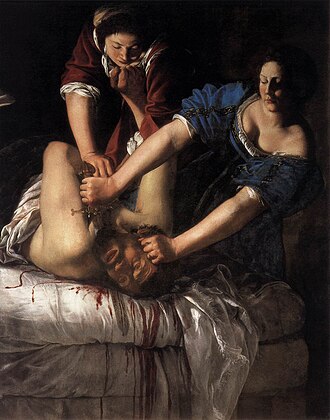 ホロフェルネスの首を斬るユディト - Artemisia Gentileschi (1613)
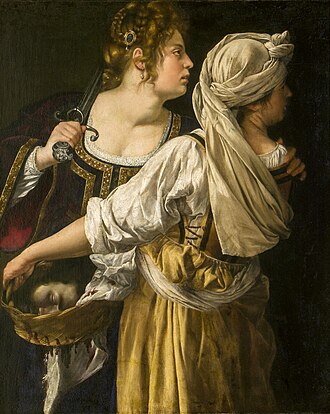 ユディトとその侍女 - Artemisia Gentileschi (1618)
%2C%20Artemisia%20GentileschiFXD.jpg) スザンナと長老たち - Artemisia Gentileschi (1610)
スザンナと長老たち - Artemisia Gentileschi (1610)%20-%20Artemisia%20Gentileschi.jpg) 絵画の寓意としての自画像 - Artemisia Gentileschi (1638)
絵画の寓意としての自画像 - Artemisia Gentileschi (1638)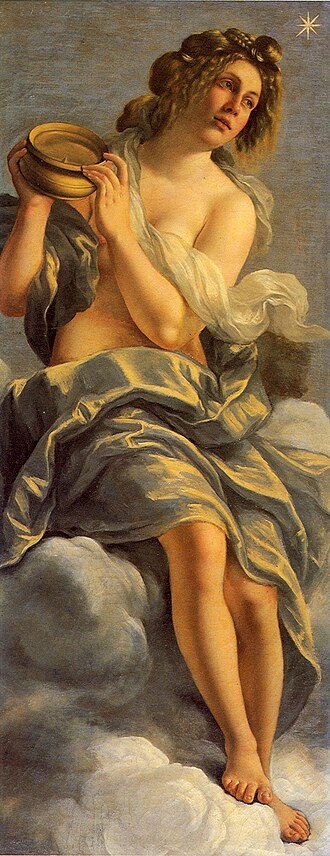 天性の素質の寓意 - Artemisia Gentileschi (1615)
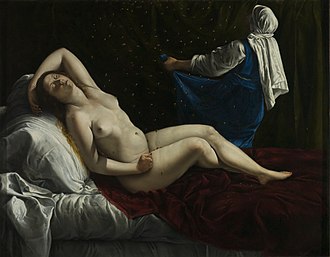 ダナエ - Artemisia Gentileschi (1612)
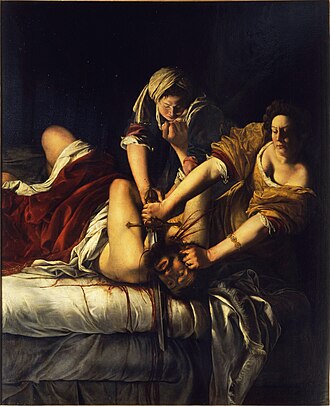 ホロフェルネスの首を斬るユディト - Artemisia Gentileschi (1620)
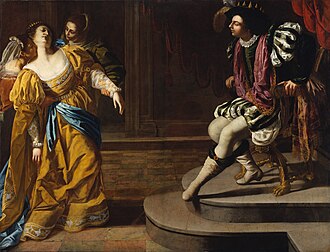 アハシュエロス王の前のエステル - Artemisia Gentileschi (1620s)
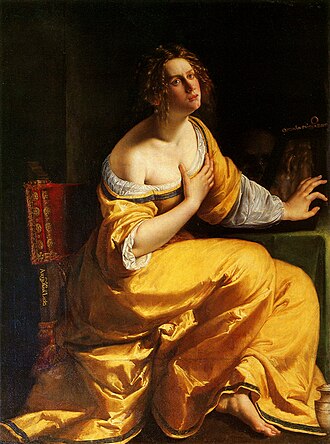 マグダラのマリアの回心 - Artemisia Gentileschi (1616)
%20-%20Artemisia%20Gentileschi%20(Museum%20of%20Fine%20Arts%2C%20Budapest).jpg) Jael and Sisera - Artemisia Gentileschi (1620)
Jael and Sisera - Artemisia Gentileschi (1620)