カルヴァリオへの道で倒れるキリスト
ラファエロ・サンティ · 1510s
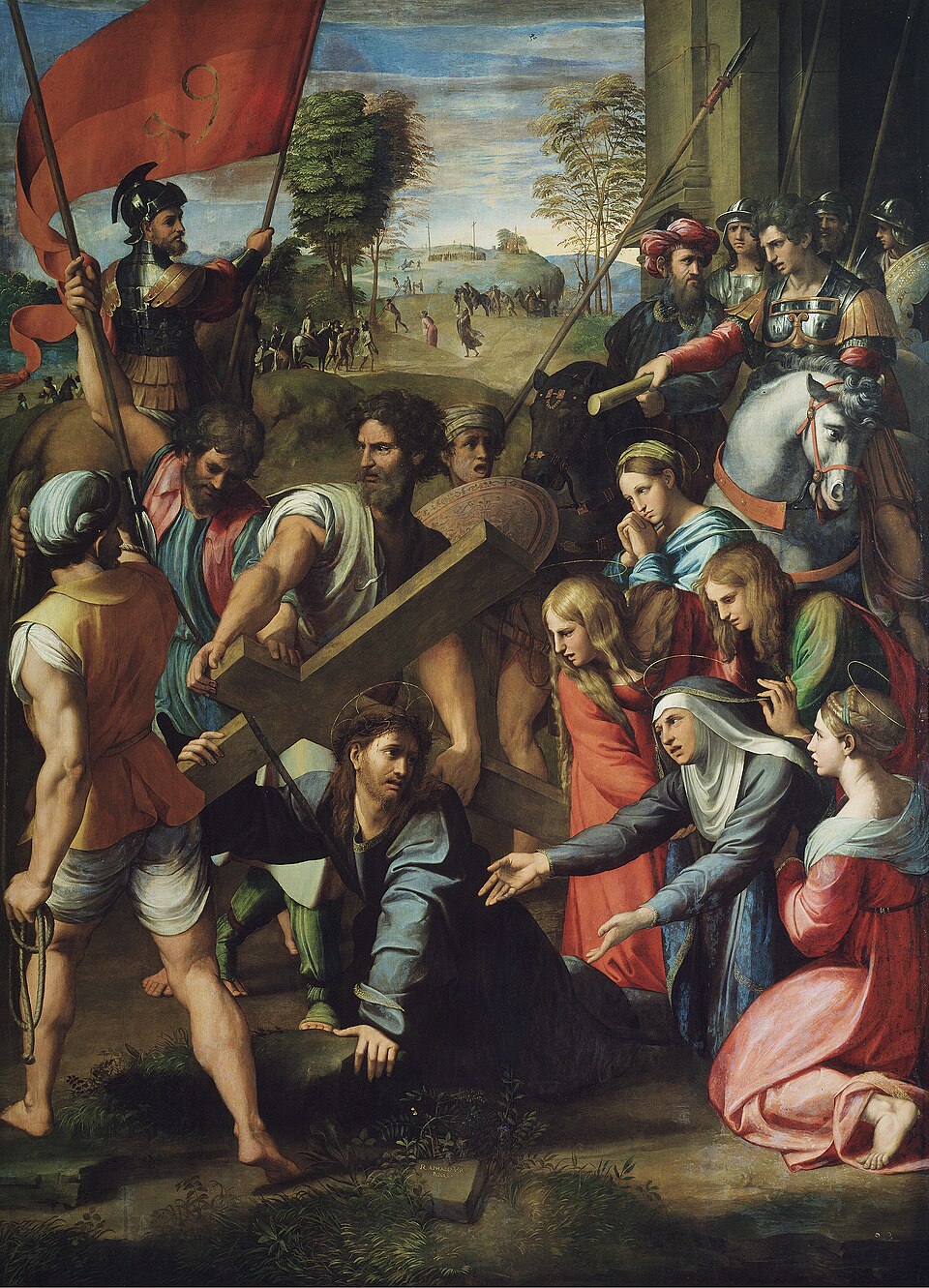
Christ falls under the cross and turns toward his mother, who has sunk to her knees. Vasari tells how this painting, shipped to Palermo, survived a shipwreck in its case and washed up unharmed at Genoa.
The story behind the painting
Christ Falling on the Way to Calvary, also called Lo Spasimo di Sicilia, was commissioned by the monastery of Santa Maria dello Spasimo in Palermo. Raphael painted it in Rome, dated c. 1514 to 1516 in the article's opening and around 1517 in its history. It was sent by sea, and Vasari tells what happened: a great storm drove the ship onto a rock, the crew and cargo were lost, but the painting in its case was carried by the sea to Genoa. Drawn ashore and found uninjured, it was seen as something divine. The monks had to ask the Pope to intervene to get it back, and in Palermo it became famous.
What to look for
Christ has fallen under the cross, and his mother suffers the spasm of agony that gives the painting its name, the Swoon of the Virgin. Here she has only sunk to her knees rather than fainting, as she is often shown. Simon of Cyrene lifts the cross for a moment and looks sternly at the guards, who tower on either side. The four Marys gather on the right. All the emotion is packed into the foreground, while the background is like a stage set, with distant groups and crosses. The man on the far left echoes, reversed, a figure in Raphael's Judgement of Solomon in the Vatican.
Meaning and intent
Devotion to the spasm of the Virgin was fashionable, if somewhat controversial, in Catholicism of the early sixteenth century, and the monastery that ordered the picture was named after it. Raphael chose the moment when a mother sees her son fall, and set it close to us, on a panel more than three metres tall. The painting is considered important for the development of his style. Its attribution was once disputed, but it is now generally accepted as designed and largely painted by Raphael himself, with the usual workshop help on easier areas.
Legacy
In 1661 the Spanish viceroy acquired it for King Philip IV, who placed it on the main altar of the chapel of the Royal Alcázar in Madrid. Napoleon took it as booty, and in Paris from 1813 to 1822 it was transferred from panel to canvas, a common French practice then. Unlike many works, it was returned, and it later went from the royal collection to the Prado. Its condition is not very good, mainly because of that transfer, but cleaning and restoration in 2012 made its quality clearer. In 1674 Juan Carreño de Miranda painted a faithful copy, now in the Real Academia de Bellas Artes de San Fernando in Madrid.
豆知識
- Painted for Santa Maria dello Spasimo in Palermo.
- Vasari says it survived a shipwreck and reached Genoa.
- Transferred to canvas in Paris between 1813 and 1822.
- In the Prado, Madrid; restored in 2012.
画家について
ラファエロ・サンティ (1483-1520)
宗教美術 · 男性 · プラド美術館 · 盛期ルネサンス · イエス・キリスト · 鎧
同じ画家の作品: ラファエロ・サンティ
 システィーナの聖母 - Raphael (1510s)
 ラ・フォルナリーナ - Raphael
 ヒワの聖母 - Raphael (1500s)
 聖母の結婚 - Raphael (1504)
 ヴェールを被る婦人の肖像 - Raphael (1510s)
 三美神 - Raphael (1504)
 アルバの聖母 - Raphael (1510)
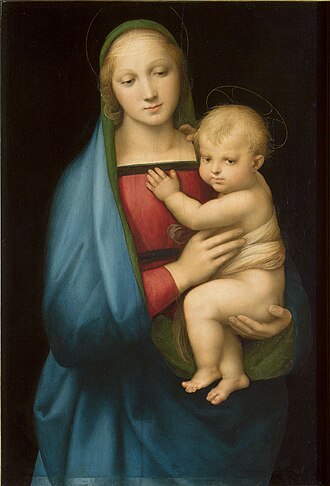 大公の聖母 - Raphael (1500s)
関連する画家の作品
 ウルビーノのヴィーナス - Titian (1538)
 聖母被昇天 - Titian (1510s)
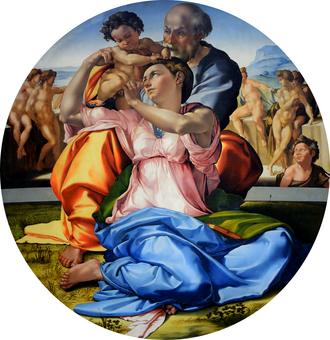 聖家族 - Michelangelo (1500s)
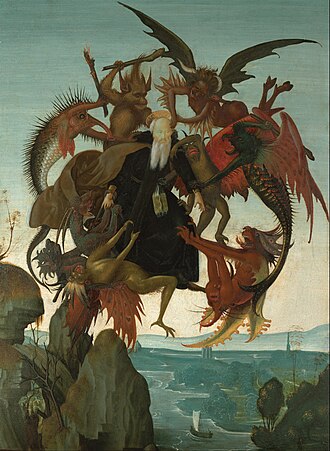 聖アンソニーの苦悩 - Michelangelo (1487)
 モナ・リザ - Leonardo da Vinci (1503-1519)
 白貂を抱く貴婦人 - Leonardo da Vinci (1490)
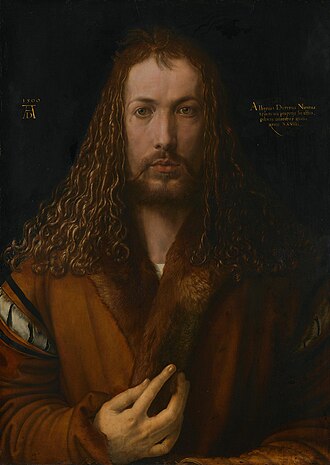 自画像 - Albrecht Dürer (1500)
 東方三博士の礼拝 - Albrecht Dürer (1504)
 ヴィーナスの誕生 - Sandro Botticelli (c. 1485)
 プリマヴェーラ - Sandro Botticelli (1480s)
 快楽の園 - Hieronymus Bosch
 愚者の船 - Hieronymus Bosch (1500s)