ウィンスロー・ホーマー
1836-1910
Winslow Homer taught himself to paint, sketched soldiers on the front lines of the Civil War and ended his life beside the Atlantic in Maine, painting the sea with a force few Americans have matched.
Origins
Winslow Homer was born in Boston on 24 February 1836, the second of three sons of Charles Savage Homer and Henrietta Maria Benson Homer, both from long lines of New Englanders. His mother, a gifted amateur watercolourist, was his first teacher, and the two stayed close all their lives. He grew up mostly in then rural Cambridge, Massachusetts, an average student whose talent for art showed early. His father was a restless businessman who left for the California gold rush and later went to Europe chasing schemes that never paid off. At 19, Homer was apprenticed to the Boston lithographer J. H. Bufford, a formative but repetitive two years.
Life and turning points
By 1857 he was a freelance illustrator, having turned down a staff post at Harper's Weekly. In 1859 he opened a studio in New York, took classes at the National Academy of Design and learned the basics of painting from Frederick Rondel. Harper's then sent him to the front lines of the Civil War, where he sketched battles and camp life. Paintings followed, and Home, Sweet Home won him election as a full Academician in 1865. He spent a year in Paris from 1867, quit illustration in 1875 to live on his paintings, and spent 1881 and 1882 in Cullercoats, England. In 1883 he settled at Prouts Neck, Maine, where he died in 1910 at 74.
Style and technique
Homer was largely self-taught. His early wood engravings show clean outlines, simplified forms, strong contrasts of light and dark and lively groupings, qualities that stayed with him all his career. His oils have weight and density, while his watercolours are fluid and confident; he took them up regularly in 1873 in Gloucester and afterwards seldom travelled without paper and brushes. In England his palette grew sober and his subjects more universal, focused on working women and men. In Maine he painted monumental sea scenes such as Undertow and Eight Bells, and later The Fox Hunt and The Gulf Stream. His late seascapes, often without figures, show waves crashing against rocks in changing light.
Stories and anecdotes
Homer said that from the time he took his nose off the lithographic stone he had had no master and never would. When he first exhibited watercolours, one critic wrote that a child with an ink bottle could not have done worse, yet they proved popular and eased his finances. Henry James confessed he detested Homer's subjects but admitted that he had succeeded. In the Tile Club his nickname was The Obtuse Bard. In 1907 he advised a student to leave rocks for old age, because they are easy. A watercolour he made in the Bahamas, Children Under a Palm Tree, resurfaced on Antiques Roadshow in 2008, and its ownership is still disputed.
Legacy
Homer is considered one of the foremost painters of nineteenth century America. He never taught, yet his direct, energetic pictures of people facing a harsh wilderness shaped later American painters. Robert Henri spoke of his integrity of nature, and Howard Pyle urged his students to study him; N. C. Wyeth even followed Homer to Maine. The Fox Hunt, his largest painting, became his first work in a major American museum. His Prouts Neck studio is now a National Historic Landmark owned by the Portland Museum of Art. His own advice sums him up: look at nature, work independently and solve your own problems.
豆知識
- His painting Shooting the Rapids, Saguenay River was left unfinished.
- A 1962 US postage stamp reproduced his painting Breezing Up.
- For a while he lived at the Eastern Point Lighthouse in Gloucester with the keeper's family.
- He is buried in Mount Auburn Cemetery in Cambridge, Massachusetts.
関連する画家
ギュスターヴ・クールベ · Édouard Manet · Vincent van Gogh
ウィンスロー・ホーマーの作品
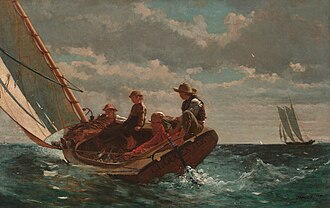 風が強まる - Winslow Homer (1873)
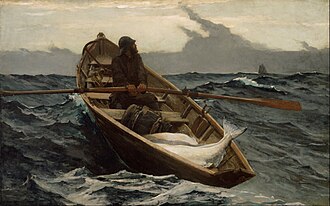 濃霧警報 - Winslow Homer (1885)
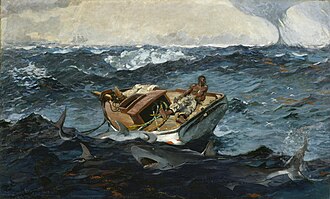 メキシコ湾流 - Winslow Homer (1899)
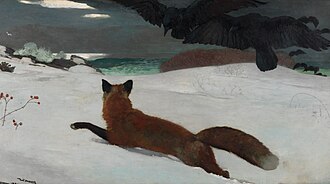 キツネ狩り - Winslow Homer (1893)
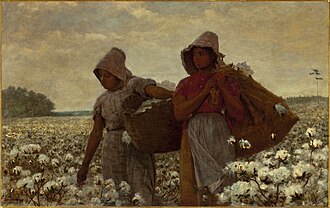 The Cotton Pickers - Winslow Homer (1876)
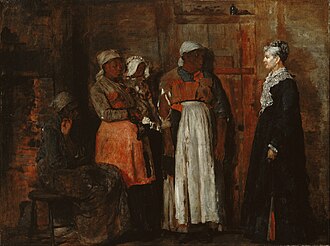 A Visit from the Old Mistress - Winslow Homer (1876)
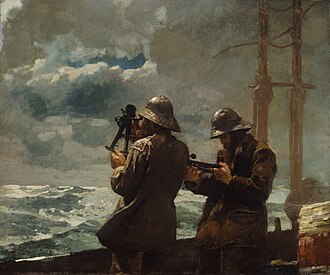 八点鐘 - Winslow Homer (1886)
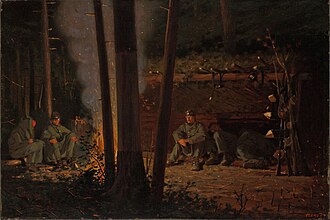 In Front of Yorktown - Winslow Homer (1860s)
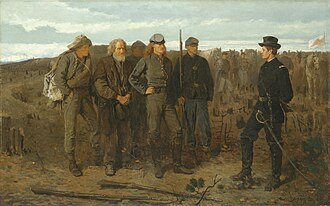 前線からの捕虜 - Winslow Homer (1866)
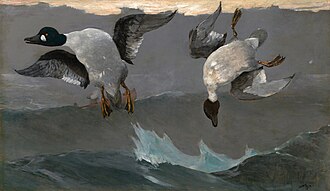 右と左 - Winslow Homer (1909)
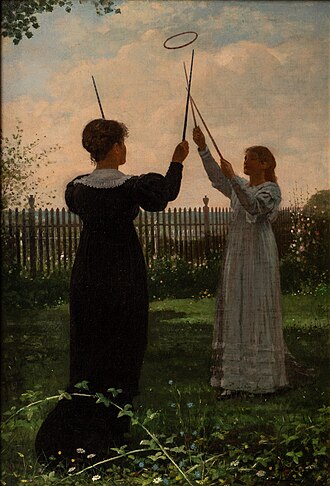 Grace Hoops - Winslow Homer (1872)
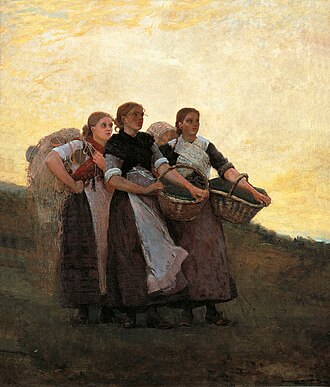 Hark! The Lark - Winslow Homer (1882)
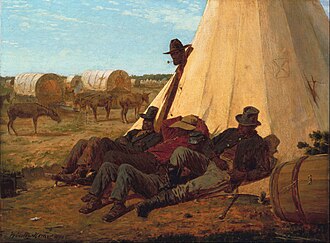 The Bright Side - Winslow Homer (1865)
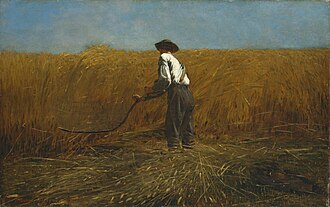 The Veteran in a New Field - Winslow Homer (1865)