The Bright Side
ウィンスロー・ホーマー · 1865
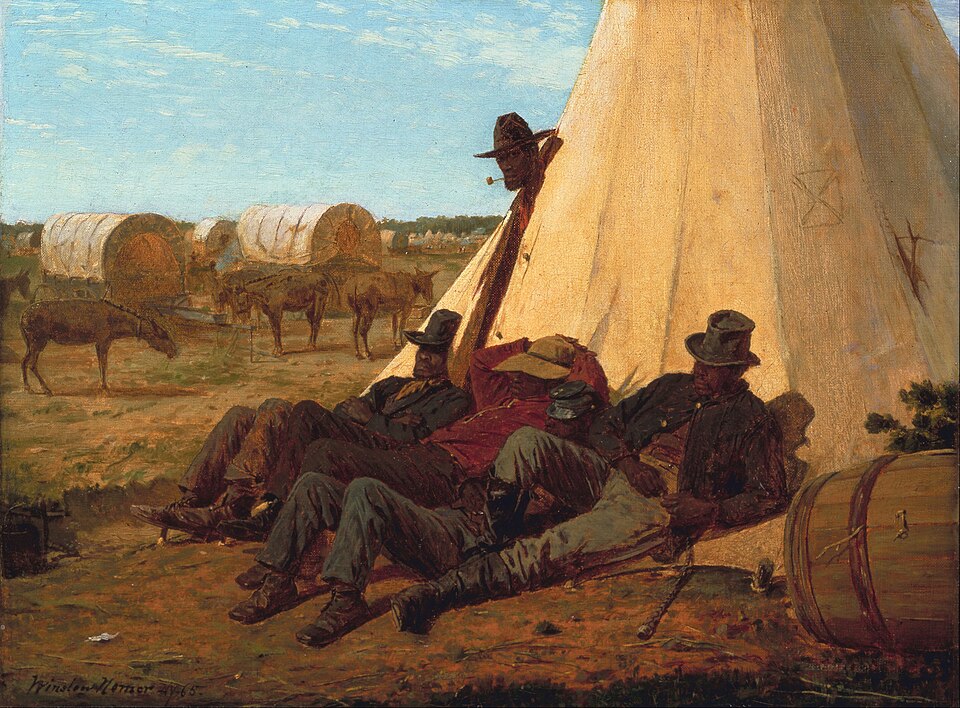
Four Black teamsters of the Union Army rest in the sun against a tent, and a fifth man pokes his head out, pipe in his teeth, staring straight back at us. Homer painted it in 1865, the last year of the Civil War, and people still argue about what he meant.
The story behind the painting
Early in his career Homer apprenticed to a lithographer, then drew freelance for Harper's Weekly, which made him an artist-correspondent with the Army of the Potomac when the Civil War began. For years he watched and recorded life in the Union Army. Near the end of the war he began turning his sketches into paintings of his own, and The Bright Side is one of them. It is seen as his step from illustrator to painter: the subject and small size belong to illustration, the style to the realist he would become.
What to look for
The men lie on the sunny side of a Sibley tent. A catalogue from the year after Homer's death describes them: the man at the right in a battered high hat, military coat and top boots, a whip in his left hand; a head in a peaked military cap beyond his raised knee; a red shirt and broad-brimmed grey hat, hands clasped behind the head; the farthest with arms folded. In the tent opening another man clenches a corn-cob pipe. Behind them stand covered supply wagons, unharnessed mules and, far off, the camp. Wikipedia gives about 33.7 by 44.5 cm, Wikidata 32.4 by 43.2 cm.
Meaning and intent
Teamsters like these drove mule and horse wagons in exposed supply trains, and if captured they were often enslaved or executed. Scholars have long debated whether Homer meant to reinforce stereotypes. The title points to the sunny side of the tent, perhaps also to the Union side that promised freedom; the alternative title Light and Shade has been read as a disparaging pun on colour; others call the title ironic, since these men, once enslaved, now served the army but were no longer in bondage. One modern interpreter sees men of rangy dignity who defy any objectifying gaze.
Legacy
Shown at the National Academy of Design in New York, it was judged the strongest of Homer's three entries, and The Evening Post praised its direct style and faithful observation of nature, along with a dry, latent humour. Many viewers of the time, though, read it as a stereotype of laziness. After passing through a string of New York collections, it was owned by John D. Rockefeller III and Blanchette Hooker Rockefeller, who gave it to the Fine Arts Museums of San Francisco in 1979. It was on view at the Smithsonian American Art Museum from 2012 to 2013.
豆知識
- Painted in 1865, the last year of the American Civil War.
- Seen as Homer's transition from illustrator to painter.
- Its title and meaning have been debated by scholars.
- Given to the Fine Arts Museums of San Francisco in 1979.
画家について
ウィンスロー・ホーマー (1836-1910)
同じ画家の作品: ウィンスロー・ホーマー
 風が強まる - Winslow Homer (1873)
 濃霧警報 - Winslow Homer (1885)
 メキシコ湾流 - Winslow Homer (1899)
 キツネ狩り - Winslow Homer (1893)
 The Cotton Pickers - Winslow Homer (1876)
 A Visit from the Old Mistress - Winslow Homer (1876)
 八点鐘 - Winslow Homer (1886)
 In Front of Yorktown - Winslow Homer (1860s)
 世界の起源
 オルナンの埋葬
 草上の昼食
 オランピア
 星月夜
 夜のカフェテラス