濃霧警報
ウィンスロー・ホーマー · 1885
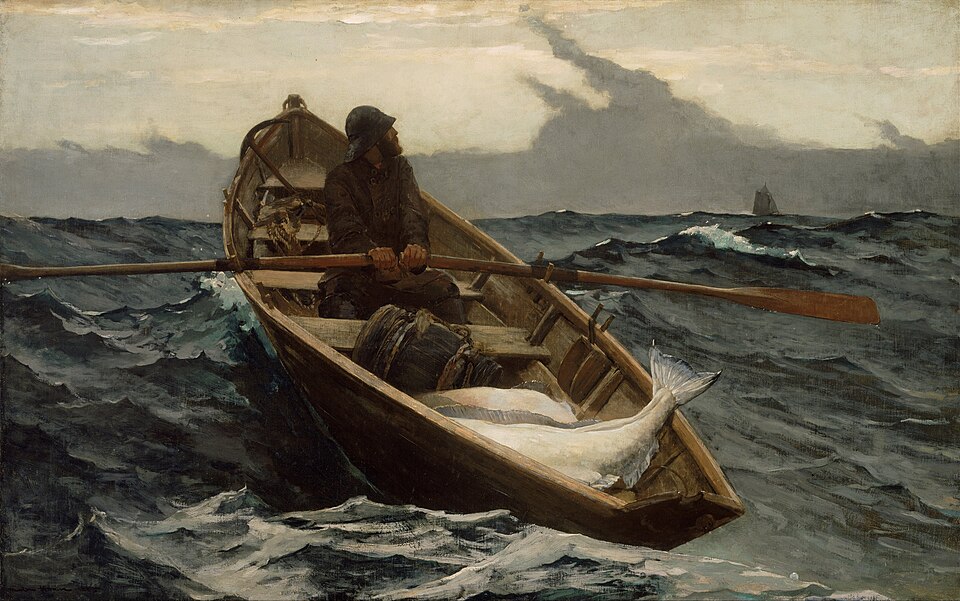
A lone fisherman rows a dory heavy with halibut, and over his shoulder a bank of fog is rolling in. Winslow Homer painted the moment before we know whether he will make it home.
The story behind the painting
After making his name with Civil War subjects and then scenes of leisure, Homer spent 1881 to 1882 in Cullercoats in northeast England, painting fishermen and their families. Back in the United States he settled for good at Prout's Neck, Maine, where his father and brother had bought land, and a studio was built for him there, finished in 1884. In 1885 he painted The Fog Warning there, one of three works that year about the local fishermen. It was first shown in Boston in 1886 at the Doll and Richards Gallery under the title Halibut Fishing. Homer's handyman Henry Lee posed for it, sitting in a dory propped on a pile of sand.
What to look for
The fisherman is seen in profile, looking back over his shoulder at the fog in the distance. Several halibut lie in the stern of the small boat. The sea is choppy and the dory rides high on the waves. On the horizon sits the mother ship, almost swallowed by the dark cloud, and the fog hides the sunset. The Museum of Fine Arts Boston notes that the streamers of fog seem to echo, even mock, the fisherman's own profile. Look at the bow too: an anchor rests there, and two oars sit in the tholepins, details Homer added late.
Meaning and intent
The museum calls this a painting with a narrative whose tale is disturbing rather than charming. The man has had a good day, but the hardest task, rowing back to safety, is still ahead. Being lost at sea in a sudden fog was a real danger at the time, and the heavy catch slows him down, yet leaving it behind would mean no pay for his work. An earlier study faced the fisherman toward the viewer, busy with his line, under warm, calm tones. Homer then darkened the sea and sky, added the fog and changed the title, so the picture became about a man against nature rather than the act of fishing.
Legacy
The Fog Warning, with The Herring Net and other 1885 works on Maine fishermen, is counted among Homer's best paintings on the subject. Many of his late paintings show a single figure at sea, and later works such as Lost on the Grand Banks, After the Hurricane, Bahamas and The Gulf Stream return to danger and tragedy on the water. The original sketch was found in his studio after his death. The painting, about 77 by 123 cm, is now in the Museum of Fine Arts Boston, and it has been used in elementary schools to teach children how to read a picture and about fishermen's lives.
豆知識
- Painted in 1885 in Homer's studio at Prout's Neck, Maine.
- First exhibited in 1886 as Halibut Fishing.
- Homer's handyman Henry Lee posed in a dory set on sand.
- In the Museum of Fine Arts Boston.
画家について
ウィンスロー・ホーマー (1836-1910)
同じ画家の作品: ウィンスロー・ホーマー
 風が強まる - Winslow Homer (1873)
 メキシコ湾流 - Winslow Homer (1899)
 キツネ狩り - Winslow Homer (1893)
 The Cotton Pickers - Winslow Homer (1876)
 A Visit from the Old Mistress - Winslow Homer (1876)
 八点鐘 - Winslow Homer (1886)
 In Front of Yorktown - Winslow Homer (1860s)
 右と左 - Winslow Homer (1909)
 世界の起源
 オルナンの埋葬
 草上の昼食
 オランピア
 星月夜
 夜のカフェテラス