The Starry Night
Vincent van Gogh · 1889
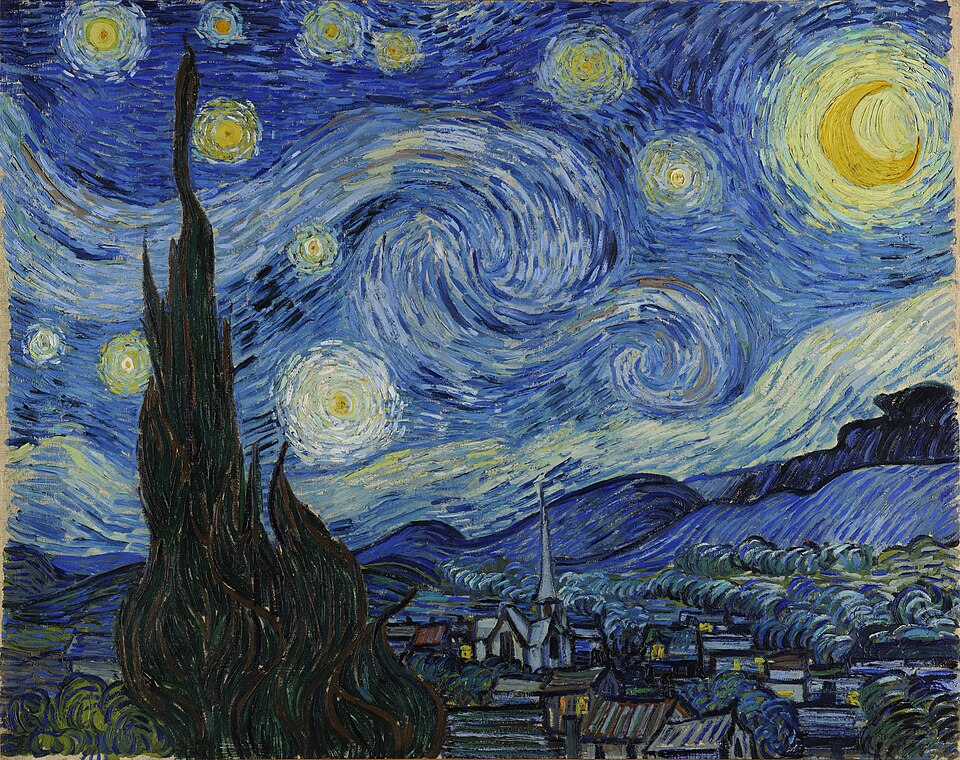
Before dawn, from behind the iron bars of an asylum window, Vincent van Gogh watched the morning star burn over the fields of Provence - and turned that sky into the most famous night in painting.
The story behind the painting
In May 1889, a few months after the breakdown in Arles that ended with him cutting his own ear, Van Gogh admitted himself to the asylum of Saint-Paul-de-Mausole, a former monastery near Saint-Rémy-de-Provence. The house was less than half full, so he was given a second-floor bedroom and a ground-floor room to paint in. From the east-facing bedroom window he looked over an enclosed wheat field toward the low hills of the Alpilles, and he painted that view at least twenty-one times, in sun, wind, rain and moonrise. The Starry Night is the only one set at night. In early June he wrote to his brother Theo that he had seen the countryside long before sunrise, with nothing but the morning star, which looked very big. By around 18 June he told Theo he had a new study of a starry sky.
What to look for
Start with the brightest star, just to the right of the dark cypress: it is Venus, which really was shining at dawn in Provence that spring. The moon above is stylised rather than accurate, since records show it was waning gibbous at the time. Follow the diagonal line of the Alpilles coming in from the right, the motif that ties all his window views together. The cypresses are deliberately enlarged and pulled close, rising like flames into the sky. Below, the village with its slender church steeple was never visible from his room; he added it from a sketch made on a hillside above Saint-Rémy. Scientific analysis has confirmed the colours he chose: ultramarine and cobalt blue for the sky, Indian yellow and zinc yellow for the stars and the moon.
Meaning and intent
What the painting means has been argued over for more than a century. Some see religious symbolism in the stars above a sleeping village; others see the turmoil of a man fighting illness. Some art historians connect the swirling sky to the astronomical discoveries of his time. Van Gogh's own letters suggest he thought of the cypresses mainly as forms and colour rather than as symbols. Most striking of all, he did not think the picture had worked: in letters to Theo he called it a failure. That distance between his judgement and ours is part of its power. It was painted during the day in his studio, built from what he had watched before sunrise, from sketches, and from his imagination, and it feels at once observed and dreamed.
Legacy
When Vincent died the painting passed to Theo, and after Theo's death six months later to his widow, Jo. It changed hands several times before Paul Rosenberg exchanged it with the Museum of Modern Art in New York in 1941, through the Lillie P. Bliss Bequest. It has stayed there ever since, and the museum rarely lends it. Today it is described as a touchstone of modern art and one of the most recognisable paintings in the Western canon. The asylum year that produced it was among the most productive of his life: Irises and his blue self-portrait come from the same months. A painting its maker called a failure has become, for millions of people, the very image of a night sky.
Lo sapevi?
- Van Gogh painted the view from his asylum bedroom window at least twenty-one times; The Starry Night is the only night scene.
- The brightest 'star', to the right of the cypress, is Venus, which was visible at dawn in Provence in spring 1889.
- The village was not visible from his room: he added it from a sketch made on a hillside above Saint-Rémy.
- The Museum of Modern Art in New York has owned the painting since 1941.
L'artista
Vincent van Gogh (1853-1890)
landscape painting · Post-impressionism · sky · cloud · night · Cupressus
Altre opere di Vincent van Gogh
.jpg) Café Terrace at Night - Vincent van Gogh (1888)
Café Terrace at Night - Vincent van Gogh (1888)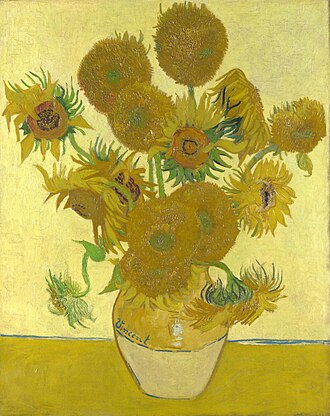 Sunflowers - Vincent van Gogh (1888)
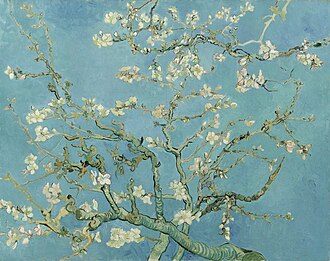 Almond Blossoms - Vincent van Gogh (1890)
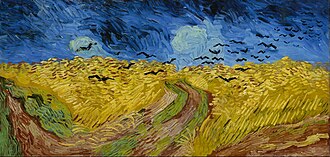 Wheatfield with Crows - Vincent van Gogh (1890)
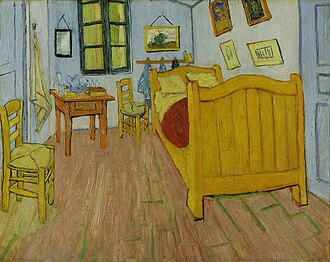 The Bedroom - Vincent van Gogh (1888)
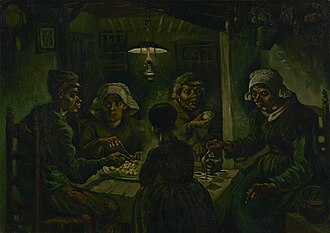 The Potato Eaters - Vincent van Gogh (1885)
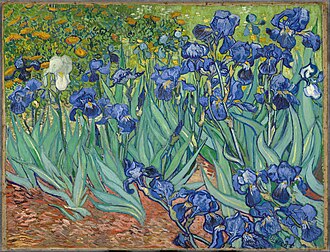 Irises - Vincent van Gogh (1889)
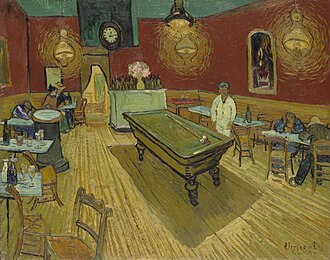 The Night Café - Vincent van Gogh (1888)
Dipinti di artisti collegati
 Where Do We Come From? What Are We? Where Are We Going? - Paul Gauguin (1897-1898)
%201889.jpg) Cristo giallo - Paul Gauguin (1889)
Cristo giallo - Paul Gauguin (1889) Luncheon on the Grass - Édouard Manet (1863)
 Olympia - Édouard Manet (1863)