The Rape of the Daughters of Leucippus
Peter Paul Rubens · 1618
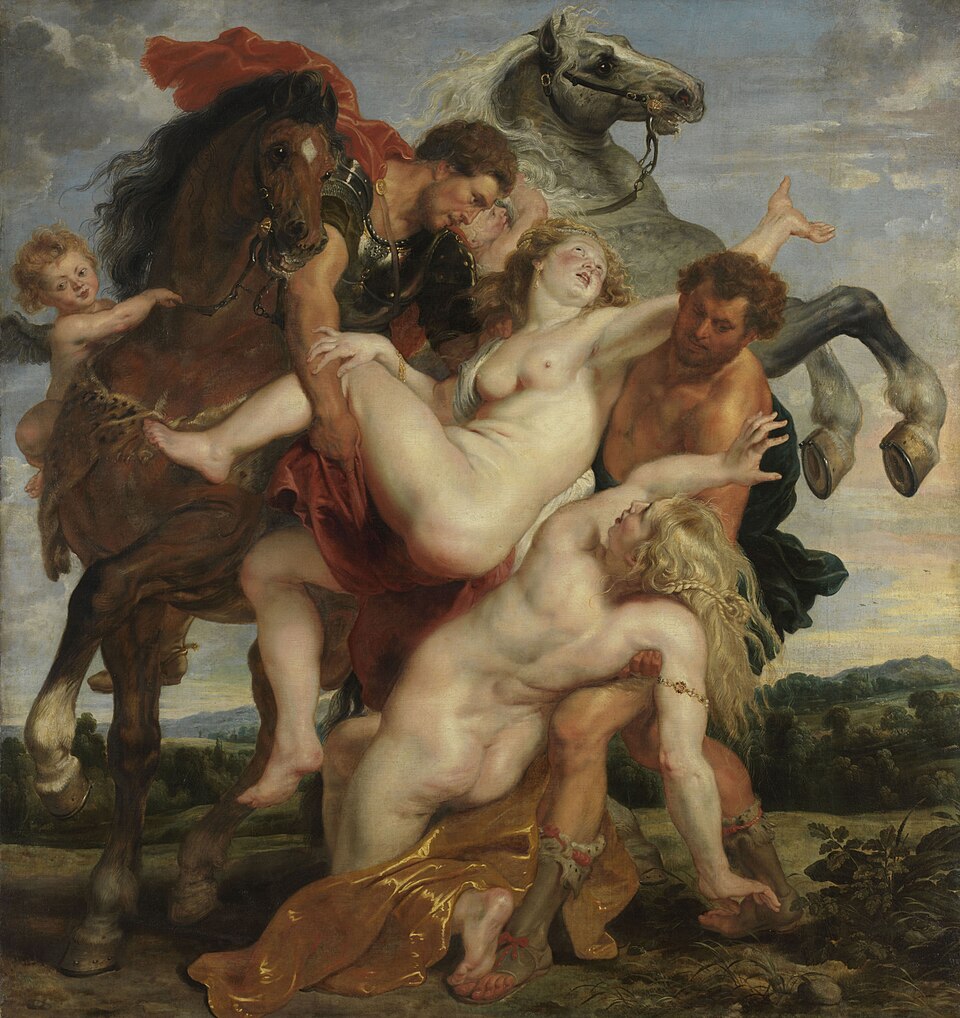
Two horsemen, two women lifted from the ground, and a whirl of limbs and manes: in 1618 Rubens turned a dark Greek myth of abduction into one of the most turbulent compositions of the Baroque.
The story behind the painting
Peter Paul Rubens painted this large canvas in 1618, working together with Jan Wildens, a specialist in landscape who painted the scenery behind the figures. The subject comes from Greek myth: the twins Castor and Pollux seize Phoebe and Hilaeira, the daughters of Leucippus of Messenia. The story is one of force, and the painting does not soften that. Nearly a century later, in 1716, the work was bought in Antwerp by Johann Wilhelm, Elector Palatine. It travelled first to Mannheim, and by 1805-06 it had reached Munich, where it hangs today in the Alte Pinakothek. English sources give its title in two ways: The Rape of the Daughters of Leucippus, and also The Theft of the Daughters of Leucippus.
What to look for
Rubens lets us tell the brothers apart. Castor, the mortal horse-tamer, wears armour; Pollux, the immortal boxer, is shown with a bare upper body. Even their horses differ. Castor's mount stays calm, steadied by a small winged putto, while Pollux's horse rears up. Notice the putto's black wing: according to the description of the painting, it hints at the fate that will later overtake the twins. The two women carry no attributes of their own. Their pale bodies twist against the dark horses and the armour, and the whole group seems to rotate within a nearly square canvas, about 224 by 210 centimetres. Behind them, Wildens' landscape opens out low and wide.
Meaning and intent
Because the sisters have no distinguishing signs, viewers have read the scene through the myth itself. In the literature of Greek myth, Phoebe later bore a son to Pollux and Hilaeira a son to Castor. Following the direction of each twin's gaze, the woman lower down, seen from the back, would be Phoebe, and the woman above, seen from the front, Hilaeira. The canvas is therefore a scene of violence that also looks ahead to the families the myth says came after it. Today we can admire Rubens' energy while also recognising plainly what the story describes: two women taken against their will.
Legacy
The painting belongs to the Bavarian State Painting Collections and is displayed in the Alte Pinakothek in Munich. Wikidata also links it to the former Electoral Gallery in Dusseldorf, part of its long journey through princely collections after the Elector's purchase in 1716. It is classed as a Baroque mythological painting and a nude, and it shows how Rubens worked with other masters: the figures are his, the landscape belongs to Jan Wildens. For visitors, it remains a striking lesson in movement, and a reminder that many celebrated mythological scenes rest on stories of coercion.
Lo sapevi?
- Painted in 1618 by Rubens, with the landscape by Jan Wildens.
- Bought in Antwerp in 1716 by Johann Wilhelm, Elector Palatine; in Munich by 1805-06.
- Canvas about 224 x 210.5 cm, now in the Alte Pinakothek, Munich.
- Castor wears armour; Pollux is shown bare-chested.
L'artista
Peter Paul Rubens (1577-1640)
woman · man · mythological painting · nude · waist-length hair · Baroque · nudity · horse · Bavarian State Painting Collections · body armor · blond hair · clothed male, naked female
Altre opere di Peter Paul Rubens
.jpg) The Elevation of the Cross - Peter Paul Rubens (1609)
The Elevation of the Cross - Peter Paul Rubens (1609) Rubens and Isabella Brant in the honeysuckle bower - Peter Paul Rubens (1600s)
 Samson and Delilah - Peter Paul Rubens (1600s)
 The Descent from the Cross - Peter Paul Rubens (1611)
 Head of Medusa - Peter Paul Rubens (1618)
 Helena Fourment in a Fur Robe - Peter Paul Rubens (1638)
.jpg) The Garden of Love - Peter Paul Rubens (1632)
The Garden of Love - Peter Paul Rubens (1632) The Origin of the Milky Way - Peter Paul Rubens (1630s)
Dipinti di artisti collegati
 The Starry Night - Vincent van Gogh (1889)
.jpg) Café Terrace at Night - Vincent van Gogh (1888)
Café Terrace at Night - Vincent van Gogh (1888) Supper at Emmaus - Caravaggio (1601)
 La vocazione di San Matteo - Caravaggio (1609)
 Las Meninas - Diego Velázquez (1656)
 The Surrender of Brea - Diego Velázquez (1635)
%20-%20Google%20Art%20Project.jpg) Charles I in Three Positions - Anthony van Dyck (1635)
Charles I in Three Positions - Anthony van Dyck (1635)%20with%20M.%20de%20St%20Antoine%20-%20Google%20Art%20Project.jpg) Charles I (1600-1649) with M. de St Antoine - Anthony van Dyck (1636)
Charles I (1600-1649) with M. de St Antoine - Anthony van Dyck (1636) The Night Watch - Rembrandt van Rijn (1642)
 Self-Portrait - Rembrandt van Rijn (1659)
 Girl with a Pearl Earring - Johannes Vermeer (1665)
 The Milkmaid - Johannes Vermeer (c. 1658)