The Republic
Jean-Léon Gérôme · 1848
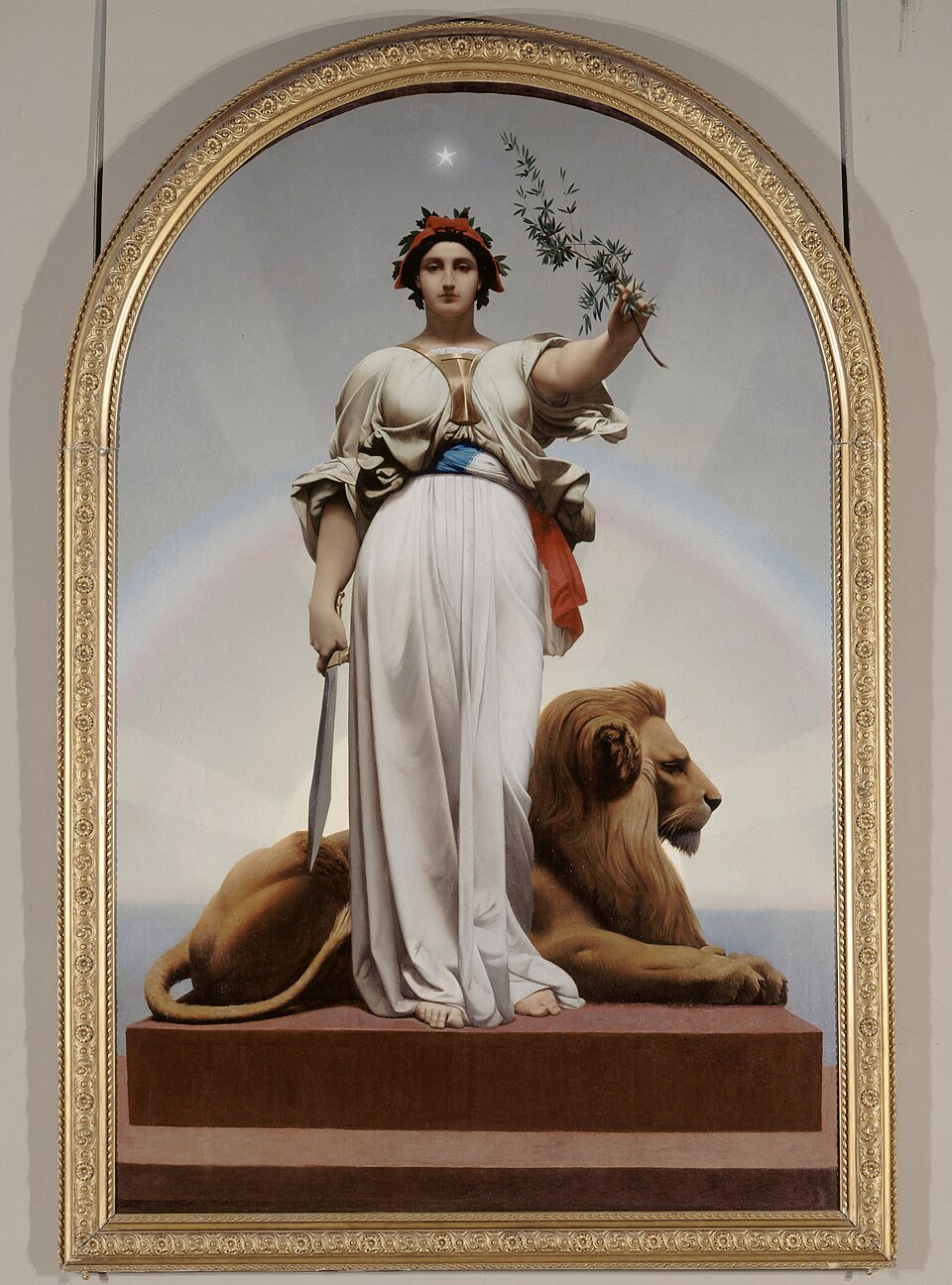
A barefoot goddess in white stands stiffly on a pedestal, a laurel branch raised, a sword pointed at the ground, a lion lying behind her. In 1848 France needed a face for its new Republic, and the young Gérôme answered with this calm, almost frozen figure.
The story behind the painting
After the July Monarchy fell in 1848, the provisional government of the Second Republic launched a competition for an allegorical figure of the Republic, in painting, sculpture and on a medal. The aim was an image that could spread across France and put the egalitarian ideals of 1848 into art. The programme was published on 28 March 1848. Entrants had one month to send an unsigned sketch 65 cm high, with a sealed envelope revealing their identity. The jury, which included Ingres, Delaroche and Delacroix, kept 20 of the 58 sketches. Hippolyte Flandrin was its favourite, and Gérôme came sixth in the votes.
What to look for
The canvas measures 292 by 193 cm, or 322 by 223 cm with its frame, which is rounded at the top. The Republic faces us, upright and stiff, in a gentle contrapposto. Her left arm holds out a laurel branch and her right hand, down by her side, holds a sword pointing to the ground. Her white dress is tied with a tricolour sash, a copper collar covers its top, and a crown of oak held by a red ribbon binds her hair. She stands barefoot on a two-step pedestal, with a lion lying in profile behind her. Behind, a dawn sky over a strip of sea is crossed by a tricolour rainbow, and a small five-pointed star shines above her head.
Meaning and intent
Gérôme made his Republic a moderate, very governmental goddess, as one commentary puts it: fixed, almost hieratic, seen from the front. He chose not to give her the Phrygian cap, a sign linked to the Terror of 1793. The historian Maurice Agulhon saw in her the defence of the homeland, with the lion at her feet and the sword lowered. The tricolour rainbow seems to continue her sash, a sign of republican calm after the upheaval of revolution. The painting is in the Neo-Grec style. The second stage of the contest was to paint the final picture, but on 23 October 1848 the jury cancelled the competition without naming a winner.
Legacy
Even without a prize, the State bought The Republic in 1848 for the town hall of Montmartre. In 1922 it was entrusted to the town hall of Les Lilas, which hung it on its grand staircase. It was restored in the 1960s, and in 2010 it was lent to the Musée d'Orsay for the Gérôme exhibition. Wikidata places it in the Musée des Beaux-Arts de la Ville de Paris, the Petit Palais, while the French Wikipedia article says the Petit Palais holds a second painting and that the sketch is in a private collection. The two sources do not fully agree on where this canvas is today.
Lo sapevi?
- Painted for the 1848 competition for a figure of the Republic.
- Gérôme came sixth; the contest was cancelled with no winner.
- Gérôme left out the Phrygian cap, linked to the Terror of 1793.
- Bought by the State for the town hall of Montmartre in 1848.
L'artista
Jean-Léon Gérôme (1824-1904)
Musée des Beaux-Arts de la ville de Paris
Altre opere di Jean-Léon Gérôme
 Pollice Verso - Jean-Léon Gérôme (1872)
 The Slave Market - Jean-Léon Gérôme (1866)
 Phryne before the Areopagus - Jean-Léon Gérôme (1861)
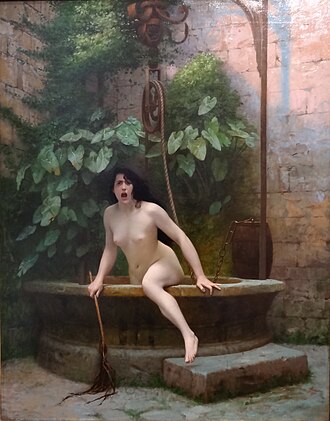 Truth Coming Out of Her Well - Jean-Léon Gérôme (1896)
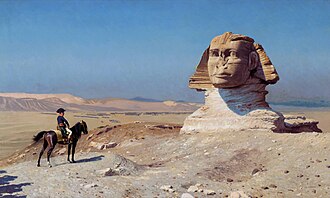 Bonaparte Before the Sphinx - Jean-Léon Gérôme (1867)
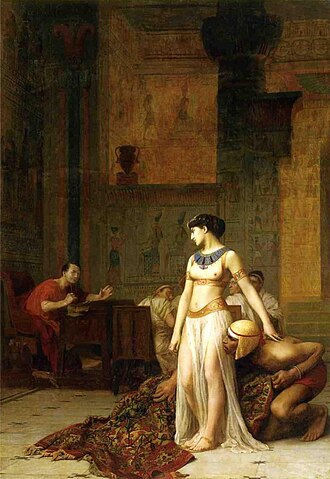 Cleopatra and Caesar - Jean-Léon Gérôme (1866)
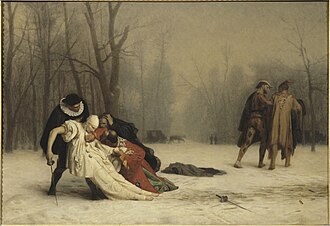 The Duel After the Masquerade - Jean-Léon Gérôme (1857)
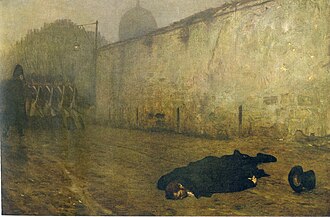 The Execution of Marshal Ney - Jean-Léon Gérôme (1868)
Dipinti di artisti collegati
 Luncheon on the Grass - Édouard Manet (1863)
 Olympia - Édouard Manet (1863)
 L'Origine du monde - Gustave Courbet (1866)
 A Burial at Ornans - Gustave Courbet (2020)
 Carnation, Lily, Lily, Rose - John Singer Sargent (1885-1886)
 Madame X - John Singer Sargent (1884)
 Liberty Leading the People - Eugène Delacroix (1830)
 Death of Sardanapalus - Eugène Delacroix (1827)
 The Death of Socrates - Jacques-Louis David (1787)
 The Oath of the Horatii - Jacques-Louis David (1784)
 The Ladies Waldegrave - Joshua Reynolds (1780)
 Captain George K. H. Coussmaker - Joshua Reynolds (1782)