Truth Coming Out of Her Well
Jean-Léon Gérôme · 1896
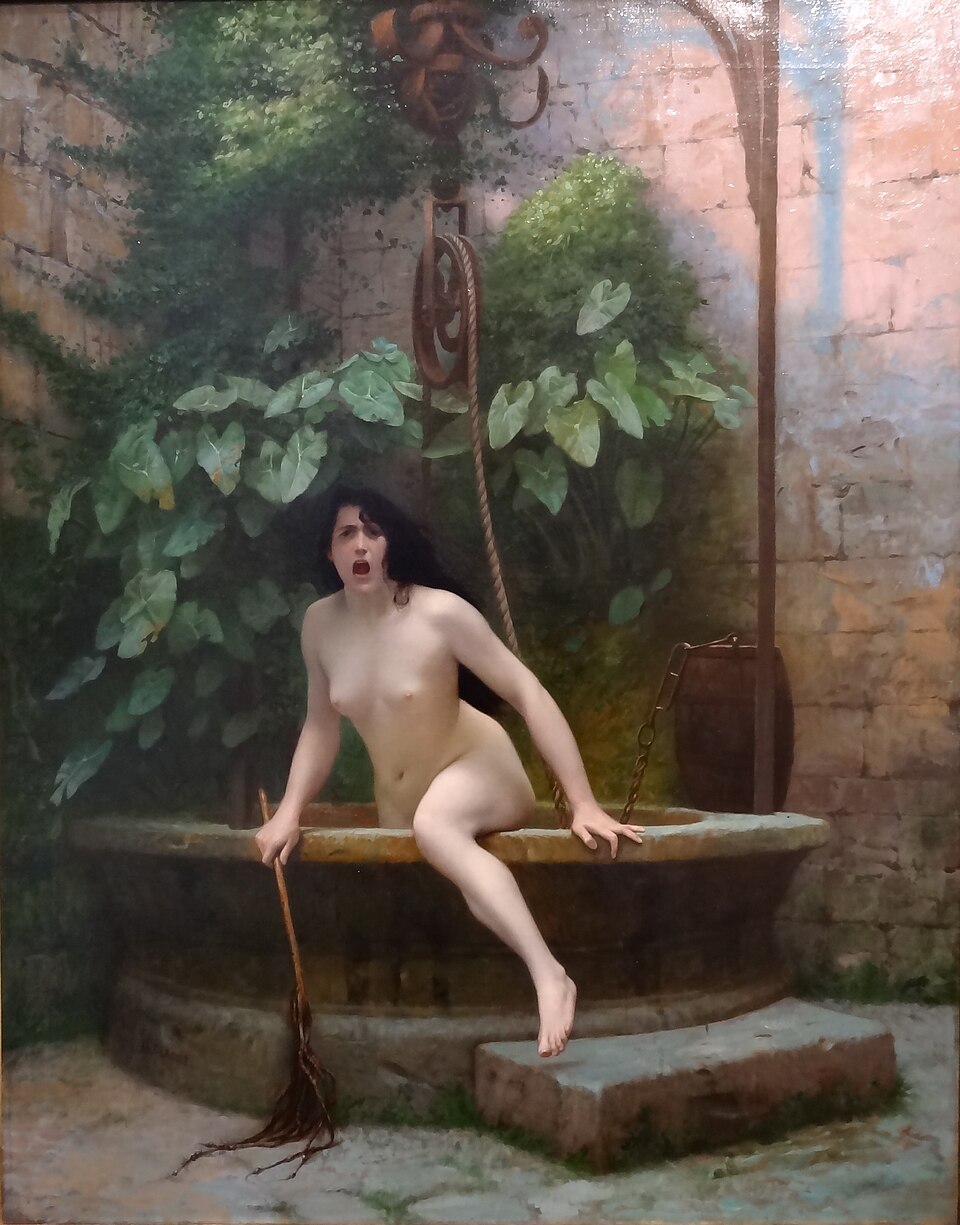
A naked woman climbs furiously out of a well, whip in hand, ready to punish humanity. Gérôme painted this fierce image of Truth in his last decade, and a museum curator in Moulins later called it our own Mona Lisa.
The story behind the painting
The full French title says it all: Truth coming from the well, armed with her whip to chastise humanity. Gérôme painted it in 1896, during the last decade of his life, when he made at least four paintings of Truth as a nude woman thrown into, lying at the bottom of, or emerging from a well. At the Salon of 1895 he had shown Truth killed by liars and actors, her body flung into a well with her mirror after her. At the next Salon, in 1896, he answered with this picture of Truth climbing back out, angry and armed.
What to look for
The canvas, about 91 by 72 cm, shows Truth as a woman with long black hair reaching her waist, rising naked over the stone wall of a well. Look at the pulley above the opening, the hard edge of the masonry and the whip she carries, the instrument the title promises she will use on humanity. Her nudity is not decoration: it may come from the French expression la vérité nue, the naked truth. Unlike the calm Truth that Paul Baudry painted around 1879, sitting placidly on a well with a mirror, Gérôme gives her motion and fury, bursting out toward the viewer.
Meaning and intent
The image comes from a saying of the philosopher Democritus, usually translated as: of truth we know nothing, for truth is in a well. Earlier, Gérôme's pupil Jules-Arsène Garnier had shown Truth leaving her well while a crowd ran away, after a fable by Florian. Many have assumed that Gérôme's paintings, like a later one by Édouard Debat-Ponsan, comment on the Dreyfus affair. The art historian Bernard Tillier argues instead that they belong to Gérôme's ongoing attack on Impressionism. In a 1902 preface Gérôme also used Truth and the well as a metaphor for the deep influence of photography.
Legacy
Gérôme kept at least one of these paintings. When he died in 1904, his biographer Charles Moreau-Vauthier wrote that the maid found him slumped in front of a portrait of Rembrandt, at the foot of his own painting of Truth, without saying which one. Since 1978 this canvas has been on permanent display at the Musée Anne de Beaujeu in Moulins, France. After it travelled to Los Angeles, Paris and Madrid, the museum held the exhibition Truth is at the Museum in 2012, gathering drawings, sketches and variants on the theme. Its many possible meanings led a curator to call it our own Mona Lisa.
Lo sapevi?
- Painted in 1896 and shown at the Paris Salon that year.
- One of at least four paintings of Truth and the well by Gérôme.
- Based on a saying attributed to Democritus.
- In the Musée Anne de Beaujeu, Moulins, since 1978.
L'artista
Jean-Léon Gérôme (1824-1904)
woman · nude · nudity · waist-length hair · allegory · academic art · black hair · wall
Altre opere di Jean-Léon Gérôme
 Pollice Verso - Jean-Léon Gérôme (1872)
 The Slave Market - Jean-Léon Gérôme (1866)
%20-%2001.jpg) Phryne before the Areopagus - Jean-Léon Gérôme (1861)
Phryne before the Areopagus - Jean-Léon Gérôme (1861) Bonaparte Before the Sphinx - Jean-Léon Gérôme (1867)
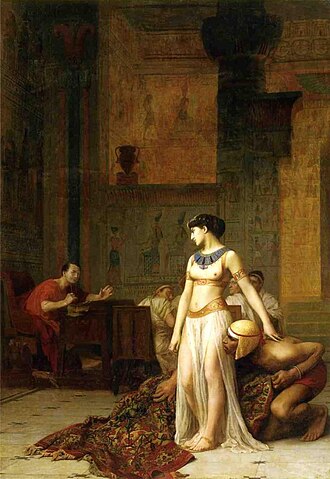 Cleopatra and Caesar - Jean-Léon Gérôme (1866)
 The Duel After the Masquerade - Jean-Léon Gérôme (1857)
.jpg) The Execution of Marshal Ney - Jean-Léon Gérôme (1868)
The Execution of Marshal Ney - Jean-Léon Gérôme (1868)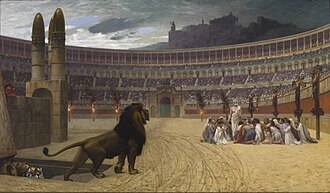 The Christian Martyrs' Last Prayer - Jean-Léon Gérôme (1883)
Dipinti di artisti collegati
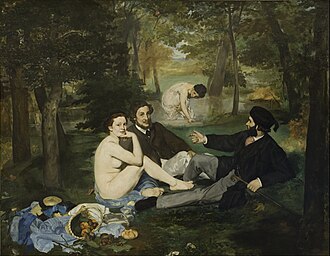 Luncheon on the Grass - Édouard Manet (1863)
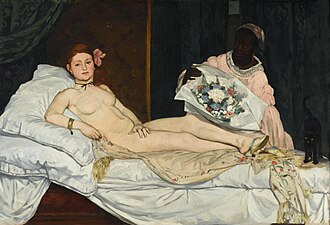 Olympia - Édouard Manet (1863)
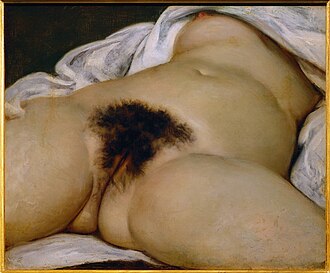 L'Origine du monde - Gustave Courbet (1866)
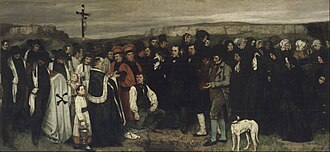 A Burial at Ornans - Gustave Courbet (2020)
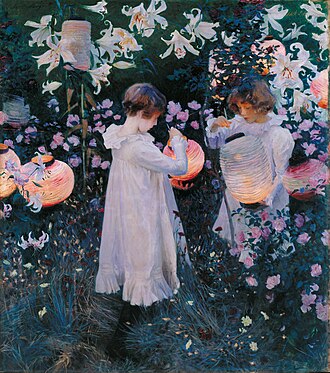 Carnation, Lily, Lily, Rose - John Singer Sargent (1885-1886)
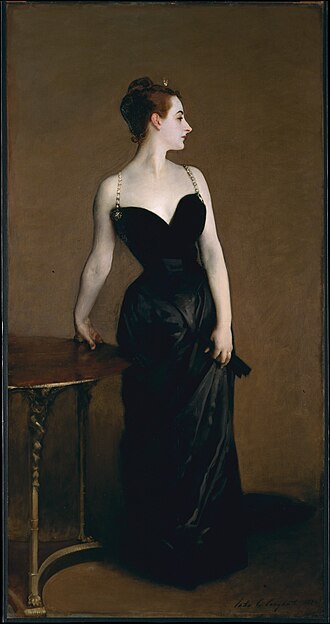 Madame X - John Singer Sargent (1884)
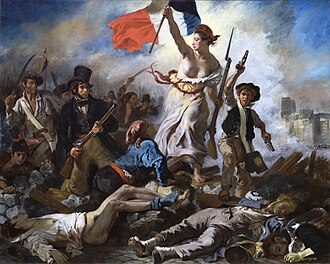 Liberty Leading the People - Eugène Delacroix (1830)
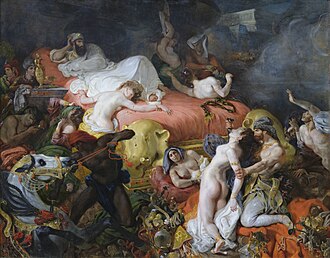 Death of Sardanapalus - Eugène Delacroix (1827)
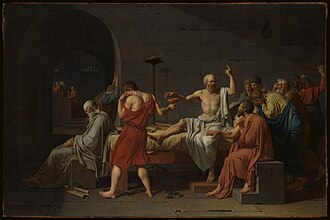 The Death of Socrates - Jacques-Louis David (1787)
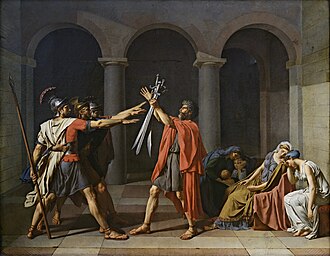 The Oath of the Horatii - Jacques-Louis David (1784)
 The Fighting Temeraire - J. M. W. Turner (1839)
 Rain, Steam and Speed - The Great Western Railway - J. M. W. Turner (1844)