The Gate of Calais
William Hogarth · 1748
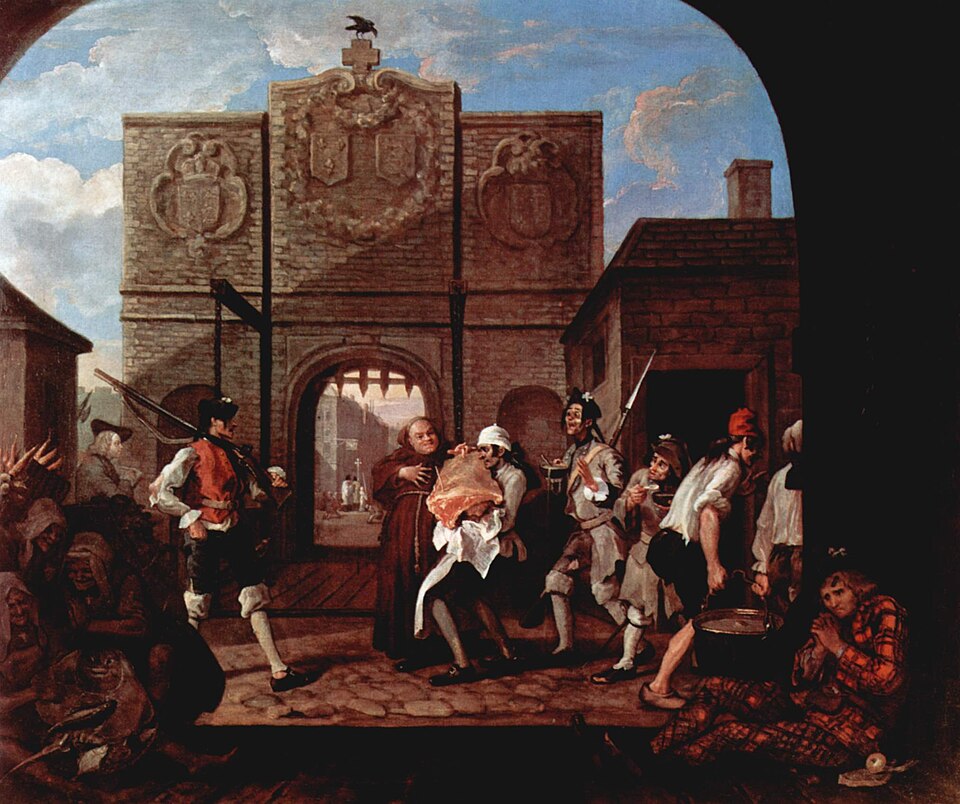
A huge side of English beef is carried through the gate of Calais while thin French soldiers and a fat friar stare at it hungrily. Hogarth painted it right after being arrested in Calais as a spy.
The story behind the painting
In July 1748 Hogarth went to Paris with artist friends during the armistice before the Treaty of Aix-la-Chapelle. On the way home he and Francis Hayman waited in Calais for the boat. Hogarth began sketching the port gate and drawbridge, which still bore the English arms, since Calais had been English until 1558. His drawing of the fortifications aroused suspicion, and he was arrested and taken before the governor. Most accounts say he showed his other sketches, it became clear he was just an artist, and he was released to wait for a wind. According to his own notes, he started the painting as soon as he got home.
What to look for
The view looks out from under an archway in the main wall of Calais. At the centre a cook in a bright white apron and cap carries a sirloin of beef bound for the English inn, the Lion d'Argent. Ragged French soldiers lick their lips over watery soup, and two in wooden clogs carry a cauldron of it. A Franciscan friar, thought to be based on Hogarth's friend the engraver John Pine, rubs his finger in the fat. In the corner a Highlander exiled after the 1745 Jacobite rising slumps against the wall with a raw onion and a crust. At the left Hogarth paints himself sketching, as a soldier's halberd and hand appear behind him.
Meaning and intent
The picture mocks the French through food and religion. Through the gate a Catholic mass is held under an inn sign of a dove, while in front the main figures seem to worship the beef: the cook bows under it as if offering it to the friar. Fishwives venerate the face of a ray, and the Jacobite clasps his hands in prayer. Over the gate a crow takes the place of the dove of peace. The second title, O, the Roast Beef of Old England, comes from a patriotic ballad in Henry Fielding's The Grub-Street Opera of 1731. Hogarth's dislike of the French also shows in Noon, The March to Finchley and Beer Street.
Legacy
An engraving, partly by Charles Mosley, was published on 6 March 1749. The main difference from the painting is the crow, missing from the print. The crow was said to be a late addition to hide a tear made when the canvas fell on a nail, although no damage was found when the painting was restored in 1966. It was shown at the Society of Artists exhibition of 1761 and later belonged to the 1st Earl of Charlemont. The 1st Duke of Westminster gave it to the National Gallery in 1895, and it was transferred to the Tate in 1951. The real gate was pulled down in 1895.
Lo sapevi?
- Painted in 1748 after Hogarth was arrested in Calais while sketching.
- Also known as O, the Roast Beef of Old England.
- Hogarth included himself, about to be arrested, at the left.
- Given to the National Gallery in 1895, moved to the Tate in 1951.
L'artista
William Hogarth (1697-1764)
Altre opere di William Hogarth
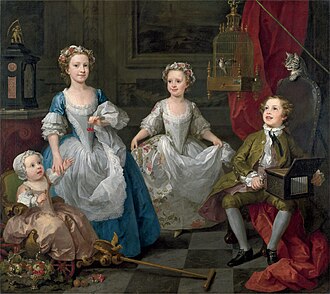 The Graham Children - William Hogarth (1742)
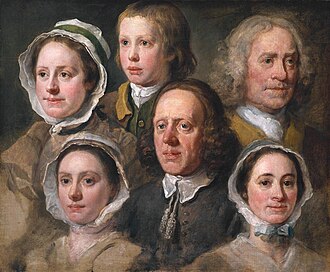 Hogarth's Servants - William Hogarth (1750s)
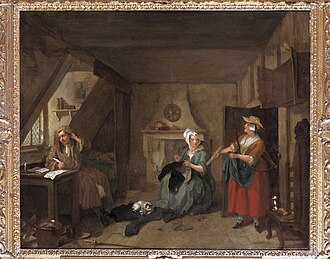 The Distrest Poet - William Hogarth (1730s)
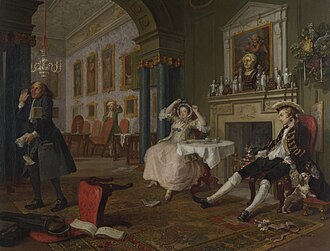 Marriage A-la-Mode: 2. The Tête à Tête - William Hogarth (1743)
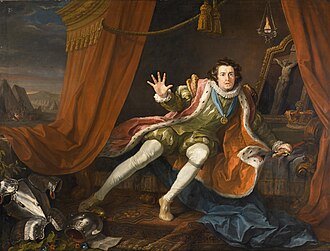 David Garrick as Richard III - William Hogarth (1745)
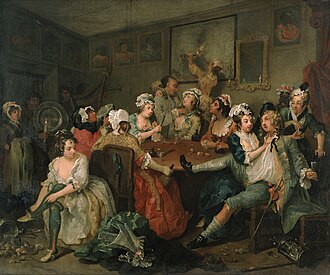 The Orgy - William Hogarth (1735)
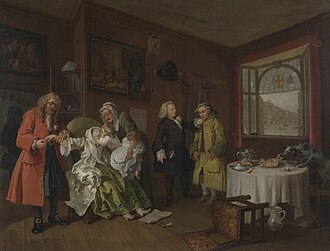 Marriage A-la-Mode: 6. The Lady's Death - William Hogarth (1743)
The Lady's Last Stake - William Hogarth (1759)