The Distrest Poet
William Hogarth · 1730s
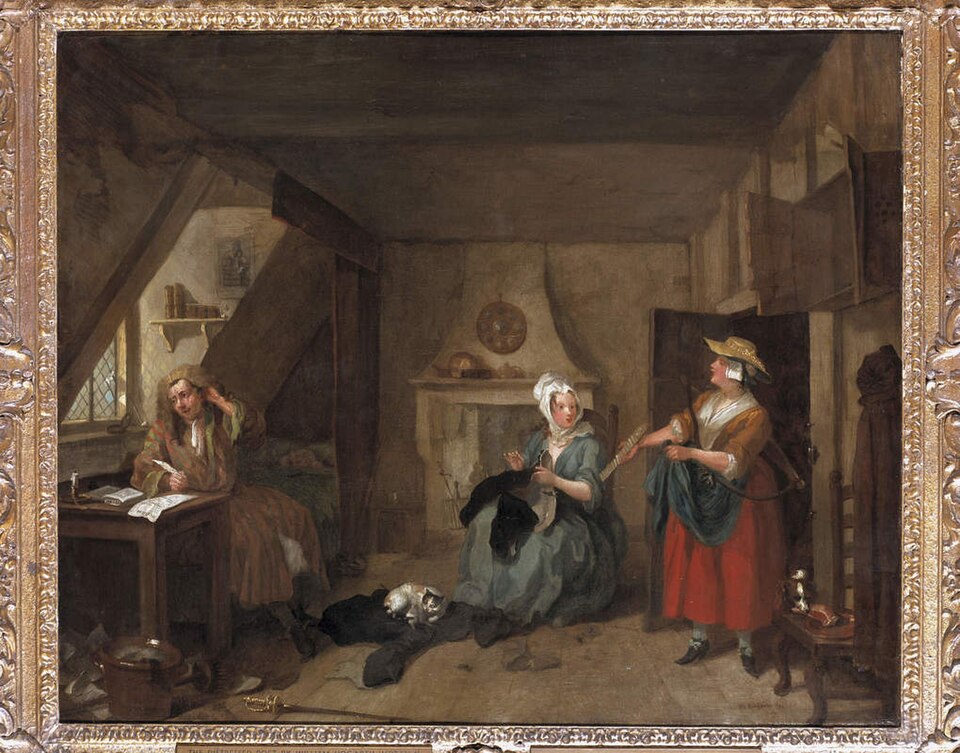
In a cramped attic, a poet scratches his head over a poem called Upon Riches while his baby cries, the cupboard stands empty and the milkmaid demands to be paid. Hogarth turned writer's block into one of his sharpest, and most personal, comedies.
The story behind the painting
Hogarth painted The Distrest Poet around 1736. The scene was probably inspired by Alexander Pope's satirical poem The Dunciad, most likely by the Dunciad Variorum of 1735, and the painting and early prints quoted Pope's lines about a writer who plunges for sense and finds no bottom. Hogarth then turned it into a print. The third state of the plate was finished late in 1740 and published on 15 December 1741 as a companion to The Enraged Musician. He announced a set of three, with a third image on painting, but that one was never made. The sources give the date loosely: Wikipedia says around 1736, Wikidata the 1730s.
What to look for
The garret is small and shabby: cracked plaster, a broken window, an uneven floor, crude furniture. The poet sits on the end of the bed in his nightgown, quill in hand, scratching his head. Edward Bysshe's guide The Art of English Poetry lies open on the table and Pope's Grub Street Journal on the floor. His wife darns clothes, a cat sits among them, and a hungry infant cries unattended in the only bed. By the open door an angry milkmaid presents her bill. The cupboard is empty except for a mouse, and a dog steals the last food from a plate. Above the poet hangs a map titled A View of the Gold Mines of Peru.
Meaning and intent
The details tell us who the poet is. He writes about riches while his family goes hungry, and the gold mine map shows his dreams. His pipe and tobacco on the sill, a mug of beer, lace cuffs drying by the fire, an ill-fitting wig and a gentleman's sword suggest he will not give up his own comforts, or that he keeps them ready for the fortune he imagines. Images above his head changed between versions, from a bill mocking Pope to a scene of Pope fighting the publisher Edmund Curll, then to the map. Scholars disagree: Ronald Paulson sees Pope, the successful Great Poet, as the real villain, while the poet himself is one of Pope's dunces.
Legacy
Hogarth knew this world from home. His father, Richard, had failed to make a living as a writer and ended up bankrupt in the Fleet Prison, so the artist may have felt real sympathy for the struggling hack. The biographer Jenny Uglow suggests that the slow change of the prints above the poet's head may show Hogarth softening towards the class of writers his father belonged to, and perhaps his own compromises on the way to success. The painting is now held by Birmingham Museums Trust. Behind the laughter is a portrait of a family paying for one man's dream.
Lo sapevi?
- Painted around 1736, probably inspired by Pope's Dunciad.
- Published as a print on 15 December 1741.
- A companion to The Enraged Musician.
- Now held by Birmingham Museums Trust.
L'artista
William Hogarth (1697-1764)
Altre opere di William Hogarth
 The Graham Children - William Hogarth (1742)
 Hogarth's Servants - William Hogarth (1750s)
 Marriage A-la-Mode: 2. The Tête à Tête - William Hogarth (1743)
 David Garrick as Richard III - William Hogarth (1745)
 The Orgy - William Hogarth (1735)
 Marriage A-la-Mode: 6. The Lady's Death - William Hogarth (1743)
The Lady's Last Stake - William Hogarth (1759)
 Marriage A-la-Mode: 1. The Marriage Settlement - William Hogarth (1743)