The Lady's Last Stake
William Hogarth · 1759
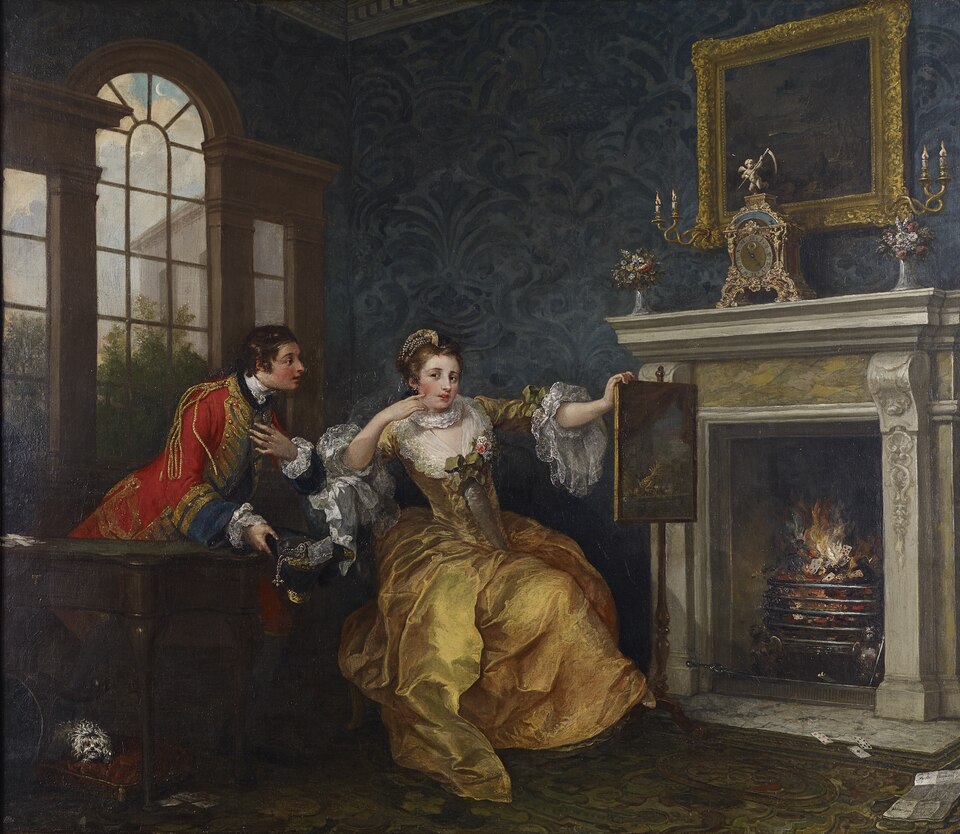
She has lost everything at cards. The officer offers one more game: win, and it all comes back; lose, and she becomes his lover. Hogarth freezes her, hand on the fire screen, at the moment of decision.
The story behind the painting
Painted about 1759, this was one of William Hogarth's last works. It was commissioned by James Caulfeild, 4th Viscount Charlemont, later 1st Earl of Charlemont, who let Hogarth choose both subject and price. Its original title was Piquet: or Virtue in Danger. It later became known as The Lady's Last Stake after a 1707 comedy by Colley Cibber, in which Lady Gentle loses money to the cheating Lord George Brilliant and must decide whether to pay her debts or settle them by betraying her husband. The canvas measures about 91 by 105 cm.
What to look for
A man and a woman have been playing piquet at a table near a fire, in front of a Venetian window in an elegant Palladian house. The woman has just lost her fortune to the man, an army officer, whose tricorne hat holds her money and jewels. She clasps the edge of the fire screen. On the floor lies a discarded letter from her husband sending her money, addressed to Charlotte and signed Townly. A small dog hides under the table. A Penitent Magdalene hangs over the fireplace, and on the mantel a clock shows Cupid with a scythe in place of Father Time, with the motto nunc nunc, now now. The time is 4:55, and cards burn in the fire.
Meaning and intent
Every detail points to her choice: be ruined financially, or morally. The dog stands for faithfulness, and it is hiding. The Magdalene recalls repentance. The clock presses for an answer now. Above the garden the horns of a crescent moon allude to the horns of a cuckold. The woman may be modelled on Hogarth's acquaintance Hester Salusbury, later Hester Thrale and then Hester Piozzi. The prominent Venetian window may have been a nod to Charlemont, who loved neo-classical architecture and had recently returned from a Grand Tour.
Legacy
When Sir Richard Grosvenor saw the painting in Hogarth's studio in 1758 he asked for one on the same terms, but rejected the result, Sigismunda mourning over the Heart of Guiscardo. Charlemont accepted his picture and let Hogarth keep it for a time to engrave, but Hogarth discarded his own unsatisfying engraving. The painting was shown at the first exhibition of the Society of Artists in 1761 and later engraved by Thomas Cheesman. It hung in Charlemont House in Dublin until 1874, then passed through dealers to J. P. Morgan in 1900, and was given to the Albright-Knox Art Gallery in Buffalo by Seymour H. Knox Jr in 1945.
Lo sapevi?
- Painted about 1759, originally titled Piquet: or Virtue in Danger.
- Commissioned by Lord Charlemont, who let Hogarth choose the subject.
- Shown at the Society of Artists' first exhibition in 1761.
- Given to the Albright-Knox Art Gallery, Buffalo, in 1945.
L'artista
William Hogarth (1697-1764)
genre art · Buffalo AKG Art Museum
Altre opere di William Hogarth
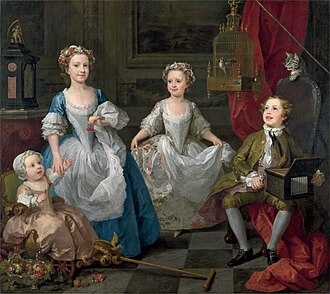 The Graham Children - William Hogarth (1742)
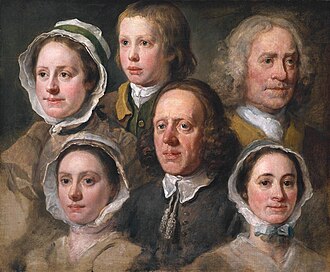 Hogarth's Servants - William Hogarth (1750s)
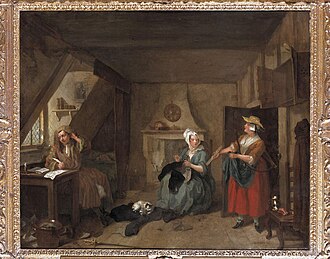 The Distrest Poet - William Hogarth (1730s)
 Marriage A-la-Mode: 2. The Tête à Tête - William Hogarth (1743)
 David Garrick as Richard III - William Hogarth (1745)
 The Orgy - William Hogarth (1735)
 Marriage A-la-Mode: 6. The Lady's Death - William Hogarth (1743)
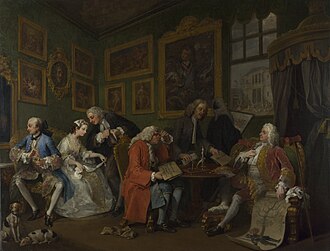 Marriage A-la-Mode: 1. The Marriage Settlement - William Hogarth (1743)