Supper at Emmaus
Caravaggio · 1601
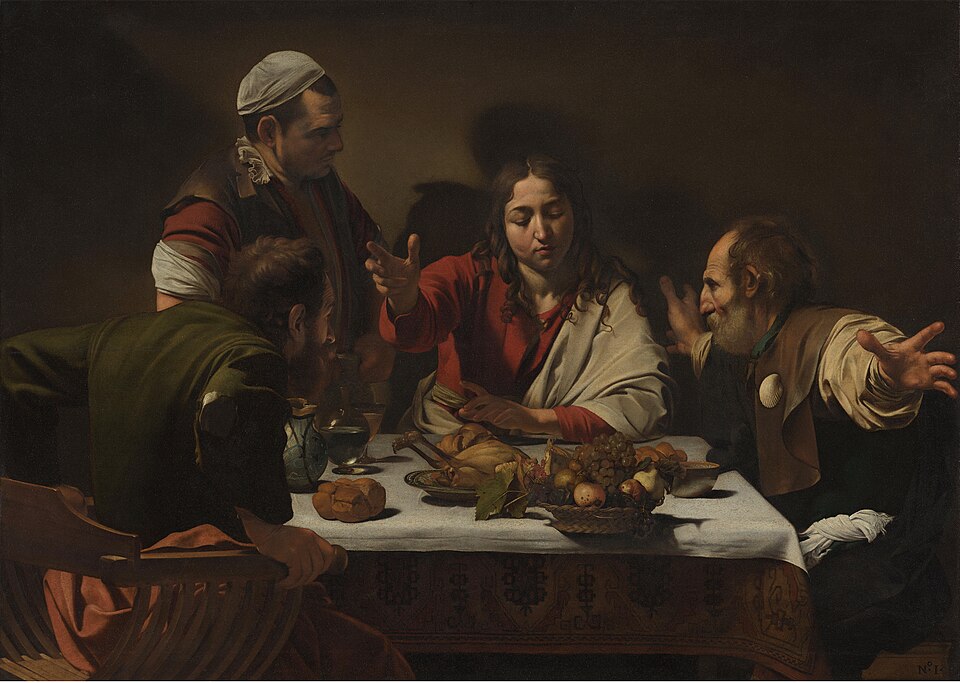
A fruit basket teeters at the table's edge, a pilgrim's arms fly wide, and a young, beardless stranger is suddenly recognised: Caravaggio freezes the instant before a miracle vanishes.
The story behind the painting
Caravaggio completed this painting in 1601, in Rome. It was commissioned and paid for by Ciriaco Mattei, brother of Cardinal Girolamo Mattei. The subject comes from the Gospel of Luke (24:30-31): after the Resurrection, two disciples walking to Emmaus meet a stranger, invite him to eat, and recognise him as Jesus only when he blesses the bread, just before he disappears from their sight. This is the London version, now in the National Gallery, a large canvas of 196.2 by 141 cm. It should not be confused with Caravaggio's later Supper at Emmaus of 1606, in the Pinacoteca di Brera in Milan.
What to look for
The figures are life-sized, set against a dark, blank background that seems to swallow everything but the table. The disciple presumed to be Cleopas wears a pilgrim's scallop shell; the other wears torn clothes. One flings his arms out in a daring foreshortening that seems to push in and out of the picture's space. A standing innkeeper, his smooth forehead and his face in shadow, appears oblivious to what is happening. On the table lies a still-life meal, and the basket of food teeters over the edge, as if about to fall toward us.
Meaning and intent
Jesus appears beardless, unlike the bearded Christ in Caravaggio's Calling of Saint Matthew. The Gospel of Mark (16:12) says he appeared 'in another form', which may explain the choice. A recurring theme in Caravaggio is the sublime breaking into everyday routine; here, an ordinary meal becomes the moment of revelation, as if Christ could enter our own daily encounters. Look again at the basket: two stray strands of wicker form an ichthys, the early Christian fish symbol for Christ, and the shadow of the fruit on the tablecloth shapes a fish's body and tail.
Legacy
The painting now hangs in the National Gallery in London. Its lasting power lies in how it pulls the viewer into the scene: trompe-l'œil effects seem to let the figures move toward us. Five years later Caravaggio returned to the subject in Milan with gestures far more restrained, making presence more important than performance. That change may reflect his life, since by then he had fled Rome as an outlaw after the death of Ranuccio Tomassoni, or a growing appreciation of understatement. Seen side by side, the two versions trace an artist's evolution.
Lo sapevi?
- The patron was Ciriaco Mattei, brother of Cardinal Girolamo Mattei.
- Strands of wicker in the fruit basket form an ichthys, the early Christian fish symbol.
- Christ is shown beardless, possibly echoing Mark's phrase 'in another form'.
- A second, more restrained version from 1606 hangs in the Pinacoteca di Brera, Milan.
L'artista
Caravaggio (1571-1610)
religious art · man · National Gallery · Jesus Christ
Altre opere di Caravaggio
 Supper at Emmaus - Caravaggio (1601)
 La vocazione di San Matteo - Caravaggio (1609)
 Decapitazione di San Giovanni Battista - Caravaggio (1608)
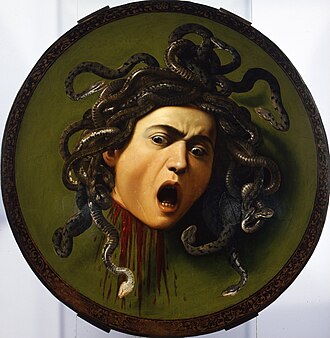 Testa di Medusa - Caravaggio (1597)
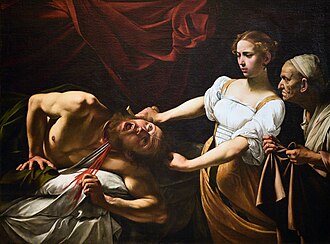 Giuditta che decapita Oloferne - Caravaggio (1598)
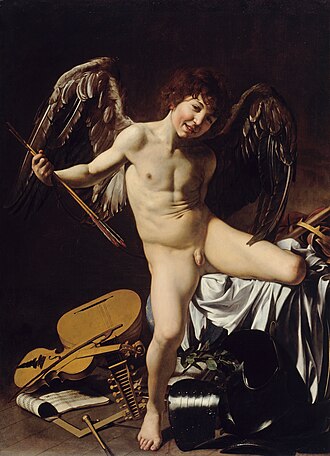 Amor Vincit Omnia - Caravaggio (1600s)
%2C%201595%20circa%2C%20534.jpg) Self-Portrait as Bacchus - Caravaggio (1595)
Self-Portrait as Bacchus - Caravaggio (1595).jpg) Death of the Virgin - Caravaggio (1600s)
Death of the Virgin - Caravaggio (1600s)
Dipinti di artisti collegati
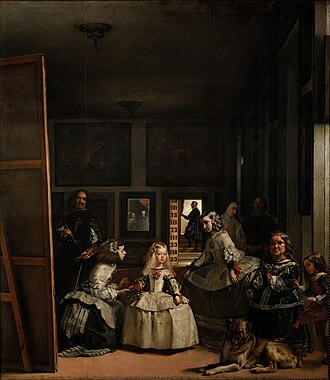 Las Meninas - Diego Velázquez (1656)
 The Surrender of Brea - Diego Velázquez (1635)
 The Night Watch - Rembrandt van Rijn (1642)
 Self-Portrait - Rembrandt van Rijn (1659)
 Girl with a Pearl Earring - Johannes Vermeer (1665)
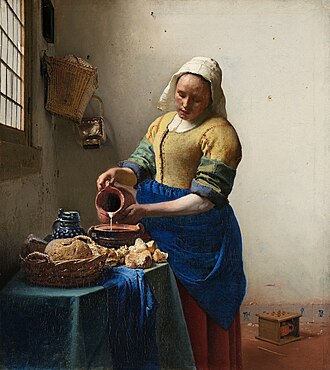 The Milkmaid - Johannes Vermeer (c. 1658)