Still Life with Bible
Vincent van Gogh · 1885
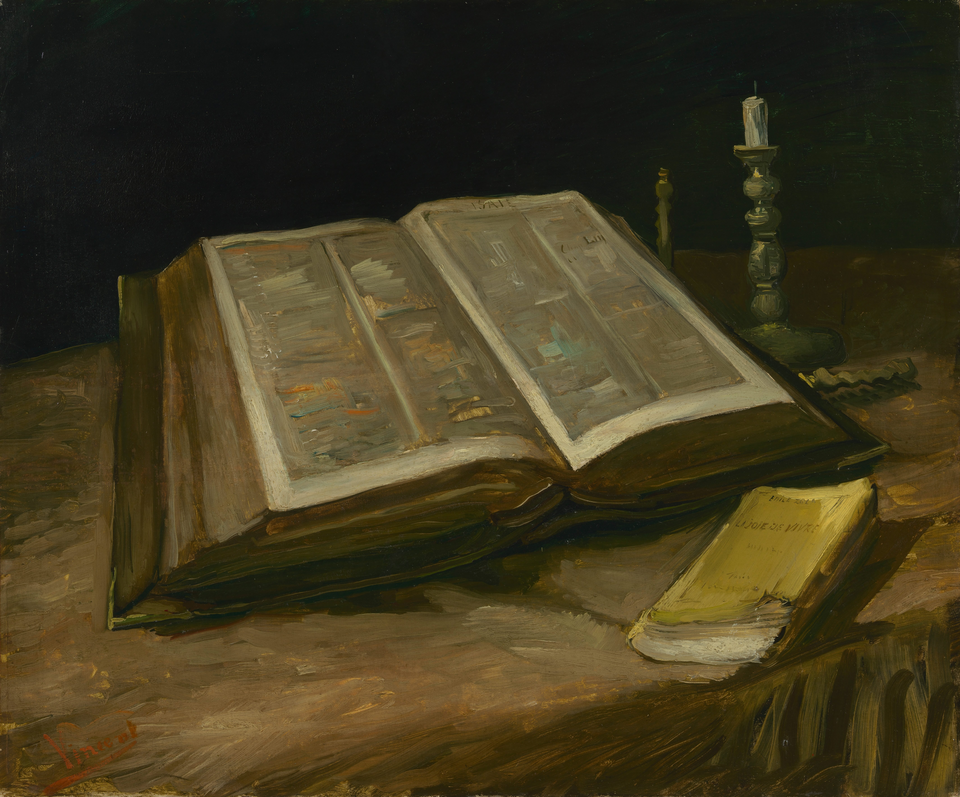
A great open Bible beside a small, worn novel by Zola, and a candle that has gone out. Months after his father's death, Van Gogh set two worlds side by side on one table.
The story behind the painting
Van Gogh painted this canvas in October 1885 in Nuenen, the Dutch village where he lived from December 1883 to November 1885. In March of that year his father, Theodorus van Gogh, a Protestant preacher, had died. The painting shows his father's Bible, and his death is usually seen as the reason for the work. One detail puzzles scholars: Vincent waited half a year before putting the memory of his father into a picture. It now belongs to the Van Gogh Museum in Amsterdam.
What to look for
Two books lie on a cloth-covered table. The Bible is large, well kept and majestic, open in the middle of the table at the Book of Isaiah. At the edge of the table lies a much smaller book, closed and battered: La Joie de vivre, The Joy of Living, by the French novelist Émile Zola. Next to the Bible stands a candle that has been put out. The whole picture is built on that contrast of size, condition and place between the two books.
Meaning and intent
Zola's novel was a realist masterpiece, while Vincent's father thought it badly written. So the painting sets a religious book of old ideas and timeless themes next to a book of modern, secular, realist ideas. The most common reading is about Vincent and his father's death, and the gap between their generations, a kind of memento mori. The extinguished candle may stand for the end of his father's life, or of his own hope. Another reading sees a psychological self-portrait contrasting his earlier self with the man he had become.
Legacy
The sources leave the meaning open. In one of his letters, number 425, Van Gogh made clear that he meant to sell the work, which suggests it may not have held deep sentimental value and supports the self-portrait reading over the mourning one. Either way, the painting shows him in Nuenen, at the end of his Dutch years, working with dark, solid forms and loaded objects. It is kept today in the Van Gogh Museum, where the two books still face each other across the table.
Lo sapevi?
- Painted in October 1885 in Nuenen.
- His father Theodorus died in March 1885.
- The Bible is open at Isaiah; Zola's La Joie de vivre lies beside it.
- In the Van Gogh Museum, Amsterdam.
L'artista
Vincent van Gogh (1853-1890)
table · still life · book · Van Gogh Museum · tablecloth
Altre opere di Vincent van Gogh
 The Starry Night - Vincent van Gogh (1889)
 Café Terrace at Night - Vincent van Gogh (1888)
 Sunflowers - Vincent van Gogh (1888)
 Almond Blossoms - Vincent van Gogh (1890)
 Wheatfield with Crows - Vincent van Gogh (1890)
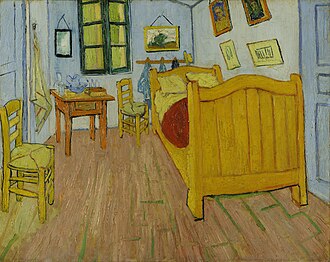 The Bedroom - Vincent van Gogh (1888)
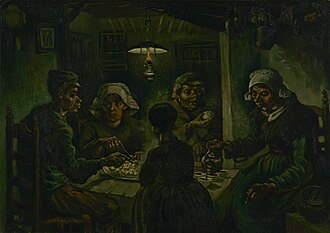 The Potato Eaters - Vincent van Gogh (1885)
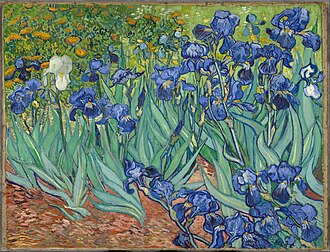 Irises - Vincent van Gogh (1889)
Dipinti di artisti collegati
 Les Grandes Baigneuses - Paul Cézanne (1900s)
 The Boy in the Red Vest - Paul Cézanne
 Where Do We Come From? What Are We? Where Are We Going? - Paul Gauguin (1897-1898)
 Cristo giallo - Paul Gauguin (1889)
 The Elevation of the Cross - Peter Paul Rubens (1609)
 The Rape of the Daughters of Leucippus - Peter Paul Rubens (1618)
 Walk on the mountain - Joaquín Sorolla (1909)
 Sad Inheritance - Joaquín Sorolla (1898)
 Dance at Le Moulin de la Galette - Pierre-Auguste Renoir (1876)
 Luncheon of the Boating Party - Pierre-Auguste Renoir (1881)
 At the Moulin Rouge - Henri de Toulouse-Lautrec (1892)
 La Toilette - Henri de Toulouse-Lautrec (1896)