Teschio di uno scheletro con sigaretta accesa
Vincent van Gogh · 1884
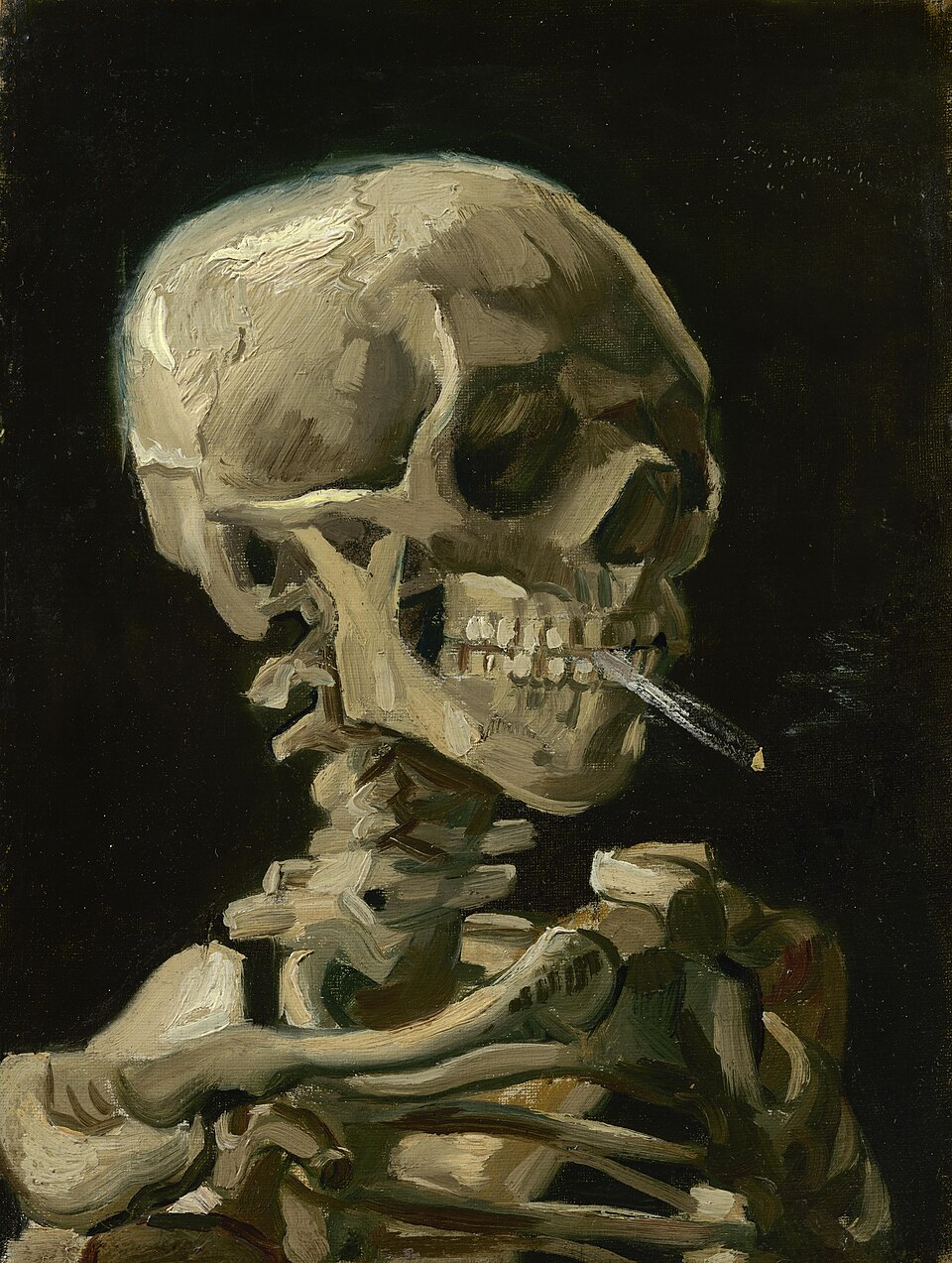
A grinning skull, a lit cigarette clamped between its teeth. Before he became the painter of sunflowers, a young Van Gogh made this small, darkly funny joke about death and art school.
The story behind the painting
In the winter of 1885 to 1886, Vincent van Gogh was in Antwerp, Belgium, attending classes at the Royal Academy of Fine Arts. The training followed a long academic routine: before it became common to work from living models, students studied skeletons to understand human anatomy. Van Gogh later said the classes were boring and taught him nothing. This small, undated oil on canvas is most likely his answer to all that drawing of bones. Instead of a dutiful anatomical study, he gave the skeleton a burning cigarette, turning a classroom exercise into a satirical comment on conservative academic practice. It is an early work, made years before the bright canvases of Arles, by an artist still finding his way and openly impatient with the rules.
What to look for
The canvas is modest, just 32 by 24.5 centimetres, and its subject is stripped down to essentials. A skull, part of a skeleton, sits before us, and between its teeth rests a lit cigarette. That single absurd detail transforms everything. Take a moment to notice how a study object, the kind of thing an academy student might draw for hours, becomes almost a character, as if caught mid-pose. The sources do not describe the palette in detail, but the subject itself sets a sombre tone that is broken by the comic gesture of smoking. Look for the tension between the seriousness of the anatomical model and the casual human habit it has been given. That clash is the heart of the picture's humour.
Meaning and intent
The painting is often read as a vanitas or memento mori, a reminder that life is brief and death certain, a tradition with deep roots in Dutch art. It was made at a time when Van Gogh himself was in poor health, which lends the joke a darker edge. Scholars have suggested possible influences from Hercules Seghers, a seventeenth-century Dutch artist, or from Félicien Rops, a Belgian contemporary of Van Gogh. Many people take it as a warning against smoking, but that reading is tricky: Van Gogh was a keen smoker himself and continued to smoke until his death in 1890. More likely it mocks the stiff academic method, while also playing, half-seriously, with mortality.
Legacy
The painting stayed in the family for decades. It was held by Vincent's brother Theo at the time of Theo's death in 1891, then passed to Theo's widow, Johanna van Gogh-Bonger, until her death in 1925, and on to their son, Vincent Willem van Gogh. In 1962 it was acquired by the Van Gogh Foundation. It was lent to the Stedelijk Museum from 1962 to 1973, and since 1973 it has been on permanent loan to the Van Gogh Museum in Amsterdam. It is rare within his work: apart from a drawing from the same period, the only other paintings in which he used skulls as a motif are two works from 1887 to 1888. Antwerp also produced his sketch Hanging Skeleton and Cat.
Lo sapevi?
- Van Gogh said his Antwerp Academy classes were boring and taught him nothing.
- Although it is often read as anti-smoking, Van Gogh smoked until his death in 1890.
- It has been on permanent loan to the Van Gogh Museum since 1973.
L'artista
Vincent van Gogh (1853-1890)
Altre opere di Vincent van Gogh
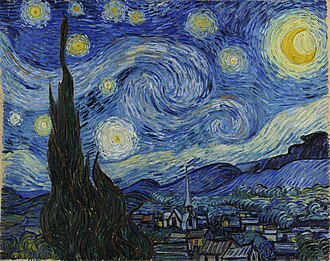 The Starry Night - Vincent van Gogh (1889)
.jpg) Café Terrace at Night - Vincent van Gogh (1888)
Café Terrace at Night - Vincent van Gogh (1888)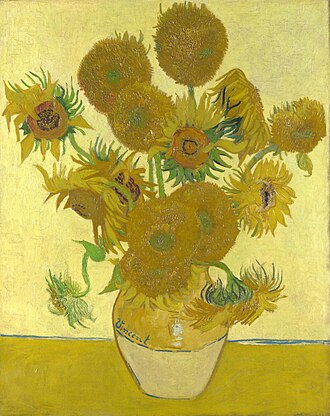 Sunflowers - Vincent van Gogh (1888)
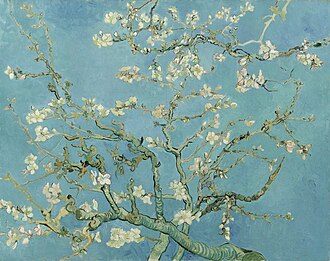 Almond Blossoms - Vincent van Gogh (1890)
 Wheatfield with Crows - Vincent van Gogh (1890)
 The Bedroom - Vincent van Gogh (1888)
 The Potato Eaters - Vincent van Gogh (1885)
 Irises - Vincent van Gogh (1889)
Dipinti di artisti collegati
 Where Do We Come From? What Are We? Where Are We Going? - Paul Gauguin (1897-1898)
%201889.jpg) Cristo giallo - Paul Gauguin (1889)
Cristo giallo - Paul Gauguin (1889) Luncheon on the Grass - Édouard Manet (1863)
 Olympia - Édouard Manet (1863)