Right and Left
Winslow Homer · 1909
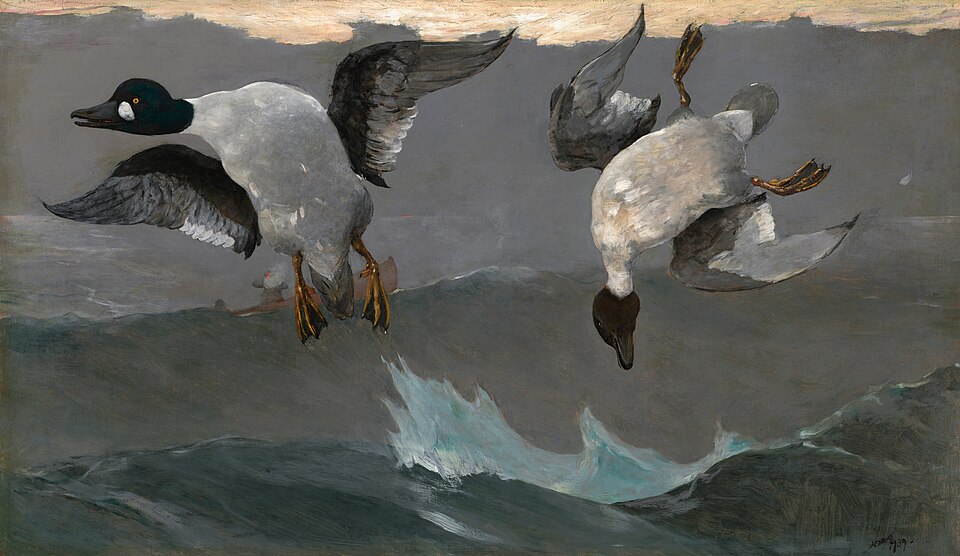
Two goldeneye ducks are hit by a shotgun blast just as they rise from the sea. Painted less than two years before Homer's death, it was his last great painting, and it freezes the very moment between life and death.
The story behind the painting
In May 1908 Homer had a mild stroke that briefly impaired his speech and muscle control. On 4 June he wrote to his brother Charles that he could paint as well as ever, and by July he had recovered except for tying his necktie the way he had for 20 years. On 8 December he wrote that he was painting, when the light allowed, a most surprising picture, probably this one. The accounts of its origin differ. William Howe Downes said Homer bought the ducks for Thanksgiving dinner and admired their plumage too much to eat them. Homer's nephew said a friend, Phineas W. Sprague, shot them and hung them on the studio door.
What to look for
The design is built on four horizontal bands of sea and sky, joined by the vertical and diagonal shapes of the ducks and the wave crests. The male at left struggles to rise; its partner, turned 90 degrees, already falls limp. Webbed feet, beaks and the bow of a boat repeat the jagged waves. Half hidden, the hunters sit in an uncertain place, and the line above them may be the horizon or a fog bank. On it sits the red sliver of the sun. At right, a stray feather serves as an exclamation point for the whole composition.
Meaning and intent
Unlike birds painted as dead still life, Right and Left shows the instant of death, as if frozen in a snapshot, with the viewer placed in the line of fire. Nicolai Cikovsky Jr. called it a staggeringly beautiful, almost oriental arrangement of abstract shapes against bands of cream and grey. For John Wilmerding it joined the momentary and the universal, mortality lit at the juncture of life and death, with an almost testamentary finality. It has also been suggested that, in 1908, when flight was a new and dangerous human adventure, Homer may have meant an oblique reference to it.
Legacy
Art historians note the painting's debt to Japanese art, comparing it with birds by Okyo Maruyama, Hiroshige and Hokusai, and it appeared in a major Japonisme exhibition in Paris in 1988. It also resembles Audubon's plate Golden-Eye Duck. Knoedler and Co. in New York had it by January 1909. According to Downes it was shown untitled and got its name from a hunter who shouted Right and left!, the term for downing two birds in quick succession with a double-barrelled gun. Its first owner, Randal Morgan, sent Homer questions about the waves, but the reply is unknown.
Lo sapevi?
- Painted in 1908-1909, after Homer's mild stroke.
- Homer's last great painting.
- Shows two common goldeneye ducks at the moment they are shot.
- The title is a hunting term for two birds downed in quick succession.
L'artista
Winslow Homer (1836-1910)
Galería Nacional de Arte · animal art · bird
Altre opere di Winslow Homer
 Breezing Up - Winslow Homer (1873)
 The Fog Warning - Winslow Homer (1885)
 The Gulf Stream - Winslow Homer (1899)
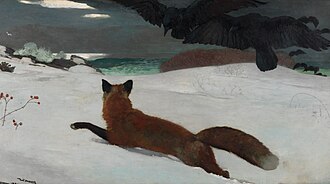 Fox Hunt - Winslow Homer (1893)
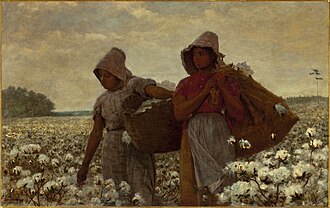 The Cotton Pickers - Winslow Homer (1876)
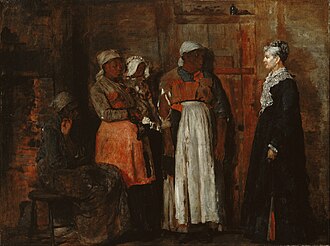 A Visit from the Old Mistress - Winslow Homer (1876)
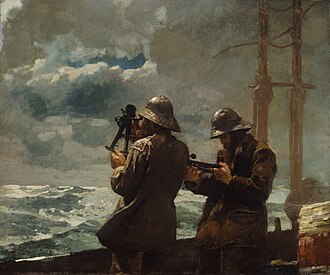 Eight Bells - Winslow Homer (1886)
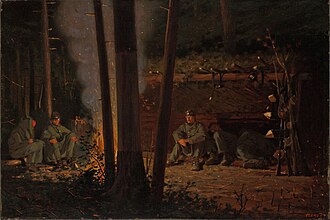 In Front of Yorktown - Winslow Homer (1860s)
Dipinti di artisti collegati
 L'Origine du monde - Gustave Courbet (1866)
 A Burial at Ornans - Gustave Courbet (2020)
 Luncheon on the Grass - Édouard Manet (1863)
 Olympia - Édouard Manet (1863)
 The Starry Night - Vincent van Gogh (1889)
 Café Terrace at Night - Vincent van Gogh (1888)