Fox Hunt
Winslow Homer · 1893
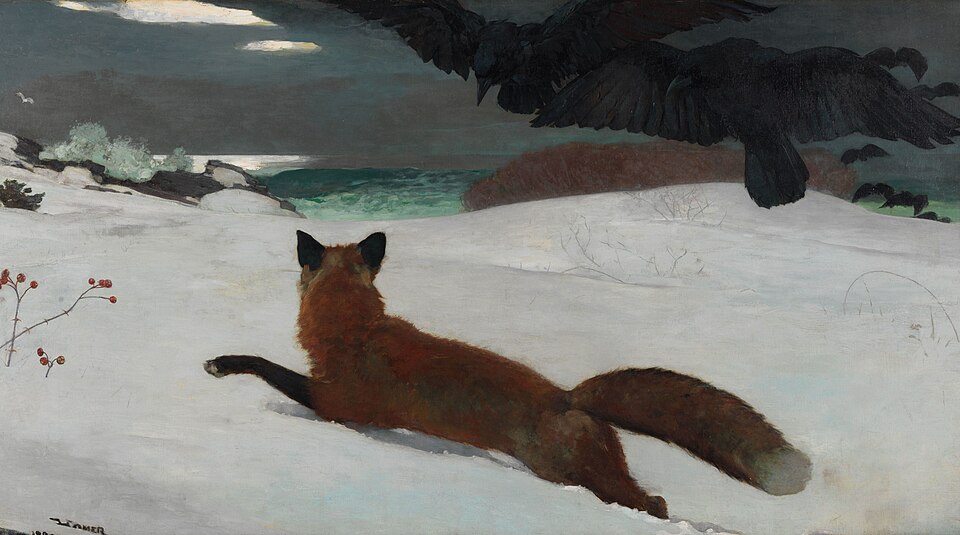
A red fox struggles through deep snow while hungry crows swoop down on it. In his largest single work, Homer turned the hunter into the hunted.
The story behind the painting
Homer painted The Fox Hunt in his studio at Prouts Neck, Maine, in the winter of 1893. According to his biographer Philip C. Beam, one hunter gave him a dead fox and another, Roswell Googins, several crows. Homer set the crows in the snow outside the studio and used string and sticks to pose the fox as if running; Nicolai Cikovsky Jr. writes that he draped a fox pelt over a barrel in the snow to record the colors. Late in the season the frozen crows thawed and went limp, and when the stationmaster Elbridge Oliver saw the picture he told Homer bluntly that those were not crows.
What to look for
The canvas is large, about 96.5 by 174 cm. A fox searching for food is itself hunted by crows driven to attack by hunger. Two huge birds swoop toward it and others hover in the distance. On the left a few sprigs of red berries break through the snow, and far off lie the coastline and the ocean under a deep blue sky. Homer's signature sinks into the snow exactly like the fox, and its R repeats the shape of the tail, called a brush. Critics have noted Japanese influence: the picture divides into three vertical panels, like a perfect Japanese screen.
Meaning and intent
Critics in 1893 at once saw its Darwinian side: a fox looking sharply at enemies made savage by a snowstorm that buried their usual hunting ground, with a twig of wild rose as the grace note that lightens the somber scene. It has been called Homer's greatest Darwinian painting, arguably his greatest of any kind. Some writers see self-disclosure in it. Thomas B. Hess, reading it in Freudian terms, thought the dapper, inquisitive, shrewd fox was a self-portrait, and Homer may have identified with the slyness and aloofness attributed to foxes. The crows have been read as omens of death.
Legacy
After painting the first crows out, Homer and Oliver spent three days at the station scattering corn to attract real crows, and Homer sketched them on telegraph blanks, then repainted the birds and called Oliver back for his approval. The Fox Hunt was shown in the annual exhibition of the Pennsylvania Academy of the Fine Arts, which bought it from the artist in 1894. It remains there today, Homer's largest single painting. Wikidata links it to French Realism and Naturalism, and the patient, almost scientific way it was made matches that label.
Lo sapevi?
- Painted at Prouts Neck, Maine, in winter 1893.
- Homer's largest single work, about 96.5 by 174 cm.
- Bought by the Pennsylvania Academy of the Fine Arts in 1894.
- The crows were repainted from sketches of live birds.
L'artista
Winslow Homer (1836-1910)
Altre opere di Winslow Homer
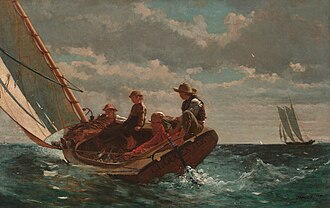 Breezing Up - Winslow Homer (1873)
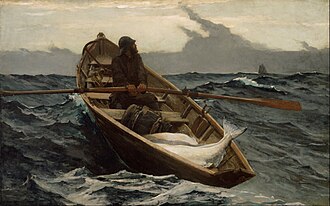 The Fog Warning - Winslow Homer (1885)
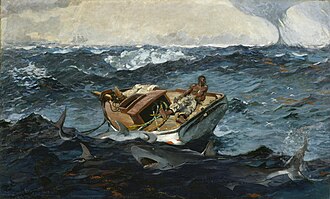 The Gulf Stream - Winslow Homer (1899)
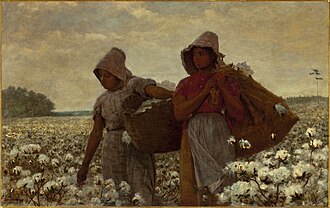 The Cotton Pickers - Winslow Homer (1876)
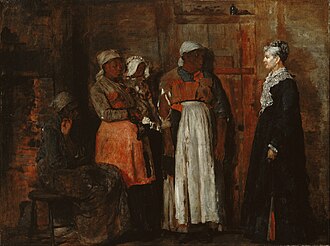 A Visit from the Old Mistress - Winslow Homer (1876)
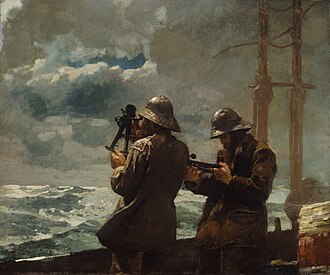 Eight Bells - Winslow Homer (1886)
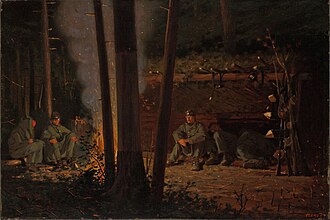 In Front of Yorktown - Winslow Homer (1860s)
 Right and Left - Winslow Homer (1909)
Dipinti di artisti collegati
 L'Origine du monde - Gustave Courbet (1866)
 A Burial at Ornans - Gustave Courbet (2020)
 Luncheon on the Grass - Édouard Manet (1863)
 Olympia - Édouard Manet (1863)
 The Starry Night - Vincent van Gogh (1889)
 Café Terrace at Night - Vincent van Gogh (1888)