Rest on the Flight into Egypt
Caravaggio · 1597
.jpg)
On a pause in a desperate journey, an angel plays the violin while Mary sleeps with her child. Caravaggio, the painter of dark rooms, gives us one of his rare landscapes.
The story behind the painting
The scene comes not from the Bible itself but from legends that grew around the Holy Family's flight into Egypt, when they were warned that Herod sought to kill the Christ Child. In these tales the family rested in a grove, and the child made trees bend and a spring gush so his parents could eat and drink. When Caravaggio painted it is disputed. His contemporary Giulio Mancini linked it to his stay with Monsignor Fantino Petrignani, probably in January 1594. But the work borrows directly from Annibale Carracci's The Choice of Hercules, finished early in 1596; the angel's pose follows Carracci's figure of Vice. Peter Robb and Helen Langdon suggest it was painted for Cardinal del Monte, while John Gash accepts Mancini. Wikidata gives 1597.
What to look for
The picture is divided by an angel seen from behind, playing the viol, the luminous center of the group. On the right Mary sleeps, her head bent over the infant Jesus. On the left the aged Joseph holds up a sheet of music for the angel. The music can be read: a motet by the Flemish composer Noel Bauldeweyn, setting words from the Song of Songs to the Madonna, Quam pulchra es, How beautiful you are. Behind them opens a landscape, rare for Caravaggio, treated in luminous tones that show his Lombard and Venetian heritage.
Meaning and intent
Like most images of the Flight into Egypt, this is a peaceful moment, one in which the scenery is to be enjoyed, more garden than wilderness. Caravaggio's unusual idea of an angel playing to the Holy Family turns the rest into a lullaby. The hymn is addressed to Mary, so the angel praises her as she sleeps, and the old man patiently serves the music. The sophisticated treatment suits the intellectual tastes of a patron like del Monte. The mother and child, delicate and real, stand among the finest of Caravaggio's many such groups.
Legacy
This was Caravaggio's first large-scale work, more ambitious and more successful than The Musicians of about 1595. One critic joked that all the sky in his 80-odd works would add up to a few square centimeters, which makes this open landscape precious. Scholars still try to identify his models: Mary seems to be the girl of the Penitent Magdalene, also in the Doria Pamphilj Gallery, and the angel has been compared with figures in Cardsharps, though these links remain tentative. The painting was apparently sold to the Pamphilj by the early 17th century and remains in their gallery in Rome.
Lo sapevi?
- Date disputed: Mancini suggests about 1594, others link it to Cardinal del Monte; Wikidata gives 1597
- The music is a motet by Noel Bauldeweyn, Quam pulchra es (Wikipedia)
- Caravaggio's first large-scale work, Galleria Doria Pamphilj (Wikipedia)
L'artista
Caravaggio (1571-1610)
woman · religious art · Mary · boy · Christ Child · angel · Saint Joseph
Altre opere di Caravaggio
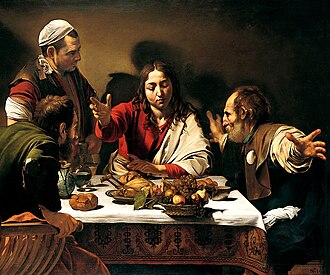 Supper at Emmaus - Caravaggio (1601)
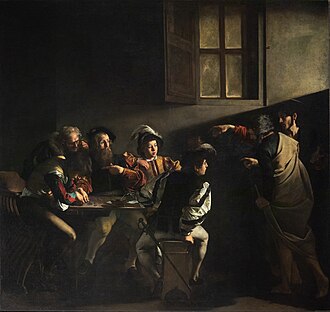 La vocazione di San Matteo - Caravaggio (1609)
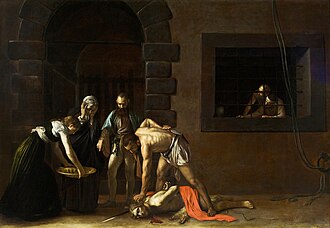 Decapitazione di San Giovanni Battista - Caravaggio (1608)
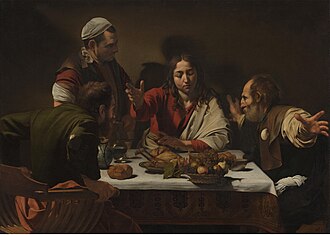 Supper at Emmaus - Caravaggio (1601)
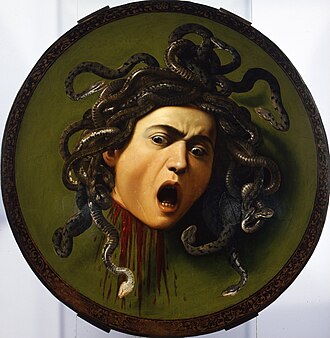 Testa di Medusa - Caravaggio (1597)
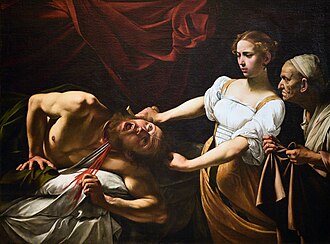 Giuditta che decapita Oloferne - Caravaggio (1598)
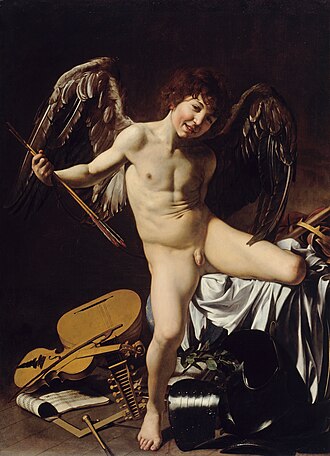 Amor Vincit Omnia - Caravaggio (1600s)
%2C%201595%20circa%2C%20534.jpg) Self-Portrait as Bacchus - Caravaggio (1595)
Self-Portrait as Bacchus - Caravaggio (1595)
Dipinti di artisti collegati
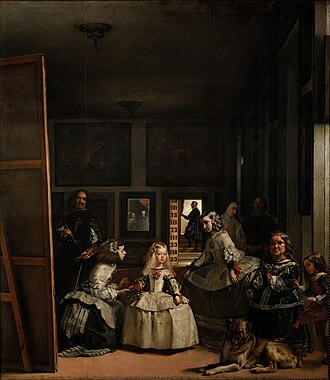 Las Meninas - Diego Velázquez (1656)
 The Surrender of Brea - Diego Velázquez (1635)
 The Night Watch - Rembrandt van Rijn (1642)
 Self-Portrait - Rembrandt van Rijn (1659)
 Girl with a Pearl Earring - Johannes Vermeer (1665)
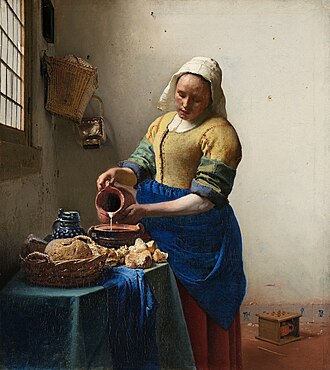 The Milkmaid - Johannes Vermeer (c. 1658)