Fiori di papavero
Vincent van Gogh · 1887
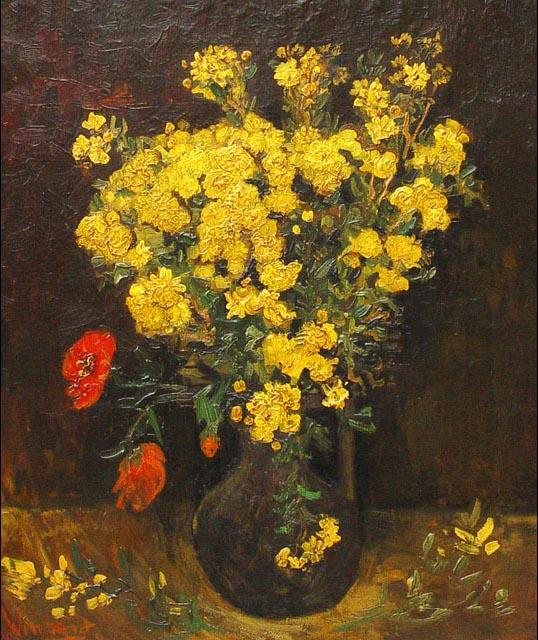
A small vase of poppies glowing out of the dark. It looks modest, yet this Van Gogh has vanished from its museum in Cairo not once, but twice.
The story behind the painting
Poppy Flowers, also known as Vase and Flowers and Vase with Viscaria, is believed to have been painted by Vincent van Gogh in 1887, three years before his death. At that time he was absorbing new influences, and this canvas reflects one of them in particular: his deep admiration for Adolphe Monticelli, an older painter whose work had struck him when he first saw it in Paris in 1886. Monticelli was known for richly worked flower pieces set against dark grounds, and Van Gogh's small still life follows that example. Beyond this, the sources say little about the circumstances of its making, so its story is told mostly through what it shows and through the extraordinary adventures it later endured.
What to look for
The canvas is small, about 65 by 54 centimetres, so it asks you to come close. A vase holds a bouquet of yellow and red poppies, and the whole arrangement stands out against a dark ground. That contrast is the key to the picture: the warm reds and yellows of the petals seem to glow because the background around them is so deep and sombre. This way of letting bright flowers emerge from darkness is exactly what connects the painting to Monticelli, whose work Van Gogh admired. Take a moment to let your eyes adjust, as if stepping from shadow into candlelight, and the blooms begin to stand forward from the dark space around them.
Meaning and intent
As a still life, Poppy Flowers is less about storytelling than about colour and mood. Its meaning lies largely in what it tells us about Van Gogh's development. Painted in 1887, it shows him learning from another artist, choosing Monticelli's moody, dark-ground approach to flowers rather than simply recording a bouquet. The poppies themselves, red and yellow, provide the painting's energy, flaring against the background. Sources do not record a specific symbolic programme for the work, so it is best enjoyed as Van Gogh likely intended: as a study in how intense colour can come alive when it meets darkness, a lesson that would shape his brighter, bolder work in the years ahead.
Legacy
Poppy Flowers belongs to the Mohamed Mahmoud Khalil Museum in Cairo, and it is famous above all for its disappearances. It was stolen on 4 June 1977 and recovered ten years later in Kuwait. In August 2010 it was stolen again from the same museum. Hours after the theft, Egyptian officials mistakenly believed they had recovered it when two Italian suspects tried to board a plane at Cairo International Airport. In October 2010, an Egyptian court found 11 culture ministry employees, including Deputy Culture Minister Mohsen Shaalan, guilty of negligence; after appeal, Shaalan served a one-year prison term ending in 2013. The businessman Naguib Sawiris offered a reward for information leading to its return. Its story is a reminder of how fragile our shared heritage can be.
Lo sapevi?
- It has been stolen from the same Cairo museum twice, in 1977 and 2010.
- After the first theft, it was recovered in Kuwait ten years later.
- It is also called Vase with Viscaria.
- It reflects Van Gogh's admiration for the painter Adolphe Monticelli.
L'artista
Vincent van Gogh (1853-1890)
floral painting · bouquet · vase
Altre opere di Vincent van Gogh
 The Starry Night - Vincent van Gogh (1889)
.jpg) Café Terrace at Night - Vincent van Gogh (1888)
Café Terrace at Night - Vincent van Gogh (1888)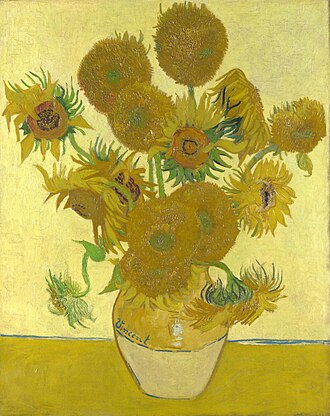 Sunflowers - Vincent van Gogh (1888)
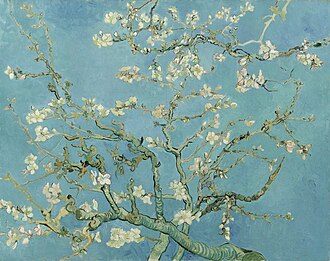 Almond Blossoms - Vincent van Gogh (1890)
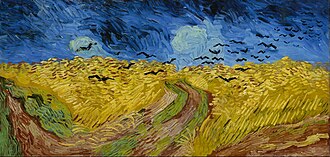 Wheatfield with Crows - Vincent van Gogh (1890)
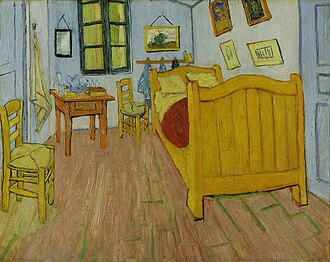 The Bedroom - Vincent van Gogh (1888)
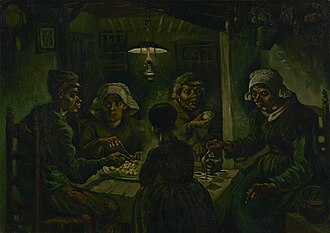 The Potato Eaters - Vincent van Gogh (1885)
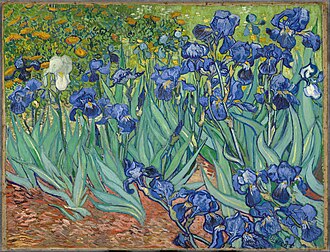 Irises - Vincent van Gogh (1889)
Dipinti di artisti collegati
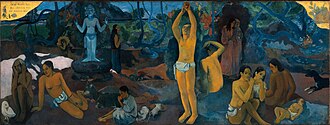 Where Do We Come From? What Are We? Where Are We Going? - Paul Gauguin (1897-1898)
%201889.jpg) Cristo giallo - Paul Gauguin (1889)
Cristo giallo - Paul Gauguin (1889) Luncheon on the Grass - Édouard Manet (1863)
 Olympia - Édouard Manet (1863)