Peach Trees in Blossom
Vincent van Gogh · 1889
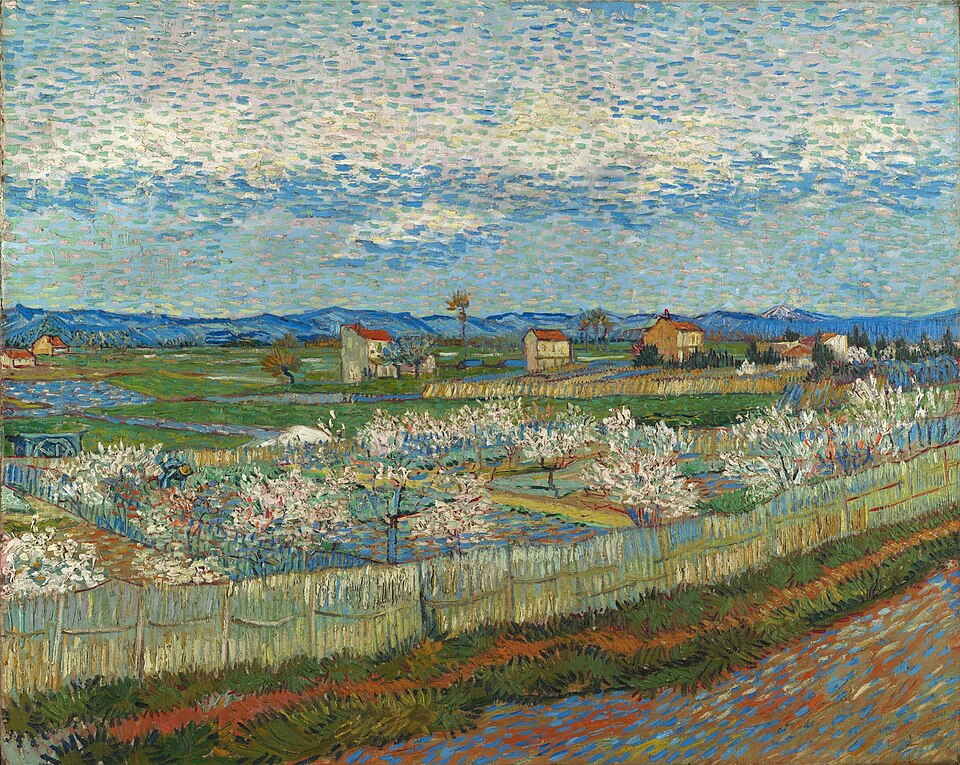
Pink peach blossom, green grass and a freshly washed sky near Arles. Van Gogh painted it in spring 1889, a few months after cutting his ear, while still a patient in hospital.
The story behind the painting
Van Gogh painted Peach Trees in Blossom in 1889, a few months after he had severed his ear, during a mentally unstable period when he was still a patient at the men's hospital in Arles. Even then he kept working. In April 1889 he wrote to his brother Theo about the painting, and on 10 April 1889 he included a sketch of it in a letter to the painter Paul Signac. Those letters let us follow the picture almost as it was being made, in the spring of a very hard year.
What to look for
The canvas, about 66 by 82 cm, shows a field with peach trees on the outskirts of Arles, with the Alpilles mountains in the background. Look at the blossoming trees against the open sky and the line of hills behind them. Years later the collector Samuel Courtauld described what he loved in it: the bright green grass and blossoming fruit trees, the newly washed sky, and water glistening everywhere. That memory came back to him on a drive through the Kent countryside, which he said reminded him of the painting.
Meaning and intent
Van Gogh intended the painting as a homage to the Japanese landscape prints that influenced him. Blossoming fruit trees were a favourite subject in those prints, and here he answers them with the orchards of Provence. Knowing that he painted it from a hospital, at one of the most fragile moments of his life, gives the fresh colours a special weight. The picture does not show suffering; it shows spring, and his steady wish to keep looking at the world with wonder.
Legacy
The Belgian artist Anna Boch bought the painting in 1891. In 1927 Samuel Courtauld acquired it and hung it in the Etruscan Room of his house in Portman Square, London. In 1935 he lent it to an exhibition in the Village Hall of Silver End in Essex, part of a project called Art for the People to widen public access to art. Today it hangs in the Great Room of the Courtauld. On 30 June 2022 two Just Stop Oil protesters glued themselves to its frame and damaged it; both were found guilty of criminal damage.
Lo sapevi?
- Painted in 1889 while Van Gogh was a patient in hospital in Arles.
- Shows peach trees near Arles with the Alpilles behind.
- A homage to Japanese landscape prints.
- Owned by Anna Boch, then Samuel Courtauld; now at the Courtauld.
L'artista
Vincent van Gogh (1853-1890)
landscape painting · Courtauld Gallery
Altre opere di Vincent van Gogh
 The Starry Night - Vincent van Gogh (1889)
 Café Terrace at Night - Vincent van Gogh (1888)
 Sunflowers - Vincent van Gogh (1888)
 Almond Blossoms - Vincent van Gogh (1890)
 Wheatfield with Crows - Vincent van Gogh (1890)
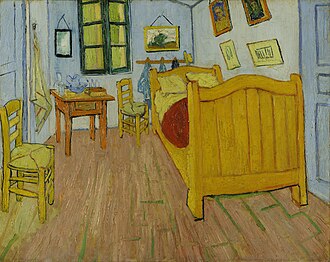 The Bedroom - Vincent van Gogh (1888)
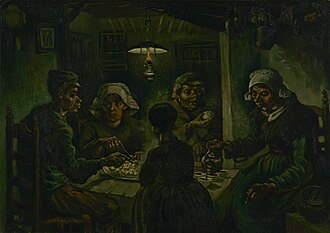 The Potato Eaters - Vincent van Gogh (1885)
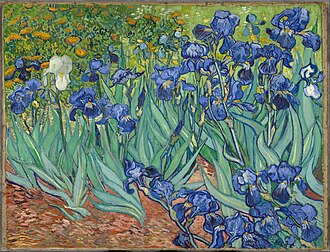 Irises - Vincent van Gogh (1889)
Dipinti di artisti collegati
 Les Grandes Baigneuses - Paul Cézanne (1900s)
 The Boy in the Red Vest - Paul Cézanne
 Where Do We Come From? What Are We? Where Are We Going? - Paul Gauguin (1897-1898)
 Cristo giallo - Paul Gauguin (1889)
 The Elevation of the Cross - Peter Paul Rubens (1609)
 The Rape of the Daughters of Leucippus - Peter Paul Rubens (1618)
 Walk on the mountain - Joaquín Sorolla (1909)
 Sad Inheritance - Joaquín Sorolla (1898)
 Dance at Le Moulin de la Galette - Pierre-Auguste Renoir (1876)
 Luncheon of the Boating Party - Pierre-Auguste Renoir (1881)
 At the Moulin Rouge - Henri de Toulouse-Lautrec (1892)
 La Toilette - Henri de Toulouse-Lautrec (1896)