Marriage A-la-Mode: 5. The Bagnio
William Hogarth · 1743
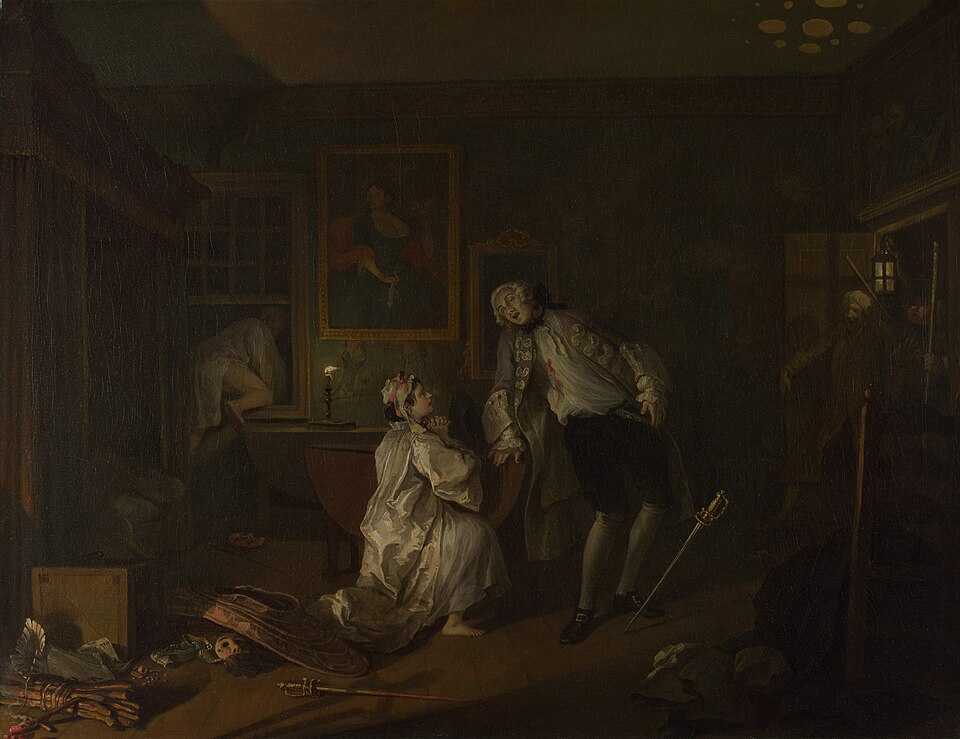
A door torn open, a sword on the floor, a husband dying in the firelight while his wife begs on her knees. In the fifth scene of Marriage A-la-Mode, Hogarth turns a fashionable marriage into a crime scene.
The story behind the painting
The Bagnio is the fifth of six satirical paintings that William Hogarth made for his series Marriage A-la-Mode, dated 1743 and now in the National Gallery in London. After a masquerade, the Countess and her lover, the lawyer Silvertongue, have taken a room at the Turk's Head Bagnio in Bow Street, Covent Garden, a real house kept by a Mrs Earl. A bill on the floor names it. By Hogarth's time a bagnio, once a coffee house with Turkish baths, meant a place where rooms could be taken for the night with no questions asked.
What to look for
Start at the door: the staple of the lock has been ripped out and lies on the floor beside the key, so the young Earl has burst in. The bed is unmade. Their masks and fancy dress lie scattered. Silvertongue's bloody sword lies in the foreground; the Earl has been run through twice. The lover fought with the fire behind him and its light in the Earl's eyes. Now he escapes through the window in his nightshirt, while the master of the house arrives at the right door with the Watch. Tiny drops of mercury, a treatment for syphilis, lie among the wreckage.
Meaning and intent
Hogarth fills the walls with comment. The Earl's head is framed by a mirror, echoing the first scene, where the young Viscount admired himself in a glass. A tapestry of the Judgment of Solomon shows a child about to be cut in two, pointing to the destruction awaiting everyone in the series. A painting of an idealised shepherdess carries the face of a well-known prostitute, with comic legs from the tapestry seeming to belong to her. Above the door is Saint Luke with his drawing board. The overturned table is a device Hogarth often used for discord.
Legacy
The Bagnio is the climax of the story: the Earl is fatally wounded and the murderer flees, setting up the sixth and final canvas, The Lady's Death. The canvas measures about 70.5 by 90.8 cm. Even in this moment of violence, Hogarth keeps his satire sharp; the source notes that he lets the fleeing Silvertongue be glimpsed undressed to show how ridiculous the Countess's plea for forgiveness is. Read together, the six scenes remain one of the most pointed tales of a marriage made for money and status.
Lo sapevi?
- Fifth of six paintings in Hogarth's Marriage A-la-Mode, dated 1743.
- Set in the Turk's Head Bagnio, Bow Street, Covent Garden.
- The Earl is fatally wounded by his wife's lover, Silvertongue.
- Held by the National Gallery, London.
L'artista
William Hogarth (1697-1764)
Altre opere di William Hogarth
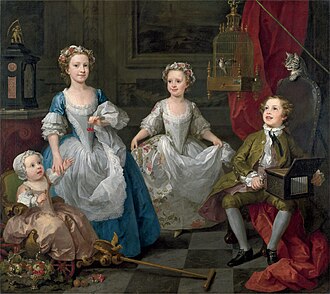 The Graham Children - William Hogarth (1742)
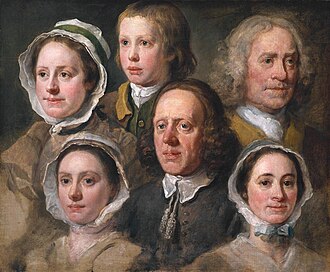 Hogarth's Servants - William Hogarth (1750s)
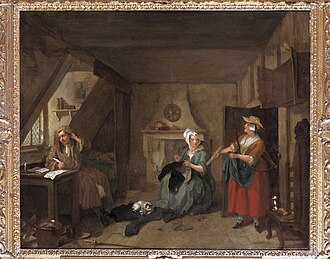 The Distrest Poet - William Hogarth (1730s)
 Marriage A-la-Mode: 2. The Tête à Tête - William Hogarth (1743)
 David Garrick as Richard III - William Hogarth (1745)
 The Orgy - William Hogarth (1735)
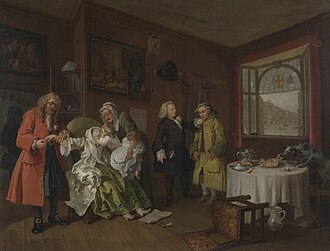 Marriage A-la-Mode: 6. The Lady's Death - William Hogarth (1743)
The Lady's Last Stake - William Hogarth (1759)