Raccolto a La Crau, con Montmajour sullo sfondo
Vincent van Gogh · 1888
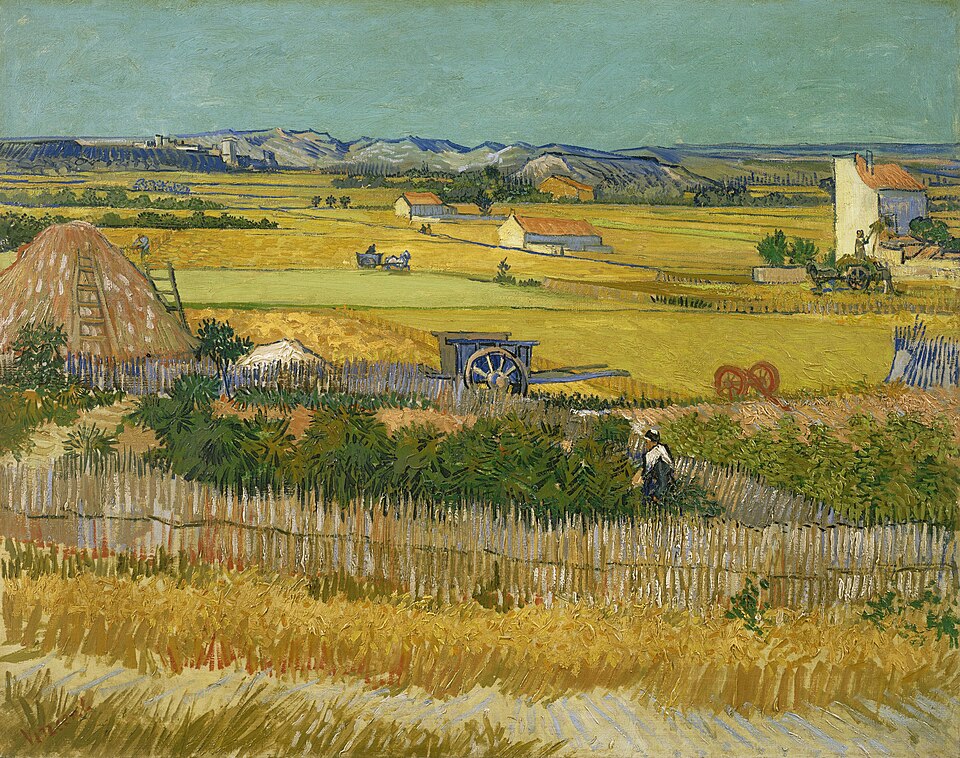
Van Gogh told his brother this canvas absolutely killed all the others. Look across the golden plain of La Crau at harvest time and you may understand why.
The story behind the painting
In February 1888 Vincent van Gogh left the Paris winter for Arles in Provence. Aged thirty-five, he entered an intensely productive period of about fifteen months, devoted to discovering the southern light, during which he made more than two hundred canvases. This painting dates from June 1888. Van Gogh set himself a difficult task: to express summer itself, which he felt, unlike spring, was not easy to convey. He prepared with two watercolours before painting the scene from a hilltop overlooking the fertile plain of La Crau, south-east of Arles, at the height of the harvest.
What to look for
This is a deep, panoramic landscape, and it rewards slow looking. The foreground and middle distance are crowded with the life of the harvest: fences and paths, orchards and Provençal farmhouses, sheaves and haystacks, ladders, horse-drawn carts, a reaper and a man with a pitchfork. The fields glow in warm straw yellows, golds and coppery orange that seem to hold the heat of a summer day. Then let your eye travel to the horizon, where the blue and violet of the Alpilles hills and the abbey of Montmajour set up a cool counterpoint to all that warmth.
Meaning and intent
Van Gogh wanted this picture to be summer, not merely a view in summer. The warm colours of the wheat stand for the intense Provençal sun and the almost tangible heat of the day, while the bluish distance gives that heat something to push against. At the same time, the painting is a portrait of work: peasants bringing in their crop across a vast, ordered landscape. Van Gogh himself considered it one of his masterpieces, a sign of how much this vision of fertile, sunlit labour meant to him during his hopeful months in Arles.
Legacy
Delighted with the result, Van Gogh hoped to show the painting at the Salon des Indépendants in Paris in 1889, and wrote to his brother Theo, an art dealer, that it absolutely killed all the others. It is now one of the treasures of the Van Gogh Museum in Amsterdam. The Arles period it belongs to was cut short by illness; after a year at the asylum of Saint-Paul in Saint-Rémy, Van Gogh died in 1890 at the age of thirty-seven. This sunlit plain remains one of the clearest expressions of the joy he found in the south.
Lo sapevi?
- It was painted in June 1888, during Van Gogh's stay in Arles.
- Van Gogh made two preparatory watercolours before the painting.
- He wrote to Theo that the canvas absolutely killed all the others.
- It hangs in the Van Gogh Museum, Amsterdam.
L'artista
Vincent van Gogh (1853-1890)
landscape painting · Van Gogh Museum
Altre opere di Vincent van Gogh
 The Starry Night - Vincent van Gogh (1889)
.jpg) Café Terrace at Night - Vincent van Gogh (1888)
Café Terrace at Night - Vincent van Gogh (1888)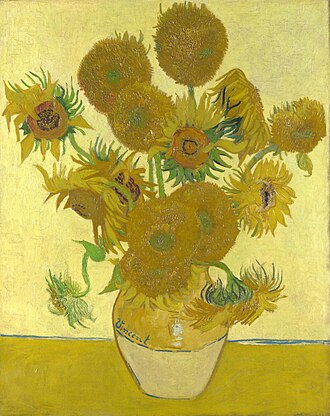 Sunflowers - Vincent van Gogh (1888)
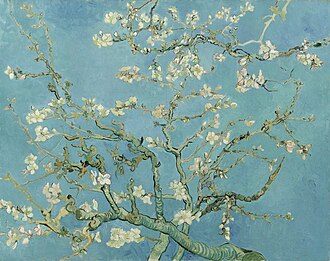 Almond Blossoms - Vincent van Gogh (1890)
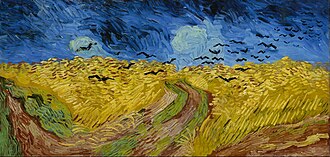 Wheatfield with Crows - Vincent van Gogh (1890)
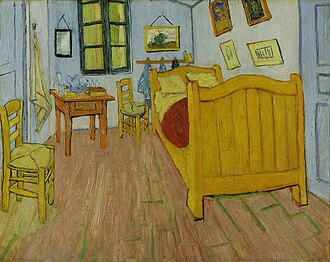 The Bedroom - Vincent van Gogh (1888)
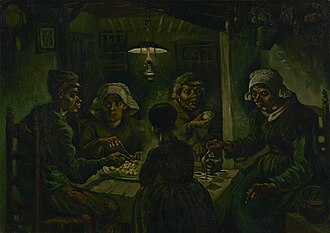 The Potato Eaters - Vincent van Gogh (1885)
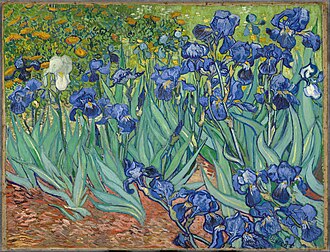 Irises - Vincent van Gogh (1889)
Dipinti di artisti collegati
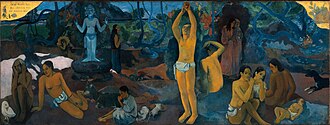 Where Do We Come From? What Are We? Where Are We Going? - Paul Gauguin (1897-1898)
%201889.jpg) Cristo giallo - Paul Gauguin (1889)
Cristo giallo - Paul Gauguin (1889)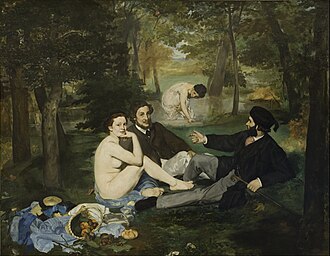 Luncheon on the Grass - Édouard Manet (1863)
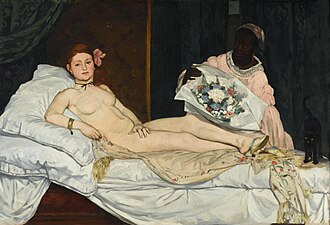 Olympia - Édouard Manet (1863)