Hark! The Lark
Winslow Homer · 1882
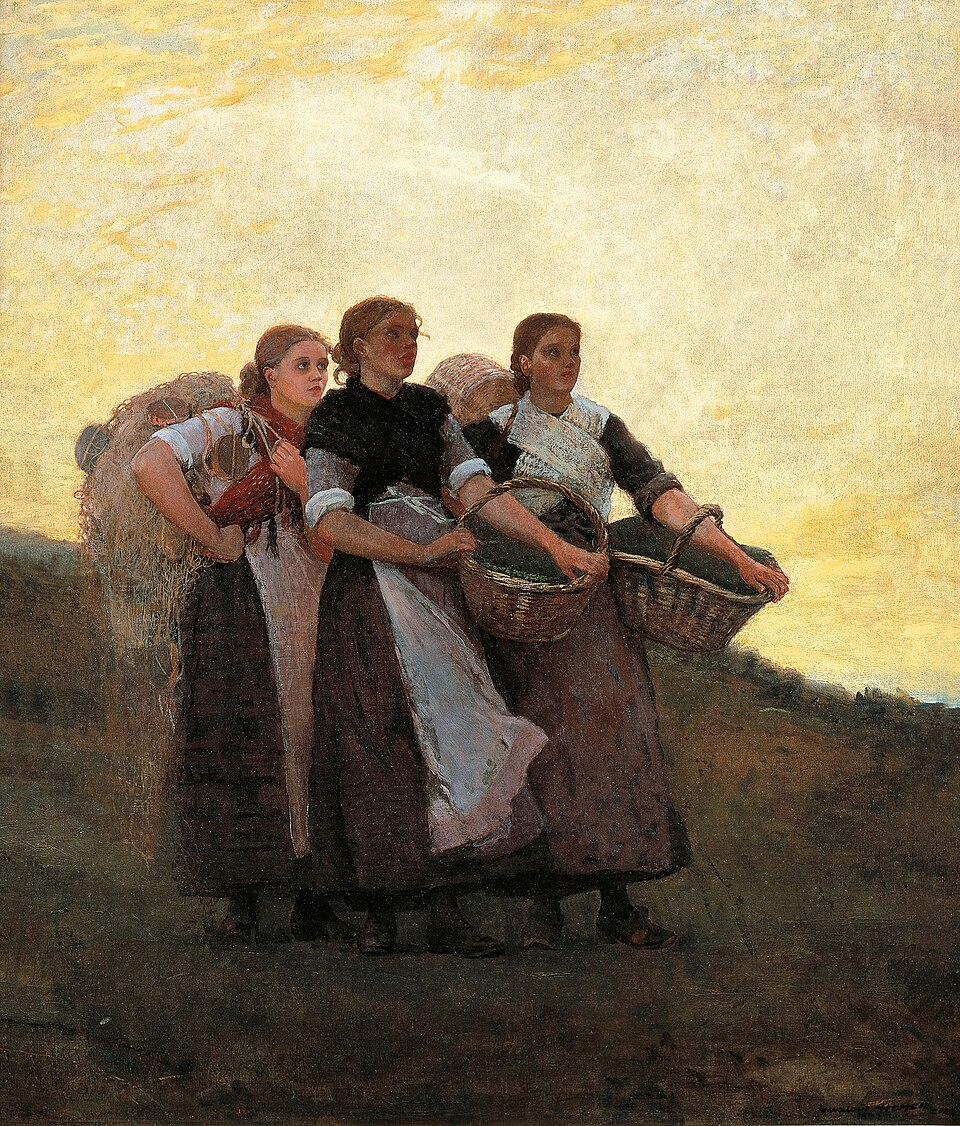
Three fisherwomen with heavy baskets lift their heads at the song of a lark. Winslow Homer painted them on the English coast in 1882 and called it the most important picture he ever painted.
The story behind the painting
In 1881 Winslow Homer travelled to England and settled for about eighteen months in Cullercoats, a fishing village on the North Sea near Newcastle upon Tyne. Before that he had made his name in the United States as an illustrator and painter of the Civil War, rural life, leisure and childhood. In Cullercoats his focus shifted to fishing communities and the physical demands of coastal life, and the stay marked an important turning point in his career. Hark! The Lark, painted in 1882, came out of that time, and Homer chose it for the Royal Academy's Summer Exhibition in London that year.
What to look for
Three young women stand in a hilly coastal landscape. They wear long dresses and aprons and carry the large baskets that belong to the work of a fishing village. Look at their heads: they turn or lift as if they had just heard the distant song of a lark, a small pause in a day of labour. The canvas is fairly large, about 92 by 80 cm, and the women fill it as solid, upright figures rather than small details in a view of the sea.
Meaning and intent
Scholars see the women's monumentality as part of Homer's wider treatment of working people and his growing interest in the sea. They have compared the composition to his earlier The Cotton Pickers of 1876, seeing a continuity in how he painted working women as strong, substantial presences rather than picturesque types, something that drew him during his English stay. The title is reportedly taken from Shakespeare's Cymbeline, which gives the scene a literary and particularly British echo. Homer himself later called it the most important picture he ever painted, and the very best one.
Legacy
The painting led Homer to a related watercolour in 1883, A Voice from the Cliffs, which he turned into an etching in 1888. After it was shown at the Union League Club of New York in 1890, the British-American businessman Frederick Layton acquired it for the Layton Art Gallery, Milwaukee's first public museum. It has stayed in Milwaukee ever since and is now part of the Milwaukee Art Museum, a lasting record of the English months that changed the direction of Homer's art toward the sea.
Lo sapevi?
- Painted in 1882 in Cullercoats, a fishing village in England.
- Shown at the Royal Academy Summer Exhibition of 1882.
- Homer called it his most important picture.
- In Milwaukee since Frederick Layton acquired it after 1890.
L'artista
Winslow Homer (1836-1910)
Altre opere di Winslow Homer
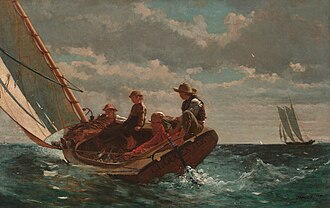 Breezing Up - Winslow Homer (1873)
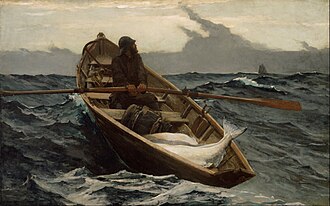 The Fog Warning - Winslow Homer (1885)
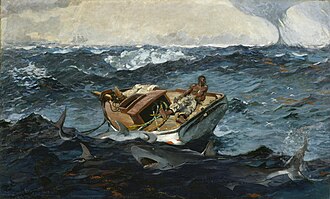 The Gulf Stream - Winslow Homer (1899)
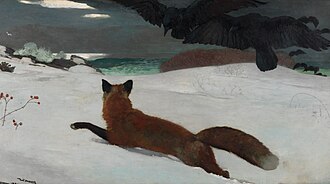 Fox Hunt - Winslow Homer (1893)
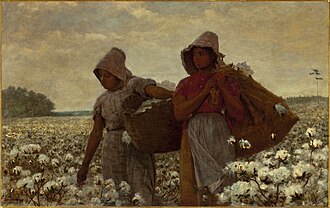 The Cotton Pickers - Winslow Homer (1876)
 A Visit from the Old Mistress - Winslow Homer (1876)
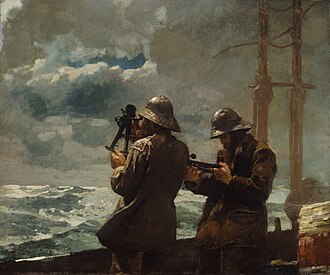 Eight Bells - Winslow Homer (1886)
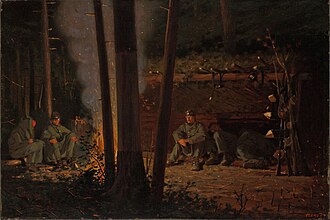 In Front of Yorktown - Winslow Homer (1860s)
Dipinti di artisti collegati
 L'Origine du monde - Gustave Courbet (1866)
 A Burial at Ornans - Gustave Courbet (2020)
 Luncheon on the Grass - Édouard Manet (1863)
 Olympia - Édouard Manet (1863)
 The Starry Night - Vincent van Gogh (1889)
 Café Terrace at Night - Vincent van Gogh (1888)