Esquisse pour le paradis
Paolo Veronese · 1577
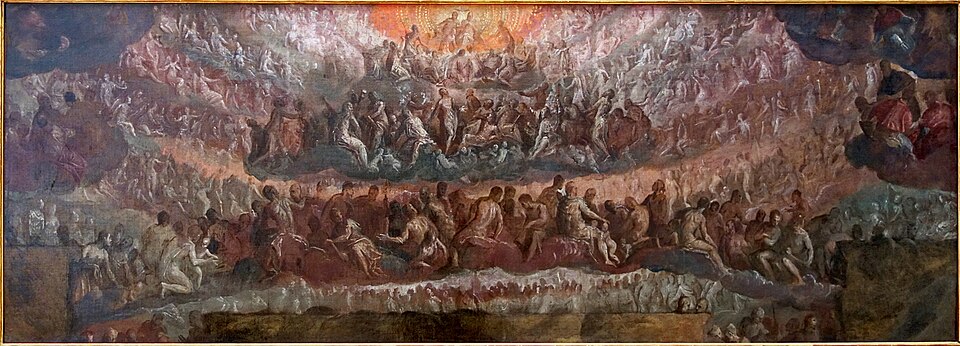
A whole heaven in one long oil sketch: crowds of saints rise in rings toward a glow of orange light where the Virgin is about to be crowned. It was Veronese's plan for one of the largest commissions in Venice, a plan he never carried out.
The story behind the painting
In 1577 a fire destroyed the hall of the Great Council in the Doge's Palace in Venice. The hall was to be rebuilt, and between 1578 and 1582 a competition chose who would recreate the huge vision of Paradise that had decorated it, following a program drawn up by two Venetian patricians, Jacopo Marcello and Jacopo Contarini, and the Camaldolese monk Gerolamo Bardi. Veronese, Tintoretto, Francesco Bassano and Palma the Younger took part. The prize went jointly to Veronese and Bassano, Veronese to paint the central group and Bassano the figures on either side. Wikipedia dates this sketch 1578, while Wikidata gives 1577.
What to look for
The canvas is wide, about 87 by 234 cm, and plans the entire composition, including the parts assigned to Bassano. It is built as a pyramid of concentric half circles resting on an inverted half circle in the foreground. Crowds of figures, nude or wrapped in simple drapery, all turn their eyes to the top, where an orange halo of light marks the divine presence. There sits the Trinity: God the Father on the right, Christ on the left and the Holy Spirit at the center. Together God and Christ hold a crown above the Virgin Mary, seen in profile and kneeling before them.
Meaning and intent
The range of colors is narrow, dominated by mauves and pinks alternating with the yellow and orange glints of the light. Color and light work as one here, creating backlit effects on some groups in the foreground that help the eye climb step by step toward the summit. Several groups of figures, painted in more detail than the rest, are placed symmetrically at the top left and right. The sketch is probably Veronese's first proposal for the competition, a way to show the judges how a whole heaven could be ordered around a single point of light.
Legacy
The plan was never carried out, most likely because of Veronese's death. A second competition was launched in 1588 and won by Tintoretto, who painted with his son Domenico the Paradise still in place in the Doge's Palace today. In 1879 the sketch was given to the museum in Lille by the Cottini sisters, who divided their father Jean Cottini's collection of Italian art of the 16th and 17th centuries among public bodies and museums. It entered the Palais des Beaux-Arts as a Tintoretto, until Detlev von Hadeln attributed it to Veronese in 1919, an attribution critics have accepted unanimously.
Lo sapevi?
- Made for the competition to replace the Paradise in the Doge's Palace after the fire of 1577.
- Dated 1578 by Wikipedia and 1577 by Wikidata.
- Given to the Lille museum in 1879 as a Tintoretto.
- Attributed to Veronese by Detlev von Hadeln in 1919.
L'artista
Paolo Veronese (1528-1588)
religious art · Mannerism · crowd · Palais des Beaux-Arts de Lille · saint
Altre opere di Paolo Veronese
 The Wedding at Cana - Paolo Veronese (1560s)
 The Feast in the House of Levi - Paolo Veronese (1573)
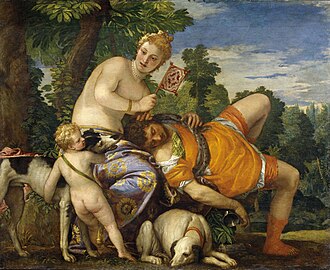 Venus and Adonis - Paolo Veronese (1580)
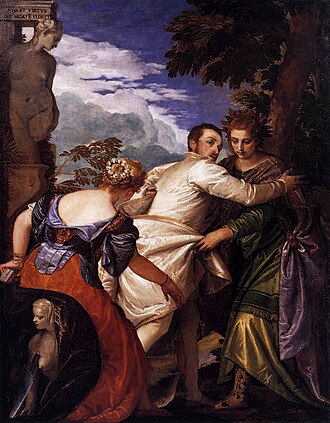 Allegory of Virtue and Vice - Paolo Veronese (1565)
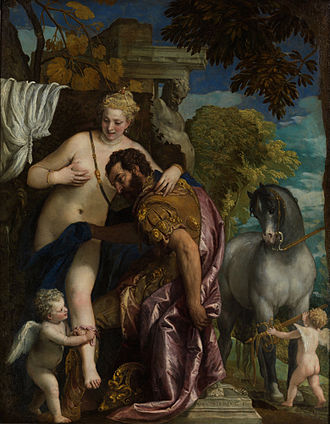 Venus and Mars - Paolo Veronese (1570s)
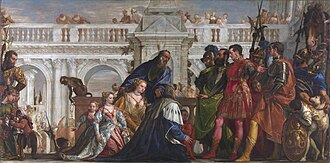 The Family of Darius Before Alexander - Paolo Veronese (1565)
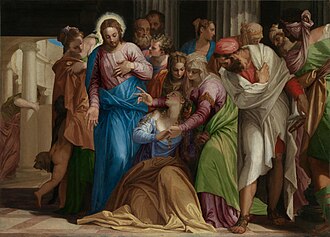 The Conversion of Mary Magdalene - Paolo Veronese (1548)
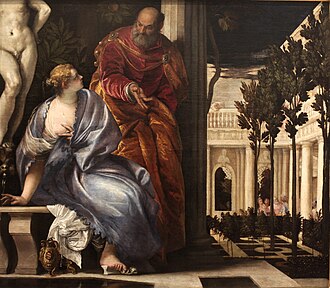 Bathsheba at Her Bath - Paolo Veronese (1575)
Dipinti di artisti collegati
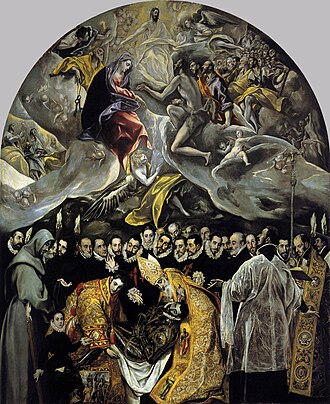 The Burial of the Count of Orgaz - El Greco (1586)
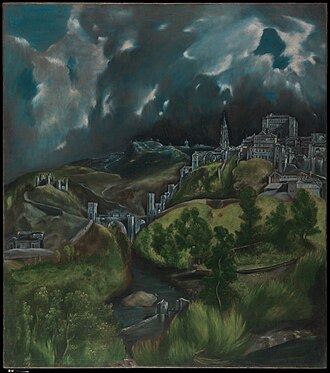 View of Toledo - El Greco (1596)
 Last Supper - Jacopo Tintoretto (1563)
 Miracle of the Slave - Jacopo Tintoretto (1540s)
 Venus of Urbino - Titian (1538)
 Assumption of the Virgin - Titian (1510s)
 Supper at Emmaus - Caravaggio (1601)
 La vocazione di San Matteo - Caravaggio (1609)
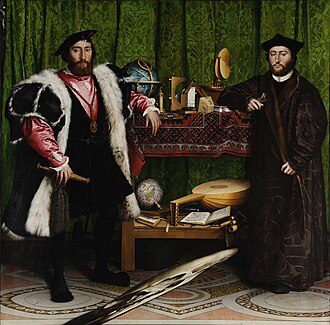 The Ambassadors - Hans Holbein the Younger (1533)
 The Body of the Dead Christ in the Tomb - Hans Holbein the Younger (1520s)