Venus and Mars
Paolo Veronese · 1570s
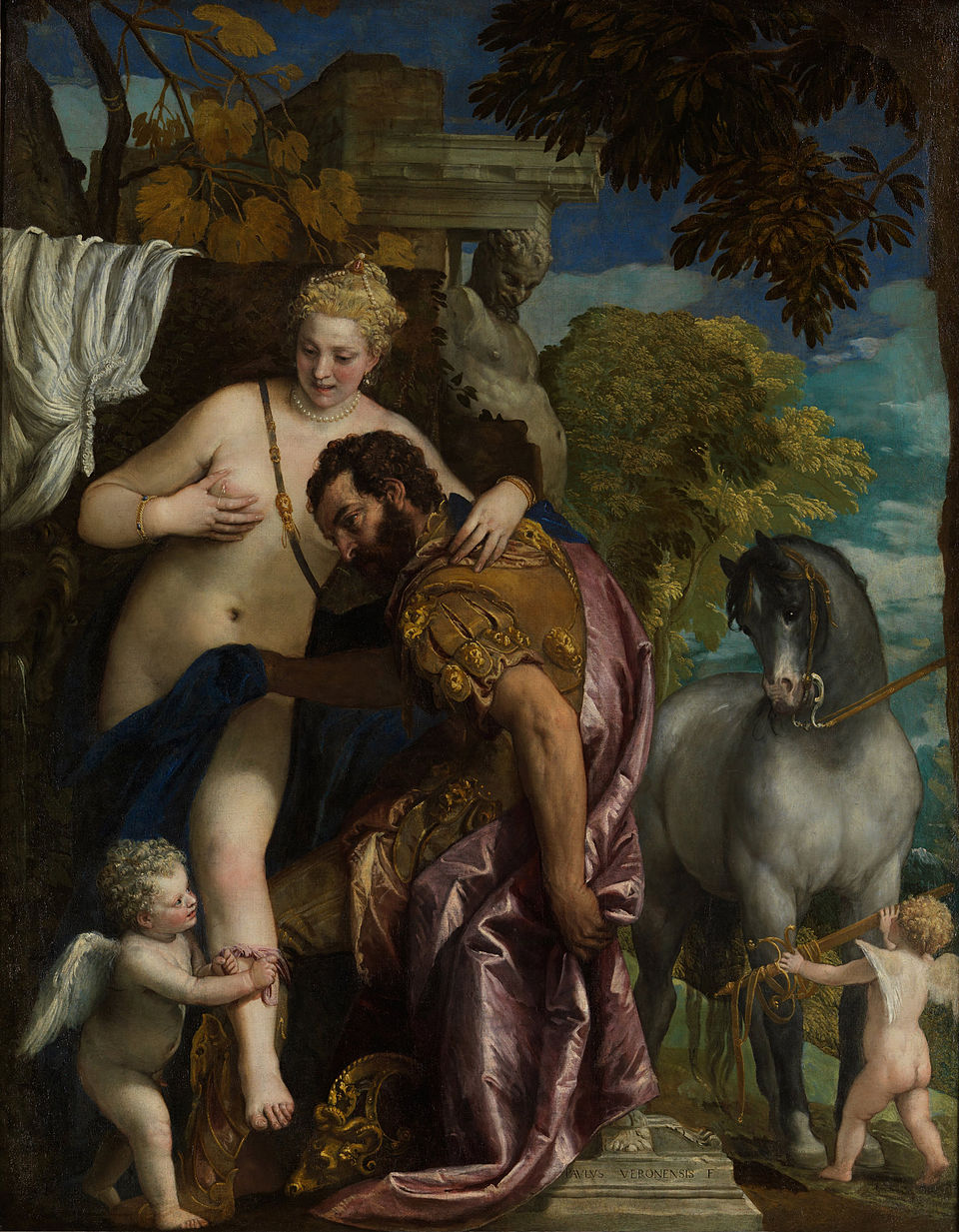
The god of war sits in his armour, disarmed by love, while a small putto ties a ribbon around the legs of Venus. Veronese painted this vision of peace for an emperor, and X-rays show he kept changing it.
The story behind the painting
Paolo Veronese painted Venus and Mars in the 1570s. According to the Wikipedia article, it was commissioned by Rudolf II, Holy Roman Emperor, as one of three mythological, love-themed works; the other two, named in the article as The Allegory of Virtue and Performance and Allegory of the Source of Wisdom and Power, are in the Frick Collection in New York. The painting deals with the love of Venus, Roman goddess of love, and Mars, god of war, as told in Ovid's Metamorphoses.
What to look for
The tall canvas, about 206 by 161 cm, sets the meeting of the lovers in idyllic, peaceful scenery. On the left stands the naked goddess, her left hand embracing Mars, who sits in front of her in armour. Her right hand rests on her breast, from which milk flows. On the right stands the war horse of Mars; its silhouette is based on ancient sculpture, its strong muscles softened by its bowed head and calm eyes. Look for the two putti: one tames the horse, the other ties a ribbon around Venus's legs. Veronese signed on a stone disc: PAVLUS VERONENSIS F.
Meaning and intent
The two putti are the key to the meaning. The one taming the horse stands for the god of war mastering his desires, control over passion. The one binding Venus with a ribbon stands for the union of the lovers in lasting love and harmony, in a time without war. The milk from the breast of Venus symbolises the wealth of peace, food for humanity. X-ray study described by Alan Burroughs showed that Venus's body was first arranged differently, probably covered by drapery, and that the innocent cherub was not in the original version. Why Veronese made these changes is not clear.
Legacy
A 1621 inventory records the painting in Rudolf II's collection at Prague Castle. It then passed to Ferdinand III of Habsburg, and after the Swedes invaded Prague in 1648 it entered the collection of Queen Christina of Sweden, who took it with her into exile in Rome. It went to the Odescalchi family and later to the famous Orléans Collection in Paris. In 1792 it moved to the Walckiers collection in Brussels, returned to Paris in 1798, then went to London. After several English owners, it was sold in 1910 to the Metropolitan Museum of Art in New York.
Lo sapevi?
- Painted by Paolo Veronese in the 1570s for Rudolf II.
- Signed on a stone disc: PAVLUS VERONENSIS F.
- X-rays show Veronese changed the figure of Venus.
- In the Metropolitan Museum of Art since 1910.
L'artista
Paolo Veronese (1528-1588)
woman · mythological painting · Metropolitan Museum of Art · nudity · Venetian school · standing · Venus · navel · clothed male, naked female · Aphrodite
Altre opere di Paolo Veronese
 The Wedding at Cana - Paolo Veronese (1560s)
.jpg) The Feast in the House of Levi - Paolo Veronese (1573)
The Feast in the House of Levi - Paolo Veronese (1573).jpg) Venus and Adonis - Paolo Veronese (1580)
Venus and Adonis - Paolo Veronese (1580) Allegory of Virtue and Vice - Paolo Veronese (1565)
 The Family of Darius Before Alexander - Paolo Veronese (1565)
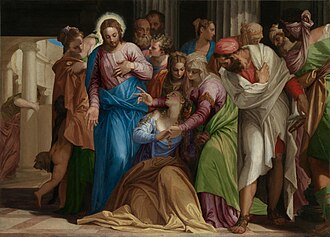 The Conversion of Mary Magdalene - Paolo Veronese (1548)
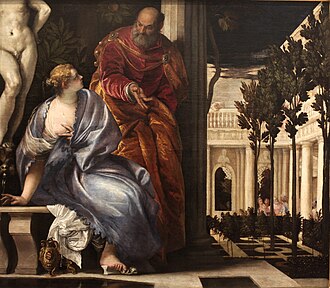 Bathsheba at Her Bath - Paolo Veronese (1575)
%20grande.jpg) Christ Among the Doctors - Paolo Veronese (1560)
Christ Among the Doctors - Paolo Veronese (1560)
Dipinti di artisti collegati
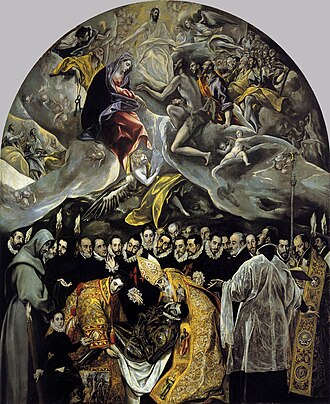 The Burial of the Count of Orgaz - El Greco (1586)
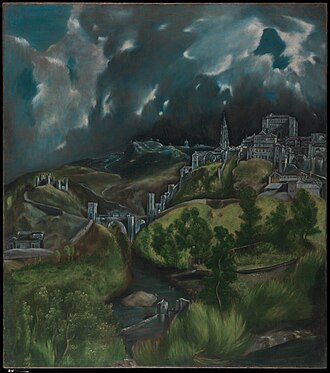 View of Toledo - El Greco (1596)
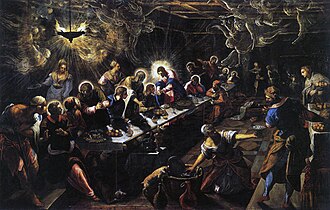 Last Supper - Jacopo Tintoretto (1563)
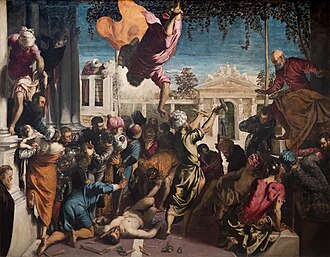 Miracle of the Slave - Jacopo Tintoretto (1540s)
.jpg) Venus of Urbino - Titian (1538)
Venus of Urbino - Titian (1538)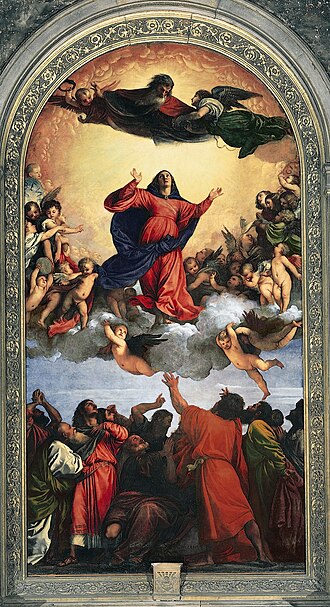 Assumption of the Virgin - Titian (1510s)
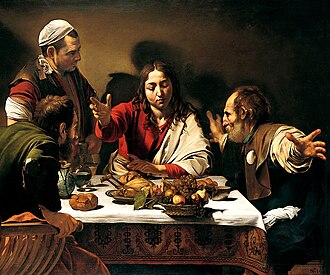 Supper at Emmaus - Caravaggio (1601)
 La vocazione di San Matteo - Caravaggio (1609)
 The Ambassadors - Hans Holbein the Younger (1533)
 The Body of the Dead Christ in the Tomb - Hans Holbein the Younger (1520s)