David and Goliath
Caravaggio · 1600
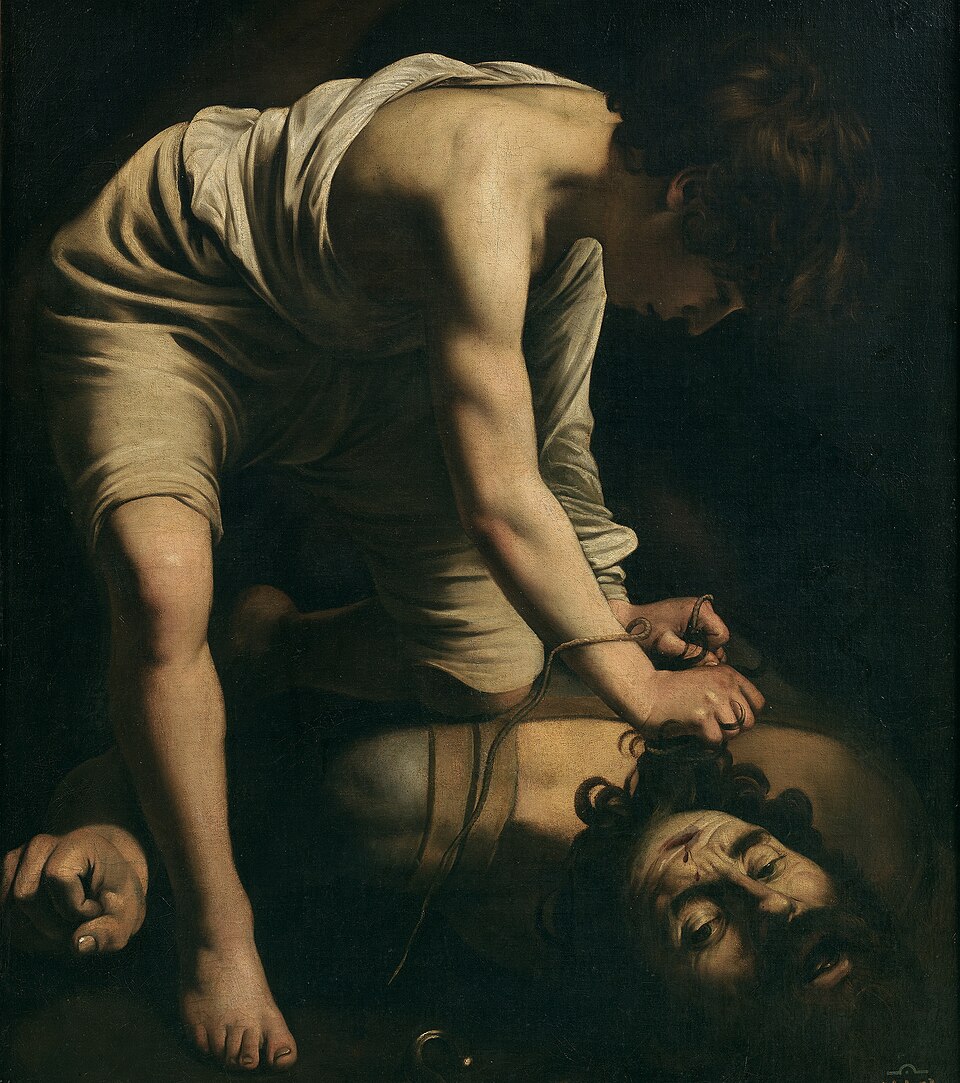
No armies, no triumph: only a boy kneeling on a giant's body in the dark, quietly tying up the severed head by the hair. Caravaggio painted this David around 1600, and it is now in the Prado.
The story behind the painting
Caravaggio made this painting early in his career, around 1600, while he lived in the household of Cardinal Francesco Maria del Monte in Rome. It shows the biblical David as a young boy, as in the Bible story, after he has felled the Philistine champion Goliath. Later Caravaggio returned to the theme twice, in the David with the Head of Goliath now in Vienna and another in the Galleria Borghese in Rome.
What to look for
Light falls on David's leg, arm and flank, on the massive shoulders from which Goliath's head has been cut, and on the head itself; everything else is dark. Even David's face is almost lost in shadow. A wound on Goliath's forehead shows where the stone from the sling struck. The boy kneels almost casually on the man's torso, hands in his enemy's hair, intent on his work. The canvas is about 110 by 91 cm.
Meaning and intent
Caravaggio first painted Goliath's face in wild-eyed, open-mouthed terror, tongue rolling and eyes turned to the edges of their sockets. In the finished picture that melodrama is gone, and the drama passes to the quietly efficient David. The overwhelming impression is of something intensely personal and private, a victory without any celebration. Caravaggio chose silence over spectacle, and the quiet makes the moment more unsettling, not less. What remains is a boy, a body and the dark around them.
Legacy
This painting and two others made at about the same time, the first Sacrifice of Isaac and the first John the Baptist, were taken to Spain soon after they were painted. There they were often copied and made a deep impression on Spanish art. The work is known by several titles, including David with the Head of Goliath and David Victorious over Goliath. Its quiet, dark drama thus travelled far beyond Rome soon after it was made.
Lo sapevi?
- Painted around 1600, while Caravaggio lived with Cardinal del Monte.
- Goliath's terrified face was painted over with a calmer one.
- Taken to Spain early and widely copied there.
- Kept in the Museo del Prado, Madrid.
L'artista
Caravaggio (1571-1610)
religious art · man · Museo del Prado · Baroque · corpse · David · beheaded head · head
Altre opere di Caravaggio
 Supper at Emmaus - Caravaggio (1601)
 La vocazione di San Matteo - Caravaggio (1609)
 Decapitazione di San Giovanni Battista - Caravaggio (1608)
 Supper at Emmaus - Caravaggio (1601)
 Testa di Medusa - Caravaggio (1597)
 Giuditta che decapita Oloferne - Caravaggio (1598)
 Amor Vincit Omnia - Caravaggio (1600s)
%2C%201595%20circa%2C%20534.jpg) Self-Portrait as Bacchus - Caravaggio (1595)
Self-Portrait as Bacchus - Caravaggio (1595)
Dipinti di artisti collegati
 Las Meninas - Diego Velázquez (1656)
 The Surrender of Brea - Diego Velázquez (1635)
.jpg) The Elevation of the Cross - Peter Paul Rubens (1609)
The Elevation of the Cross - Peter Paul Rubens (1609) The Rape of the Daughters of Leucippus - Peter Paul Rubens (1618)
%20-%20Google%20Art%20Project.jpg) Charles I in Three Positions - Anthony van Dyck (1635)
Charles I in Three Positions - Anthony van Dyck (1635)%20with%20M.%20de%20St%20Antoine%20-%20Google%20Art%20Project.jpg) Charles I (1600-1649) with M. de St Antoine - Anthony van Dyck (1636)
Charles I (1600-1649) with M. de St Antoine - Anthony van Dyck (1636) The Night Watch - Rembrandt van Rijn (1642)
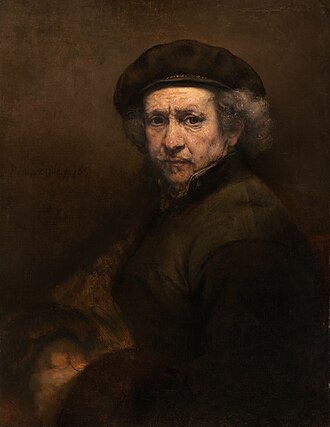 Self-Portrait - Rembrandt van Rijn (1659)
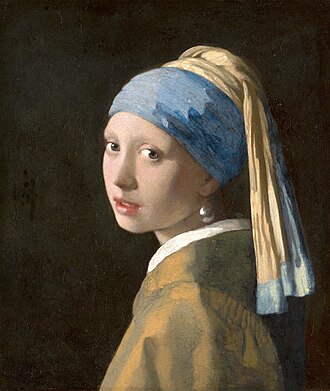 Girl with a Pearl Earring - Johannes Vermeer (1665)
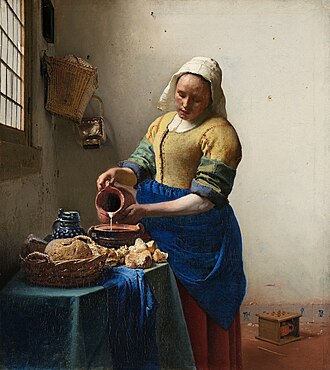 The Milkmaid - Johannes Vermeer (c. 1658)