Adoration of the Shepherds
Caravaggio · 1609
.jpg)
No golden light, no angels: just a tired young mother seated on the ground of a barn, her baby in her arms, and three shepherds leaning in with clasped hands. Caravaggio painted it in Messina a year before his death.
The story behind the painting
Caravaggio painted The Adoration of the Shepherds in Messina in 1609 for the Capuchin Franciscans and their Church of Santa Maria degli Angeli, a year before he died in 1610. By then he had lived a turbulent life, fleeing Milan after a tavern brawl, being arrested for violence, and finding a protector in Cardinal Francesco Maria del Monte in Rome. The Capuchins were among the few religious patrons who liked his brutal realism; many others called it vulgar to show biblical figures as ordinary peasants.
What to look for
The canvas is large, about 314 by 211 cm. Mary sits at the centre, swathed in bright red, holding the child. One of the three shepherds closest to her has a little of the same red over his arm as he reaches toward her. Joseph, marked only by a faint halo, looks on with the shepherds. Everyone is barefoot in ordinary clothes. A box of tools lies in the foreground, presumably the carpenter Joseph's, beside a single roughly baked loaf. The background is very dark, lit as if by one candle, and the figures are set along diagonals rather than a classical centre.
Meaning and intent
The central theme is humility. Seating the Virgin on the ground shows her not as a queen of heaven but as a simple young mother. The halos are barely visible, and apart from them only the shepherds' clasped hands hint at a holy event; there is nothing overtly marvellous about the birth. Strong chiaroscuro, the contrast of dark and light, heightens the drama and draws attention to the figures. The shepherds admire rather than venerate, and the scene keeps a calm tranquillity that honours common people.
Legacy
In his late years Caravaggio's figures took on a more spiritual expressiveness and were isolated against vast empty backgrounds, unlike the decorative settings of the Renaissance. This painting shows that change clearly: nothing seems pre-arranged, and it looks almost like a photograph of the moments after the birth. The work is now in the Regional Museum of Messina, still in the city where it was painted, after being made for the Capuchin church of Santa Maria degli Angeli there.
Lo sapevi?
- Painted in Messina in 1609 for the Capuchins.
- About 314 by 211 cm.
- Caravaggio died the following year, in 1610.
- Now in the Regional Museum of Messina.
L'artista
Caravaggio (1571-1610)
religious art · woman · Mary · Christ Child · boy · Baroque
Altre opere di Caravaggio
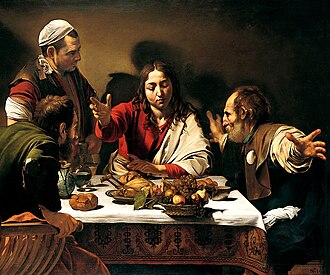 Supper at Emmaus - Caravaggio (1601)
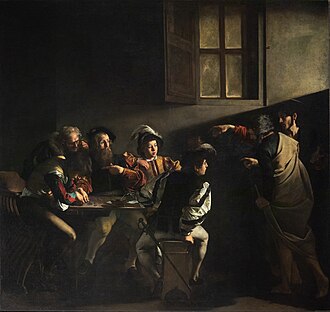 La vocazione di San Matteo - Caravaggio (1609)
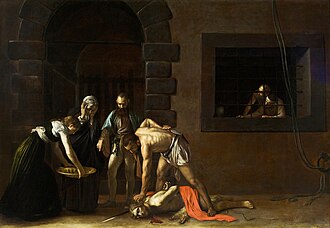 Decapitazione di San Giovanni Battista - Caravaggio (1608)
 Supper at Emmaus - Caravaggio (1601)
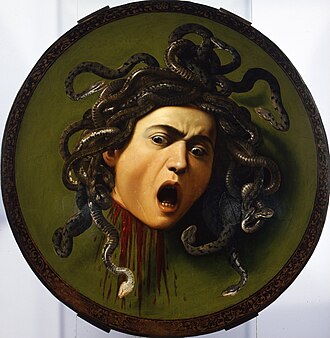 Testa di Medusa - Caravaggio (1597)
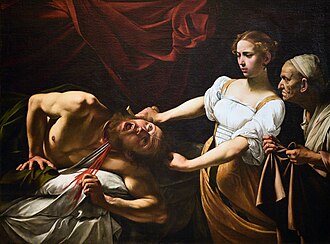 Giuditta che decapita Oloferne - Caravaggio (1598)
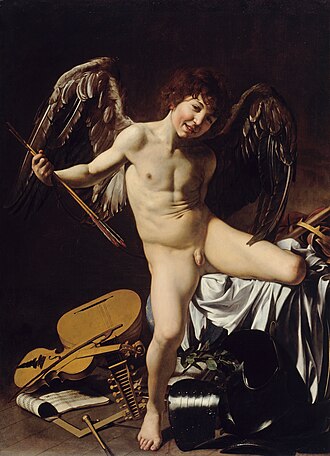 Amor Vincit Omnia - Caravaggio (1600s)
%2C%201595%20circa%2C%20534.jpg) Self-Portrait as Bacchus - Caravaggio (1595)
Self-Portrait as Bacchus - Caravaggio (1595)
Dipinti di artisti collegati
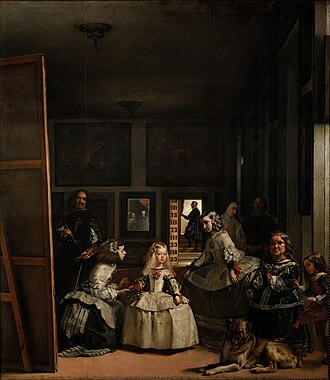 Las Meninas - Diego Velázquez (1656)
 The Surrender of Brea - Diego Velázquez (1635)
 The Night Watch - Rembrandt van Rijn (1642)
 Self-Portrait - Rembrandt van Rijn (1659)
 Girl with a Pearl Earring - Johannes Vermeer (1665)
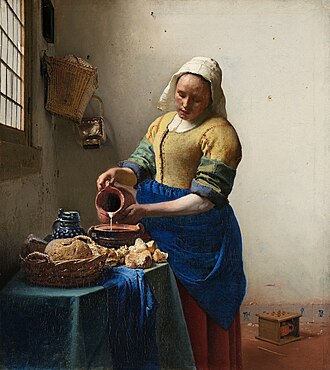 The Milkmaid - Johannes Vermeer (c. 1658)