The Jewish Cemetery
Jacob van Ruisdael · 1653
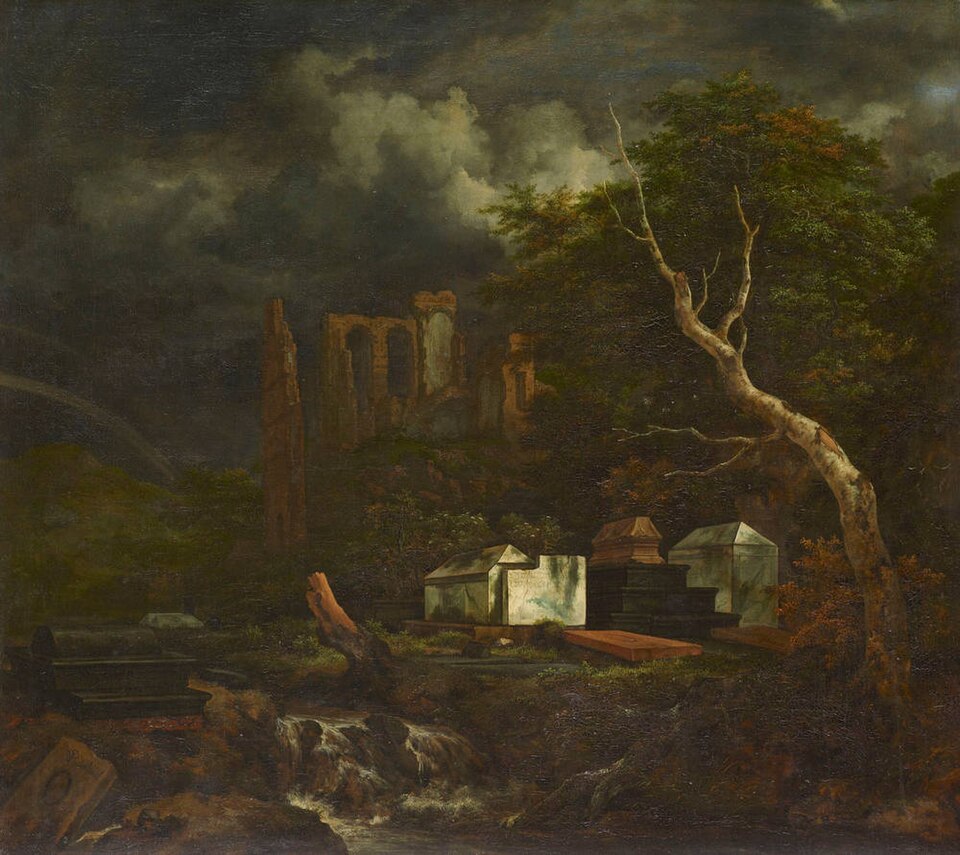
A rain shower moves away, a rainbow slips out of the frame, and sunlight falls on old tombs beside a rushing stream. Goethe stood in front of this Ruisdael in Dresden and wrote that it was devoted to the past alone.
The story behind the painting
Jacob van Ruisdael painted this oil on canvas, 84 by 95 cm, around 1655 according to the German Wikipedia article, while Wikidata gives 1653. He painted the subject twice in oil and made several chalk drawings of the cemetery, some showing a church tower instead of a ruin. The tombs come from real models in Beth Haim, the old Jewish burial ground at Ouderkerk, which still exists. The ruined building behind them was based on the ruins of Egmond Abbey near Alkmaar. The painting has been in the Dresden gallery since 1754.
What to look for
Against a dramatic sky of departing rain clouds and a rainbow running out of the picture to the left, the ruin of a perhaps sacred building with tall empty windows rises over hills and bushes. In front stand tombs of white marble, black granite and reddish sandstone; on an upright white slab are letters that faintly recall Hebrew. A dead tree leans left at the right edge, while its partner on the bank is only a stump. A stream with a small waterfall flows from the left background to the lower right. As the clouds pull back, the sun lights the foreground. Ruisdael signed on a tombstone, lower left.
Meaning and intent
The tombs can still be identified. The pale sarcophagus below the centre belongs to Eliahu Montalto, a Portuguese physician to Ferdinando I and Maria de' Medici, who died in 1616. Beside it lies the rabbi Isaac Uziel, who served Amsterdam from 1617 until 1622. Ruins, dead trees, graves and flowing water are read as signs of the transience of life and the vanity of human effort. Yet the breaking sun and the rainbow may point to hope of eternal life. Goethe did not see it as a specifically Jewish cemetery, but as the remains of an abbey and the resting place of wealthy old families.
Legacy
The painting was probably sold in 1739 and reached Dresden in 1754. In 1945 it was taken to the Soviet Union and returned in 1955. Goethe described it in his essay Ruysdael as a Poet, printed in 1816. A larger, brighter version is in the Detroit Institute of Arts; the dealer John Smith in 1835 called the Dresden picture a duplicate. In 1982, at an exhibition in The Hague showing both, the painter Konrad Klapheck preferred Detroit, while his wife Lilo preferred Dresden, and they argued. Today a thick varnish makes the picture look darker than the nineteenth century described.
Lo sapevi?
- Painted around 1655 (Wikidata: 1653), 84 by 95 cm.
- The tombs are real ones from Beth Haim at Ouderkerk.
- In the Dresden gallery since 1754; taken to the USSR in 1945, returned 1955.
- Described by Goethe in Ruysdael as a Poet (1816).
L'artista
Jacob van Ruisdael (1628-1682)
landscape painting · Staatliche Kunstsammlungen Dresden
Altre opere di Jacob van Ruisdael
 The Windmill at Wijk bij Duurstede - Jacob van Ruisdael (1670)
 The Jewish Cemetery - Jacob van Ruisdael (1650s)
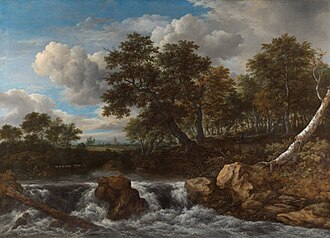 Landscape with Waterfall - Jacob van Ruisdael (1668)
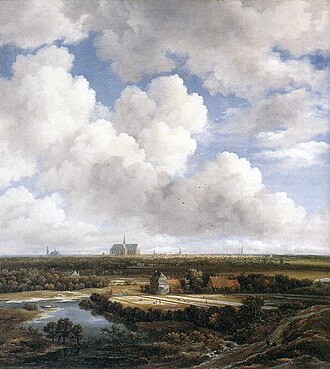 View of Haarlem with Bleaching Fields - Jacob van Ruisdael (1670)
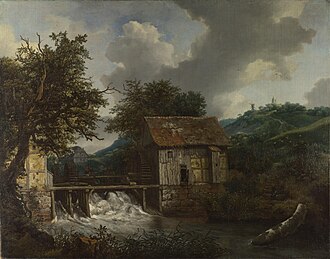 Two Watermills and an Open Sluice near Singraven - Jacob van Ruisdael (1650)
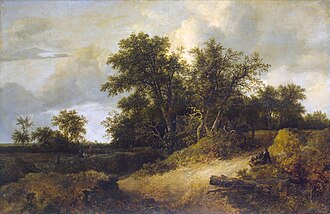 Peasant Cottage in a Landscape - Jacob van Ruisdael (1646)
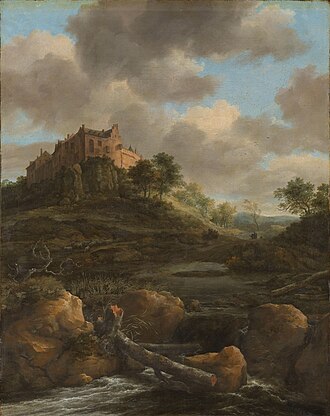 Bentheim Castle - Jacob van Ruisdael (1650s)
View of Egmond aan Zee - Jacob van Ruisdael (1650)
Dipinti di artisti collegati
 The Night Watch - Rembrandt van Rijn (1642)
 Self-Portrait - Rembrandt van Rijn (1659)
 Girl with a Pearl Earring - Johannes Vermeer (1665)
 The Milkmaid - Johannes Vermeer (c. 1658)
 The Feast of Saint Nicholas - Jan Steen (1660s)
 Girl eating oysters - Jan Steen (1658)
 A Militiaman Holding a Berkemeyer, Known as the ‘Merry Drinker’ - Frans Hals (1620s)
 Laughing Cavalier - Frans Hals (1624)
 The Courtyard of a House in Delft - Pieter de Hooch (1658)
 A Woman Peeling Apples - Pieter de Hooch (1663)