Peasant Cottage in a Landscape
Jacob van Ruisdael · 1646
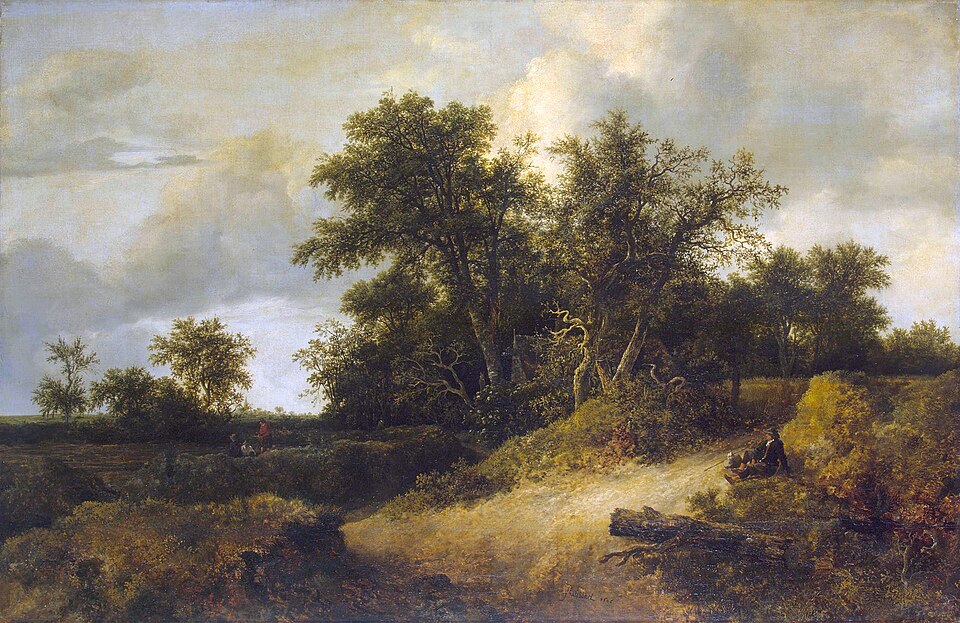
Low dunes, a pool, a few figures resting by the road: a quiet Dutch landscape, signed and dated 1646. Jacob van Ruisdael was still a teenager when he painted it, and on a remarkably large scale.
The story behind the painting
This is one of the earliest known works by Jacob van Ruisdael, the Dutch Golden Age landscape painter, and he was only a teenager when he made it. It is signed and dated 1646. For a young artist just starting out, the dimensions are remarkably ambitious: 105 by 163 cm. Ruisdael did not stop at one version. A smaller painting, also dated 1646, is in the Goeverneurshuis in Paramaribo, Suriname, listed as number 610 in Seymour Slive's 2001 catalogue of his work. Wikipedia calls this picture oil on panel.
What to look for
The painting shows a landscape of small dunes. A peasant sits on the side of the road with his bundle and stick beside him. To the left is a pool; on one bank a workman talks with two seated figures, and on the opposite bank stand trees. There is little green in the foliage, which has been worked over at length with the help of a mahlstick, the rest that steadies a painter's hand. Look also at the foreground: it seems to be unfinished, a glimpse of the picture still in progress.
Meaning and intent
Who painted the small figures is unknown. They are the staffage, the people added to give life and scale to a landscape, and art historian Seymour Slive doubts they are by the hand of Ruisdael's father, Isaack van Ruisdael. Whoever placed them there, they set the tone: a traveller pausing, people talking by the water, nothing dramatic happening. The subject is the ground itself, the rise of the dunes and the trees, studied with patience by a very young painter who would make the Dutch landscape his life's work.
Legacy
The painting has gathered many names. Hofstede de Groot's 1911 catalogue calls it Wooded Dunes, number 895. Slive's 2001 catalogue calls it Dune Landscape, number 615. The Hermitage Museum in St Petersburg, which owns it under inventory number 939, calls it Peasant Cottage in a Landscape. Kuznetsov, writing about the Ruisdaels in Russia, calls it Cottage in a Grove, and Hermitage curator Irina Sokolova named it Small House in a Grove. Five titles for one modest scene show how closely scholars have studied this early work.
Lo sapevi?
- Signed and dated 1646, painted when Ruisdael was a teenager.
- Measures 105 by 163 cm, large for a beginning artist.
- Kept in the Hermitage Museum, St Petersburg.
- A smaller 1646 version is in Paramaribo, Suriname.
L'artista
Jacob van Ruisdael (1628-1682)
landscape painting · tree · Hermitage Museum
Altre opere di Jacob van Ruisdael
 The Windmill at Wijk bij Duurstede - Jacob van Ruisdael (1670)
 The Jewish Cemetery - Jacob van Ruisdael (1650s)
 Landscape with Waterfall - Jacob van Ruisdael (1668)
 View of Haarlem with Bleaching Fields - Jacob van Ruisdael (1670)
 Two Watermills and an Open Sluice near Singraven - Jacob van Ruisdael (1650)
 The Jewish Cemetery - Jacob van Ruisdael (1653)
 Bentheim Castle - Jacob van Ruisdael (1650s)
View of Egmond aan Zee - Jacob van Ruisdael (1650)
Dipinti di artisti collegati
 The Night Watch - Rembrandt van Rijn (1642)
 Self-Portrait - Rembrandt van Rijn (1659)
 Girl with a Pearl Earring - Johannes Vermeer (1665)
 The Milkmaid - Johannes Vermeer (c. 1658)
 The Feast of Saint Nicholas - Jan Steen (1660s)
 Girl eating oysters - Jan Steen (1658)
 A Militiaman Holding a Berkemeyer, Known as the ‘Merry Drinker’ - Frans Hals (1620s)
 Laughing Cavalier - Frans Hals (1624)
 The Courtyard of a House in Delft - Pieter de Hooch (1658)
 A Woman Peeling Apples - Pieter de Hooch (1663)