La Vague verte
Claude Monet · 1867
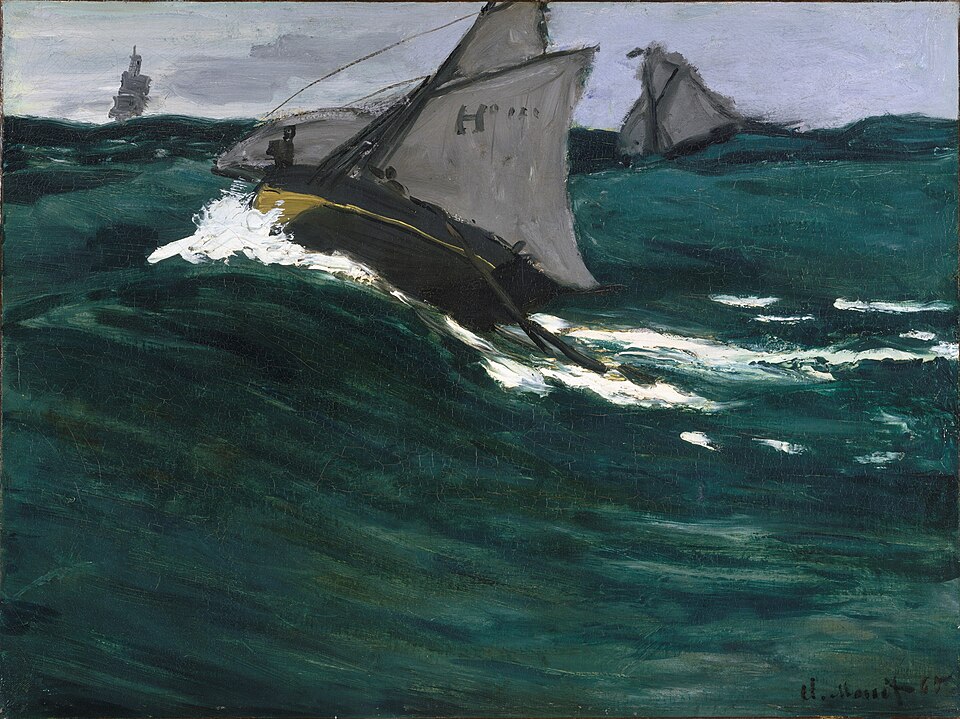
A small sailboat leans hard into a dark green sea, white spray laid on straight from the tube. Young Monet, still learning from Manet, painted the struggle of a boat against the swell.
The story behind the painting
In 1863 Monet left the studio of Charles Gleyre, whose academic teaching no longer suited him, and set out to paint in nature, encouraged by Gleyre himself. New techniques interested him, especially Manet's. The sea had been familiar to Monet since childhood, and his regular stays in Honfleur and Le Havre made it a major source of inspiration. He wrote 1865 after his signature, but the source says that date is not meaningful: the picture was more likely painted during or after his stays of 1866 or 1867. Roger Marx reported that Zacharie Astruc saw Monet painting seascapes with a palette knife at Ville-d'Avray in 1866.
What to look for
The sea fills about four fifths of the canvas. Monet treated it briefly, with discreet touches of pure black laid into emerald green that was still wet. The whites come straight from the tube, applied with a palette knife, one of only three works he painted this way. The boat is off centre and steeply tilted, which gives a sense of a fight against the elements, reinforced by a wavy horizon marked by the swell. Three boats placed at different depths underline the perspective. The canvas is about 48.6 by 64.8 cm.
Meaning and intent
The source sees a clear debt to Manet, who painted The Porpoises in 1864 with a strong contrast between a light sky and very dark ships, a foreground boat cut off at the top of its masts, and a lively gesture recalling prints by Hiroshige. Monet, a great lover of Japanese art, may also have drawn on works by Hokusai. The result is less a picture of a place than of a force: wind, water and a small hull holding on, painted with a boldness that announces the painter he would become.
Legacy
The dealer Durand-Ruel passed the painting to Mary Cassatt in 1882. Théodore Duret lent it to the fourth Impressionist exhibition, where it was listed in the catalogue as Marine, dated 1875. It then went through several private collections before it was bequeathed to the Metropolitan Museum of Art in 1929. Since then the Met has shown it in about fifteen exhibitions in the United States and Europe, so this early sea by Monet has travelled almost as much as the boats it shows.
Le saviez-vous ?
- Painted around 1866 to 1867, though signed with the date 1865.
- One of only three works Monet painted with a palette knife.
- Once owned by Mary Cassatt.
- Bequeathed to the Metropolitan Museum of Art in 1929.
À propos de l'artiste
Claude Monet (1840-1926)
Metropolitan Museum of Art · bateau · vague
Autres œuvres de Claude Monet
 Impression, soleil levant - Claude Monet (1872)
 Nymphéas - Claude Monet (1906)
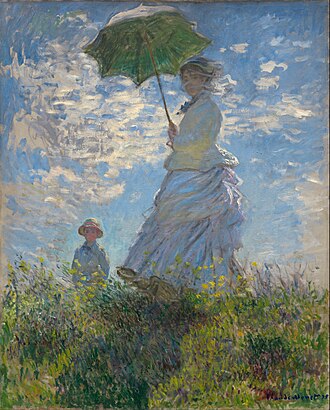 La Femme à l'ombrelle - Claude Monet (1875)
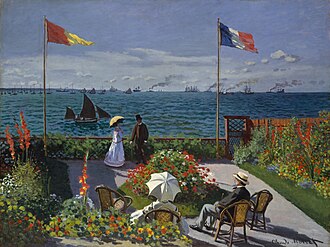 Terrasse à Sainte-Adresse - Claude Monet (1867)
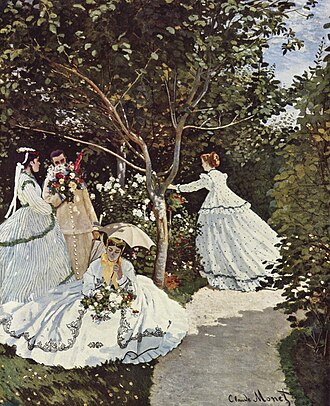 Femmes au jardin - Claude Monet (1866)
 La Pie - Claude Monet (1868)
 La Dame en blanc au jardin - Claude Monet (1867)
 Le Déjeuner sur l'herbe - Claude Monet (1866)
Œuvres d'artistes liés
 Le Dernier Voyage du Téméraire - J. M. W. Turner (1839)
 Pluie, Vapeur et Vitesse - J. M. W. Turner (1844)
 L'Origine du monde - Gustave Courbet (1866)
 Un enterrement à Ornans - Gustave Courbet (2020)
 Le Déjeuner sur l'herbe - Édouard Manet (1863)
 Olympia - Édouard Manet (1863)
 Bal du moulin de la Galette - Pierre-Auguste Renoir (1876)
 Le Déjeuner des canotiers - Pierre-Auguste Renoir (1881)
 Le Berceau - Berthe Morisot (1872)
 Jour d'été - Berthe Morisot (1879)
 L'Absinthe - Edgar Degas (1875)
 La Famille Bellelli - Edgar Degas (1858)