La Famille Bellelli
Edgar Degas · 1858
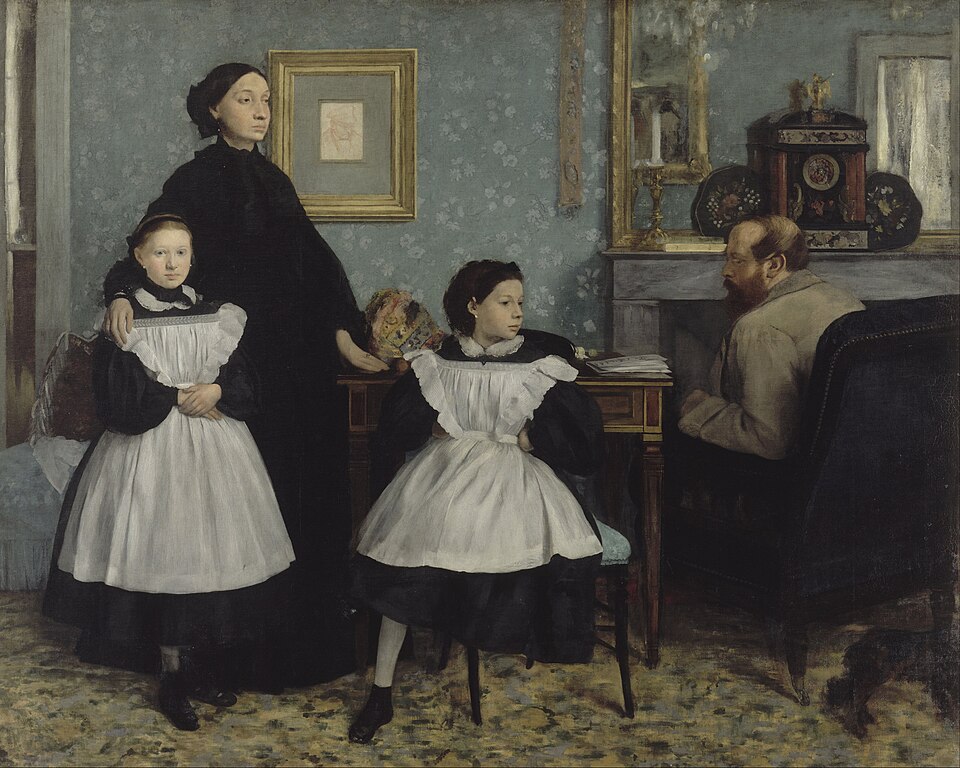
A mother in black stands like a statue, one daughter stays close, the other turns toward a father who sits apart in the shadows. The young Degas painted his aunt's family on the scale of a history painting, and let every crack in the household show.
The story behind the painting
In 1856 Degas went to Italy to study art and visit relatives. In the summer of 1858 his aunt Laura, his father's sister, invited him to Florence, where her husband, Baron Gennaro Bellelli, lived in exile after the defeat of the 1848 revolution. Degas did not get on well with Gennaro and stayed on mainly to see Laura and her daughters Giulia and Giovanna. The strain in the house was real. Laura later wrote to Degas that her husband was immensely disagreeable and dishonest, and that living with him would soon lead her to the grave. She was pregnant at the time, and the child died in infancy.
What to look for
Laura stands as if for an official portrait, dressed in black in mourning for her father, Hilaire Degas, whose portrait drawing hangs on the wall just behind her head. One hand rests protectively on Giovanna's shoulder. Giulia, at the centre on a small chair, sits with restless energy, arms akimbo, facing her father and linking the two parents. Gennaro sits apart in an armchair at his desk, his face mostly in shadow, framed by a mantelpiece, clutter and a mirror, while Laura stands against a clear flat wall. At the lower right the family dog slips out of the picture, as Arthur Danto put it, before all hell breaks loose.
Meaning and intent
The painting is read as a psychological portrait: the parents' estrangement, the divided loyalties of the children, the distance between the clear world of the mother and the blurred world of the father. Degas wrote of his cousins that he wanted to express a natural grace together with a nobility he could not define. He drew on many models, among them Van Dyck, Holbein, Ingres, Goya's Family of Charles IV and Velázquez's Las Meninas, from which he borrowed the picture, mirror and doorway that open up the room. It was his first attempt to describe a room through the people who live in it.
Legacy
There is no record of exactly when or where the picture was painted. The likeliest account is that Degas took his Italian sketches back to Paris and worked on it there for several years, since the Bellelli apartment was too small for so large a canvas. A family story that it was finished in Italy and only reached France decades later is contradicted by its showing at the Paris Salon of 1867. Called unique in the painter's work and among his contemporaries, this masterwork of Degas's youth now hangs in the Musée d'Orsay.
Le saviez-vous ?
- A portrait of Degas's aunt Laura, her husband and their two daughters.
- Based on studies made in Florence in 1858 to 1859.
- Exhibited at the Paris Salon of 1867.
- Measures about 200 by 253 cm; in the Musée d'Orsay.
À propos de l'artiste
Edgar Degas (1834-1917)
position assise · musée d'Orsay · station debout · famille · portrait de famille
Autres œuvres de Edgar Degas
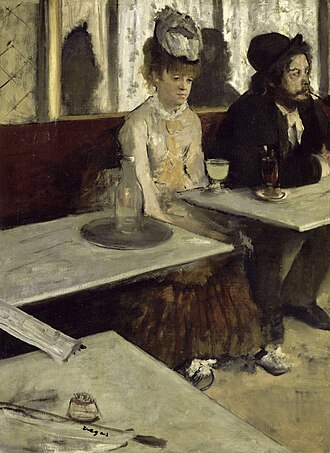 L'Absinthe - Edgar Degas (1875)
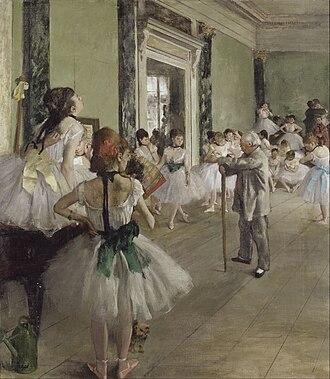 La Classe de danse - Edgar Degas (1871)
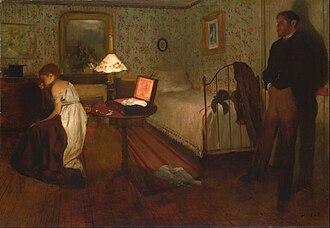 Intérieur - Edgar Degas (1868)
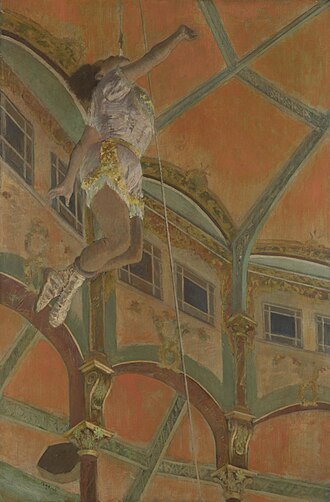 Mademoiselle La La au cirque Fernando - Edgar Degas (1879)
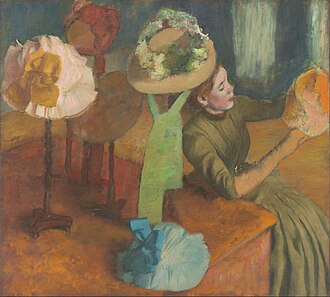 Chez la modiste - Edgar Degas
.jpg) Le Tub - Edgar Degas (1886)
Le Tub - Edgar Degas (1886)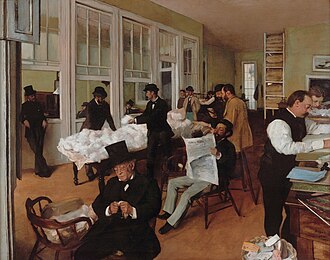 Le Bureau de coton à La Nouvelle-Orléans - Edgar Degas (1873)
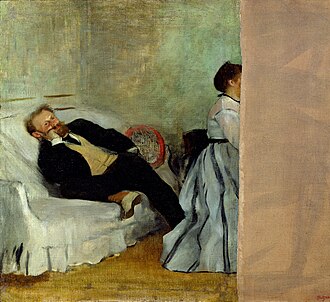 Monsieur et Madame Édouard Manet - Edgar Degas (1868)
Œuvres d'artistes liés
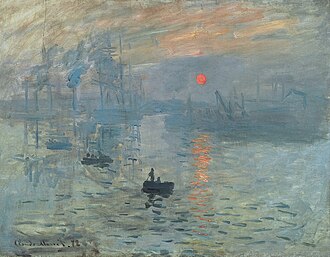 Impression, soleil levant - Claude Monet (1872)
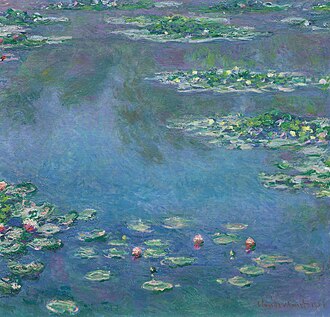 Nymphéas - Claude Monet (1906)
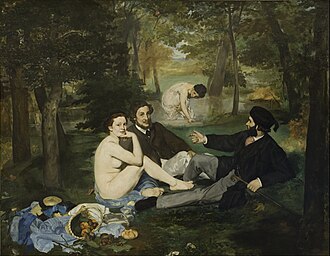 Le Déjeuner sur l'herbe - Édouard Manet (1863)
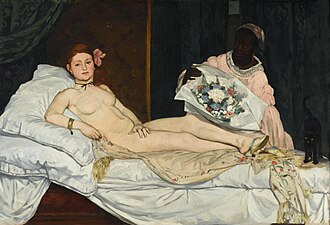 Olympia - Édouard Manet (1863)
 Bal du moulin de la Galette - Pierre-Auguste Renoir (1876)
 Le Déjeuner des canotiers - Pierre-Auguste Renoir (1881)
 La Nuit étoilée - Vincent van Gogh (1889)
.jpg) Terrasse du café le soir - Vincent van Gogh (1888)
Terrasse du café le soir - Vincent van Gogh (1888) Le Dernier Voyage du Téméraire - J. M. W. Turner (1839)
 Pluie, Vapeur et Vitesse - J. M. W. Turner (1844)
 D'où venons-nous ? Que sommes-nous ? Où allons-nous ? - Paul Gauguin (1897-1898)
%201889.jpg) Le Christ jaune - Paul Gauguin (1889)
Le Christ jaune - Paul Gauguin (1889)