Terrasse à Sainte-Adresse
Claude Monet · 1867
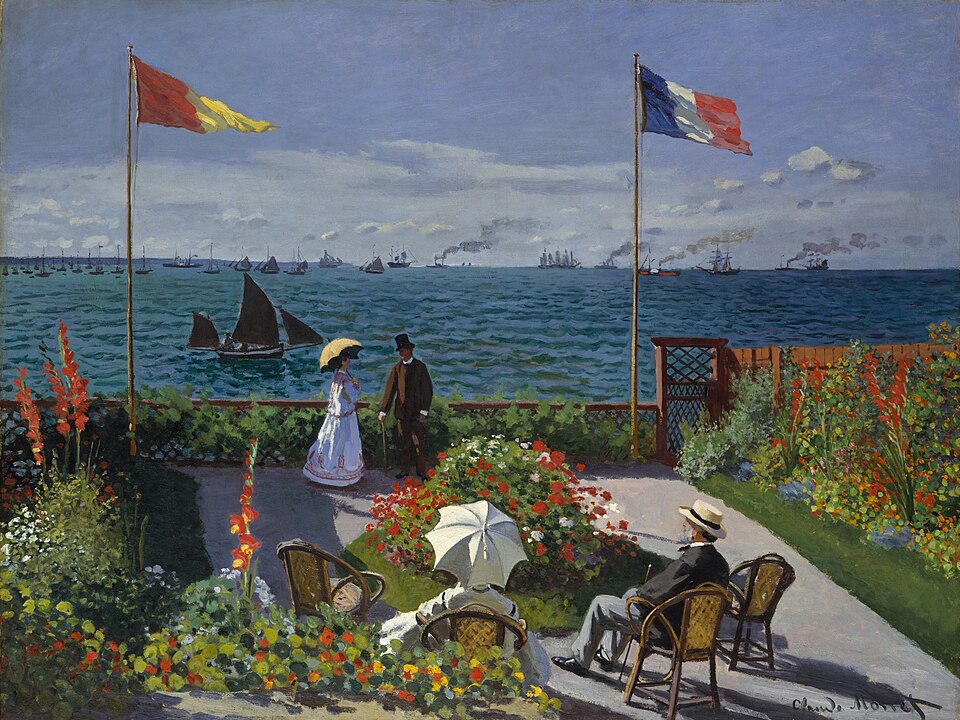
Flags snap in the sea wind, flowers blaze, and sails crowd the Channel beyond a sunlit terrace. Yet behind this picture of easy summer leisure lay a family under strain.
The story behind the painting
Claude Monet spent the summer of 1867 at Sainte-Adresse, a resort town on the English Channel near Le Havre. There, in a garden looking out toward Honfleur on the horizon, he painted this large canvas, nearly 1 by 1.3 metres. The figures were probably members of his own family: his father, Adolphe, in the foreground; his cousin's wife, Jeanne-Marguerite Lecadre, at the fence; her father; and perhaps her sister Sophie, seated with her back to us. But it is not a family portrait. That summer Monet's relations with his father were tense, because the family disapproved of his relationship with Camille Doncieux, the woman who would become his wife. The bright terrace hides a quiet drama.
What to look for
Notice how the picture is stacked in three horizontal bands: the flowered terrace, the sea busy with boats, and the sky with its fluttering flags, one of them the French tricolour. Because we look down from a high vantage point and the bands are of fairly even size, they seem to rise up the canvas parallel to its surface rather than receding into depth. Now compare the textures. Some areas are smooth and traditionally painted; others sparkle with rapid, separate brushstrokes and spots of pure colour, especially in the flowers and the glinting water. Let your eye move between the sitters, the chairs and the distant sails, and feel the tension between a convincing view and a flat, patterned surface.
Meaning and intent
Monet himself called this work, in his letters, the Chinese painting in which there are flags, and his friend Renoir called it the Japanese painting. Both nicknames point to the same source: Japanese colour woodblock prints, which Monet, Manet, Renoir, Whistler and others in their circle collected eagerly. The flat horizontal bands would have reminded sophisticated viewers of the 1860s of such prints. A print by Hokusai, Turban-shell Hall of the Five-Hundred-Rakan Temple (1830), may have inspired it, and it remains today at Monet's house in Giverny. The balance between illusion and the flatness of the surface became a lasting feature of Monet's style. The scene projects affluent domestic calm, while the family reality was more troubled.
Legacy
Twelve years after it was painted, the canvas was shown at the fourth Impressionist exhibition in Paris, from 10 April to 11 May 1879, as number 157 under the title Jardin à Sainte-Adresse. Its titles have shifted over time: it was later known by the French name La terrasse à Sainte-Adresse. The Metropolitan Museum of Art in New York acquired it in 1967, with special contributions given or bequeathed by friends of the Museum, after it appeared at auction at Christie's that December. It hangs there today as an early sign of the Impressionist direction, a young painter already blending tradition with flashes of pure colour and lessons from Japan.
Le saviez-vous ?
- Monet called it 'the Chinese painting in which there are flags'; Renoir called it 'the Japanese painting'.
- A Hokusai print that may have inspired it is still at Monet's house in Giverny.
- It was shown at the 4th Impressionist exhibition in 1879 as no. 157.
- The Metropolitan Museum of Art acquired it in 1967.
À propos de l'artiste
Claude Monet (1840-1926)
femme · scène de genre · impressionnisme · Metropolitan Museum of Art · bateau · chaise · bateau à voiles · Sainte-Adresse
Autres œuvres de Claude Monet
 Impression, soleil levant - Claude Monet (1872)
 Nymphéas - Claude Monet (1906)
 La Femme à l'ombrelle - Claude Monet (1875)
 Femmes au jardin - Claude Monet (1866)
 La Pie - Claude Monet (1868)
 La Dame en blanc au jardin - Claude Monet (1867)
 Le Déjeuner sur l'herbe - Claude Monet (1866)
 La Grenouillère - Claude Monet (1869)
Œuvres d'artistes liés
 Le Déjeuner sur l'herbe - Édouard Manet (1863)
 Olympia - Édouard Manet (1863)
 Bal du moulin de la Galette - Pierre-Auguste Renoir (1876)
 Le Déjeuner des canotiers - Pierre-Auguste Renoir (1881)
 La Nuit étoilée - Vincent van Gogh (1889)
.jpg) Terrasse du café le soir - Vincent van Gogh (1888)
Terrasse du café le soir - Vincent van Gogh (1888)