Femmes au jardin
Claude Monet · 1866
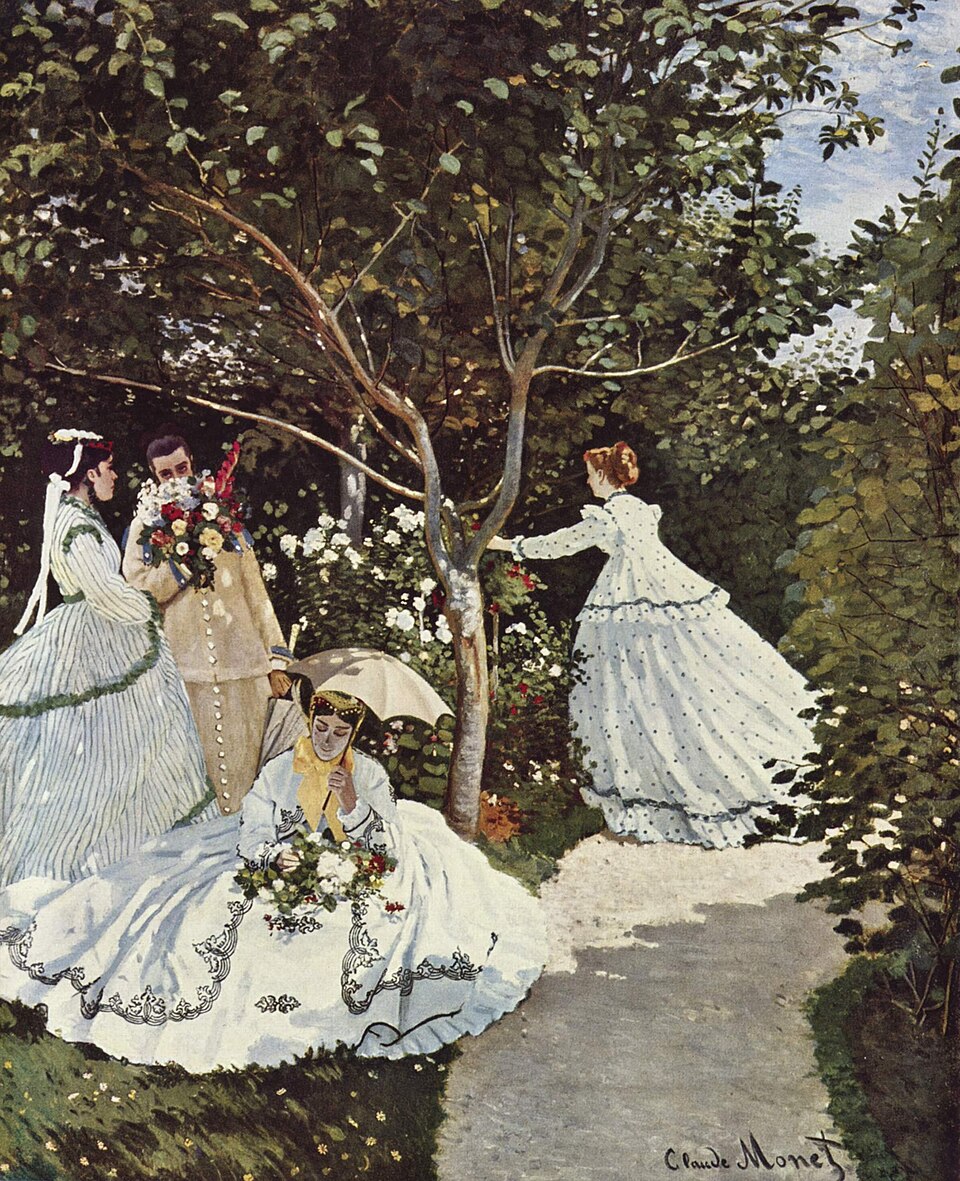
Women in white dresses gather among the flowers of a sunlit garden. To paint them in the open air, the young Monet dug a trench and lowered his huge canvas into the earth.
The story behind the painting
Claude Monet began Women in the Garden in 1866, when he was 26 and still early in his career, experimenting with both method and subject. He set out to paint a very large canvas, 255 by 205 centimetres, entirely en plein air, in the open. To keep a single point of view across the whole picture, he dug a trench and lowered the canvas into it so he could reach the upper half. The setting was the garden of a property he was renting, and his companion and future wife, Camille Doncieux, posed for the figures. Monet finished the painting indoors, turning to magazine illustrations to render the fashionable clothing.
What to look for
Let your eyes move through the garden and its women, all modelled by Camille. Their white dresses are the heart of the picture; the Musée d'Orsay observes that Monet rendered that white skilfully, anchoring the dresses firmly in the structure of the composition. Look for the play of sunlight and shadow across fabric, flowers and grass, the part of the painting most praised over time. Notice the brushwork too: the Salon jury was troubled by Monet's heavy brushstrokes, a manner that would become one of the hallmarks of Impressionism. Then glance at the woman on the right. The biographer Christoph Heinrich notes that later viewers felt she seems to glide across the ground, as if something were concealed beneath her dress.
Meaning and intent
Women in the Garden tells no story, and that was precisely the point. The painting was meant to fit Monet's chosen theme: the interplay of light and atmosphere. The figures are less characters than surfaces on which sunlight and shade can fall. That ambition puzzled its first judges, who rejected it from the Salon of 1867 for weakness of subject and narrative. Later commentators have seen the figures as poorly integrated into the scene, yet they praise the treatment of light and shadow, and in this respect the work may have shown Monet where his artistic path lay. It stands as an early step toward the movement he would come to lead.
Legacy
The Salon's rejection in 1867 was blunt. One judge complained that too many young people thought of nothing but continuing in this abominable direction, and that it was time to protect them and save art. Yet the painting found a friend. The artist Frédéric Bazille bought it to help Monet at a time when he had no money. More than a century later, the painter Herman Braun-Vega borrowed it for his own work, setting it beside Manet's The Balcony behind two Peruvian vegetable sellers in En attendant (Monet et Manet) of 1984, to contrast the affluence of the North with the poverty of the South. Today the painting hangs in the Musée d'Orsay in Paris.
Le saviez-vous ?
- Begun in 1866, when Monet was 26; painted outdoors with the canvas lowered into a trench
- Camille Doncieux, Monet's future wife, posed for the figures
- Rejected by the Paris Salon of 1867; bought by Frédéric Bazille to support Monet
- Musée d'Orsay, Paris; 255 × 205 cm
À propos de l'artiste
Claude Monet (1840-1926)
femme · scène de genre · impressionnisme · musée d'Orsay · arbre · fleur · paysage · jardin · peinture de personnage · Camille Doncieux
Autres œuvres de Claude Monet
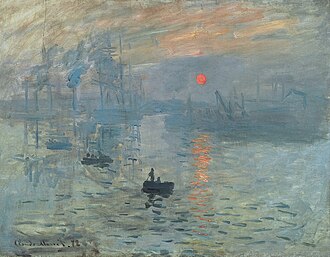 Impression, soleil levant - Claude Monet (1872)
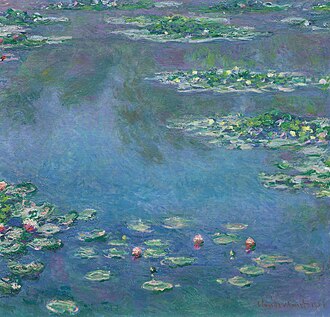 Nymphéas - Claude Monet (1906)
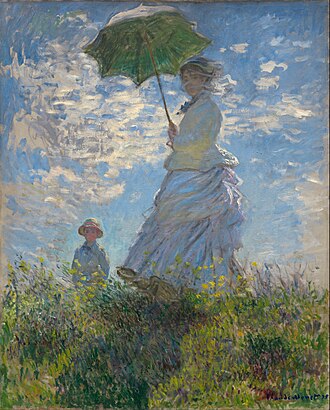 La Femme à l'ombrelle - Claude Monet (1875)
 Terrasse à Sainte-Adresse - Claude Monet (1867)
 La Pie - Claude Monet (1868)
 La Dame en blanc au jardin - Claude Monet (1867)
 Le Déjeuner sur l'herbe - Claude Monet (1866)
 La Grenouillère - Claude Monet (1869)
Œuvres d'artistes liés
 Le Déjeuner sur l'herbe - Édouard Manet (1863)
 Olympia - Édouard Manet (1863)
 Bal du moulin de la Galette - Pierre-Auguste Renoir (1876)
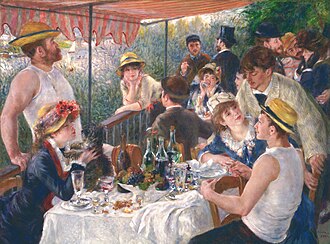 Le Déjeuner des canotiers - Pierre-Auguste Renoir (1881)
 La Nuit étoilée - Vincent van Gogh (1889)
.jpg) Terrasse du café le soir - Vincent van Gogh (1888)
Terrasse du café le soir - Vincent van Gogh (1888)