Le Couple dansant
Jan Steen · 1663
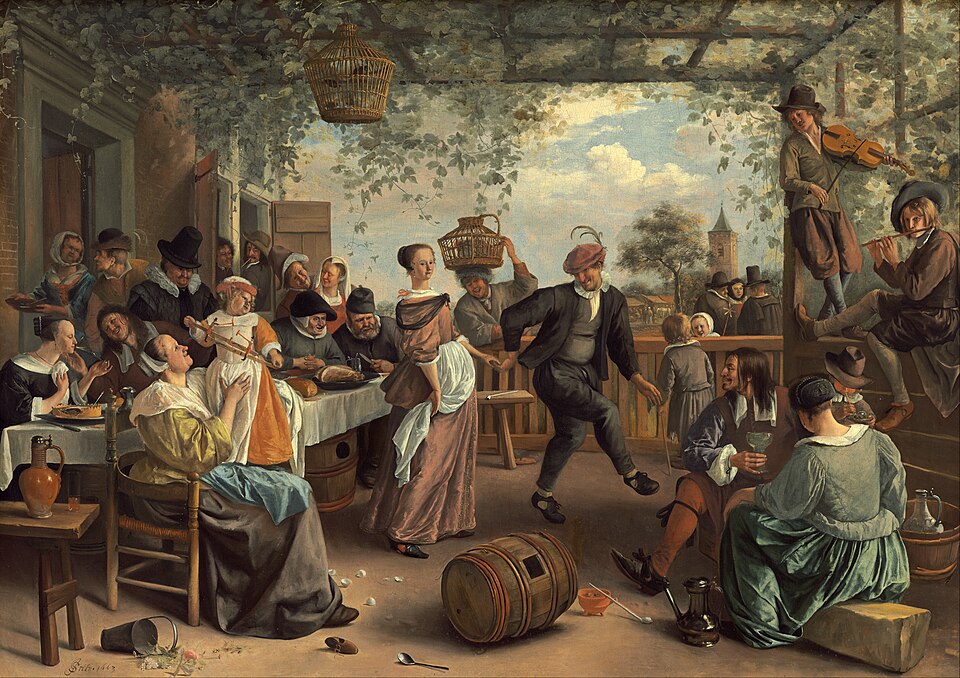
Under a vine-covered arbour, a woman in salmon pink dances with a man while a whole village fair eats, drinks, flirts and plays music around them. A little girl in bright orange watches, delighted. Jan Steen painted this lively kermis in 1663.
The story behind the painting
The setting is a kermis, a Dutch village fair that began in the fourteenth century as a harvest gathering for farmers and grew into a key social event. Kermis scenes were very popular in the Bruegel tradition. When Steen painted this in 1663 he was already well known, and at 37 his reputation was growing thanks to genre scenes like this one, in the prosperous years of the Dutch Golden Age.
What to look for
More than a dozen figures fill the wide canvas, mostly in greys, greens and blacks, under grey-green and yellow vines. At the front sits a woman in a greenish-yellow top with her child in orange. Behind them a woman in black with white ruffles drinks wine while a smiling man touches her chin. Two couples talk and laugh behind the table, three men watch the dance, and one man beside his wife and son eyes the woman in pink. Behind the fence, two men and a woman huddle in secret talk. Look for the flutes and violin, food on every corner of the table, chickens in cages, and a fallen bucket of flowers.
Meaning and intent
Such paintings often carry moral messages through symbols. The source reads the fallen flowers as a loss of innocence or morals, echoed by the drinking and flirting on the left. Steen is also known for evoking all five senses: sight in the delighted faces, sound in the music and footsteps, touch in silk, wood and joined hands, taste in food and wine, smell in flowers, food and tobacco smoke. These details give his people a clarity of humanity.
Legacy
The painting is part of the Widener Collection at the National Gallery of Art in Washington. Wikipedia counts it among the paintings that opened a new era in Dutch art, turning to the real life and values of ordinary people rather than the wealthy. Wikidata gives its size as 102.5 by 142.5 cm. Its peasant theme belongs to a broader shift: Dutch people liked to collect paintings that showed their own values, beliefs and daily activities, from family dinners to children playing.
Le saviez-vous ?
- Painted by Jan Steen in 1663.
- Set at a kermis, a Dutch village fair.
- Steen evokes all five senses in the scene.
- In the Widener Collection, National Gallery of Art, Washington.
À propos de l'artiste
Jan Steen (1626-1679)
scène de genre · National Gallery of Art
Autres œuvres de Jan Steen
 La Fête de la Saint-Nicolas - Jan Steen (1660s)
 La Mangeuse d'huîtres - Jan Steen (1658)
 Portrait d'Adolf et Catharina Croeser - Jan Steen (1655)
 Beware of Luxury - Jan Steen (1663)
 Ce que chantent les vieux, les jeunes le fredonnent - Jan Steen (1665)
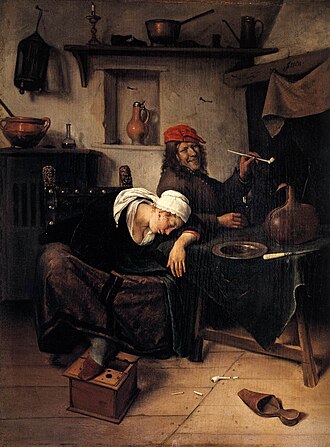 Buveurs - Jan Steen (1660s)
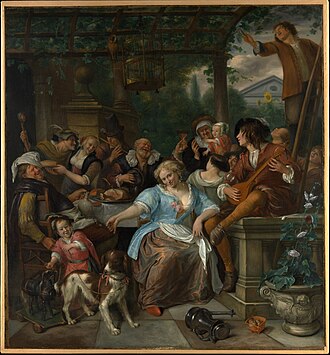 Joyeuse compagnie sur une terrasse - Jan Steen (1670)
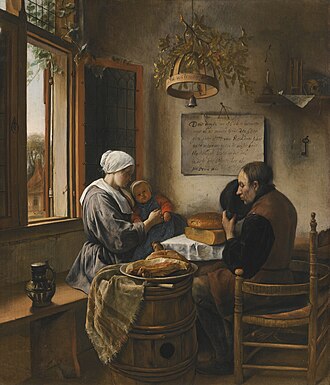 The prayer before the meal - Jan Steen (1660)
Œuvres d'artistes liés
 La Ronde de nuit - Rembrandt van Rijn (1642)
 Autoportrait - Rembrandt van Rijn (1659)
 La Jeune Fille à la perle - Johannes Vermeer (1665)
 La Laitière - Johannes Vermeer (c. 1658)
 Le Joyeux Buveur - Frans Hals (1620s)
 Le Cavalier riant - Frans Hals (1624)
 Le Moulin près de Wijk bij Duurstede - Jacob van Ruisdael (1670)
 Le Cimetière juif - Jacob van Ruisdael (1650s)
 La Cour d'une maison à Delft - Pieter de Hooch (1658)
 La Peleuse de pommes - Pieter de Hooch (1663)