Le Cimetière juif
Jacob van Ruisdael · 1650s
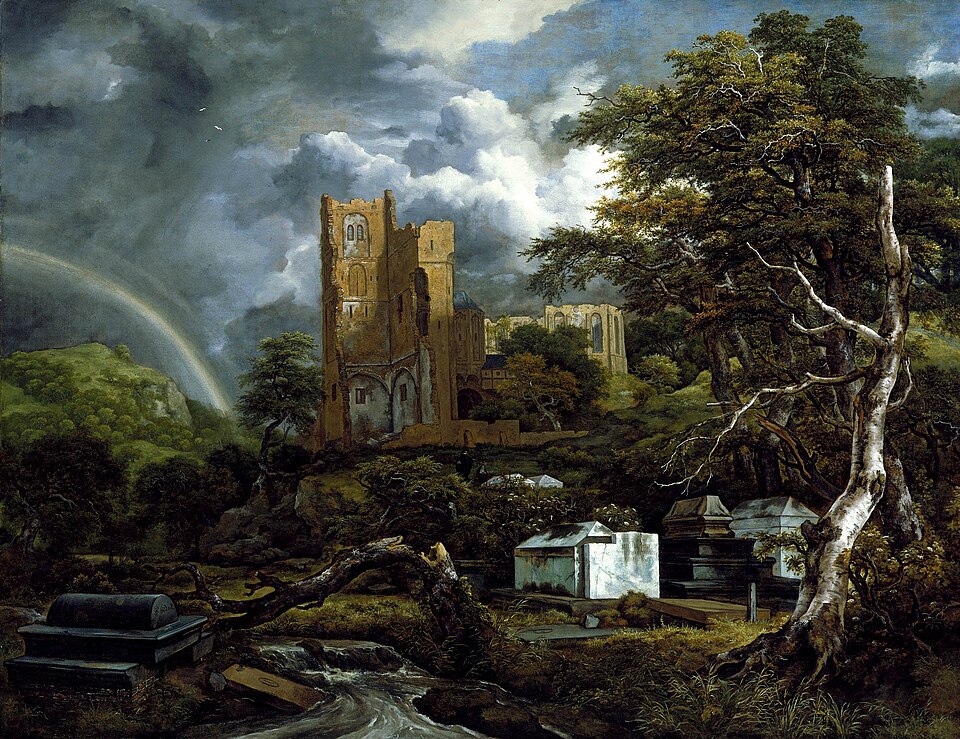
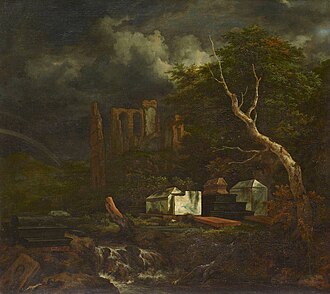
Storm light breaks over broken tombs, a dead tree bends across a rushing brook, and a rainbow arcs above a ruined church. Ruisdael's Jewish Cemetery in Detroit is a landscape about death that may also be about hope.
The story behind the painting
The painting depicts Beth Haim, the cemetery at Ouderkerk aan de Amstel on Amsterdam's southern outskirts, resting place of leaders of the newly arrived Portuguese Jewish community in the seventeenth century. Ruisdael changed the central elements from what one would actually see there, to serve his composition and his allegory. According to Erich Simon, he made two versions in 1653 and 1655, in his mid-twenties; Wikidata dates this one to the 1650s. At 142.2 by 189.2 cm, it is twice the size of a typical Dutch landscape of the time. Who, if anyone, commissioned it is unknown.
What to look for
Ruisdael isolates a corner with four of the oldest and most conspicuous Sephardi tombs, carved with illegible pseudo-Hebrew inscriptions. Light falls on the white marble tomb of Elias Montalto, physician to Maria de' Medici, who died in 1616, as if breaking through from heaven. Beside it is the red-speckled marble of Isaac Uziel, Amsterdam's chief rabbi from 1617 to 1622, so respected that his tomb needed no inscription. Then comes the tall tomb of Abraham Israel Mendez. At far left, beyond the brook, lies a dark tomb with a half-column, which Ruisdael moved to that side for composition and colour, and on which he signed. A dead tree leans over the water.
Meaning and intent
Ruisdael turns the cemetery into a landscape version of a vanitas painting. Deserted tombs, a ravaged church, storm clouds, dead trees and flowing water speak of death and the passing of earthly things; Jacob Rosenberg and Seymour Slive called it a moralizing landscape with a deliberate allegorical programme. The brook rushing under the broken arch may stand for the swift passing of a life, and the broken column for death. Yet water also renews, nature reclaims neglected ground, and the rainbow is often read as a sign of hope, even a bridge to heaven or a hint at the resurrection awaited by the community buried there.
Legacy
After being catalogued in England in 1835, the painting disappeared from public view for many years before appearing at auctions in London and Berlin. In 1926 the Detroit Institute of Arts acquired it from Julius H. Haass, given in memory of his brother. Its companion version is in Dresden. The real tombs it shows can still be traced at Beth Haim, and scholars continue to compare the painting with the cemetery, noting each place where Ruisdael moved a stone, dropped a post or changed a coat of arms to say something about death.
Le saviez-vous ?
- Shows Beth Haim, the Portuguese Jewish cemetery at Ouderkerk aan de Amstel.
- Two versions, dated 1653 and 1655 by Erich Simon; Wikidata gives the 1650s.
- 142.2 by 189.2 cm, about twice the usual size of a Dutch landscape.
- In the Detroit Institute of Arts since 1926.
À propos de l'artiste
Jacob van Ruisdael (1628-1682)
paysage · Detroit Institute of Arts
Autres œuvres de Jacob van Ruisdael
 Le Moulin près de Wijk bij Duurstede - Jacob van Ruisdael (1670)
 Paysage avec une cascade - Jacob van Ruisdael (1668)
 Vue de Haarlem avec des champs de blanchiment - Jacob van Ruisdael (1670)
 Deux moulins à eau et d'une écluse près Ouvrir Singraven - Jacob van Ruisdael (1650)
 Dunes boisées - Jacob van Ruisdael (1646)
 Le cimetière juif - Jacob van Ruisdael (1653)
 Château Bentheim - Jacob van Ruisdael (1650s)
Vue d'Egmond aan Zee - Jacob van Ruisdael (1650)
Œuvres d'artistes liés
 La Ronde de nuit - Rembrandt van Rijn (1642)
 Autoportrait - Rembrandt van Rijn (1659)
 La Jeune Fille à la perle - Johannes Vermeer (1665)
 La Laitière - Johannes Vermeer (c. 1658)
 La Fête de la Saint-Nicolas - Jan Steen (1660s)
 La Mangeuse d'huîtres - Jan Steen (1658)
 Le Joyeux Buveur - Frans Hals (1620s)
 Le Cavalier riant - Frans Hals (1624)
 La Cour d'une maison à Delft - Pieter de Hooch (1658)
 La Peleuse de pommes - Pieter de Hooch (1663)