Portrait d'Adolf et Catharina Croeser
Jan Steen · 1655
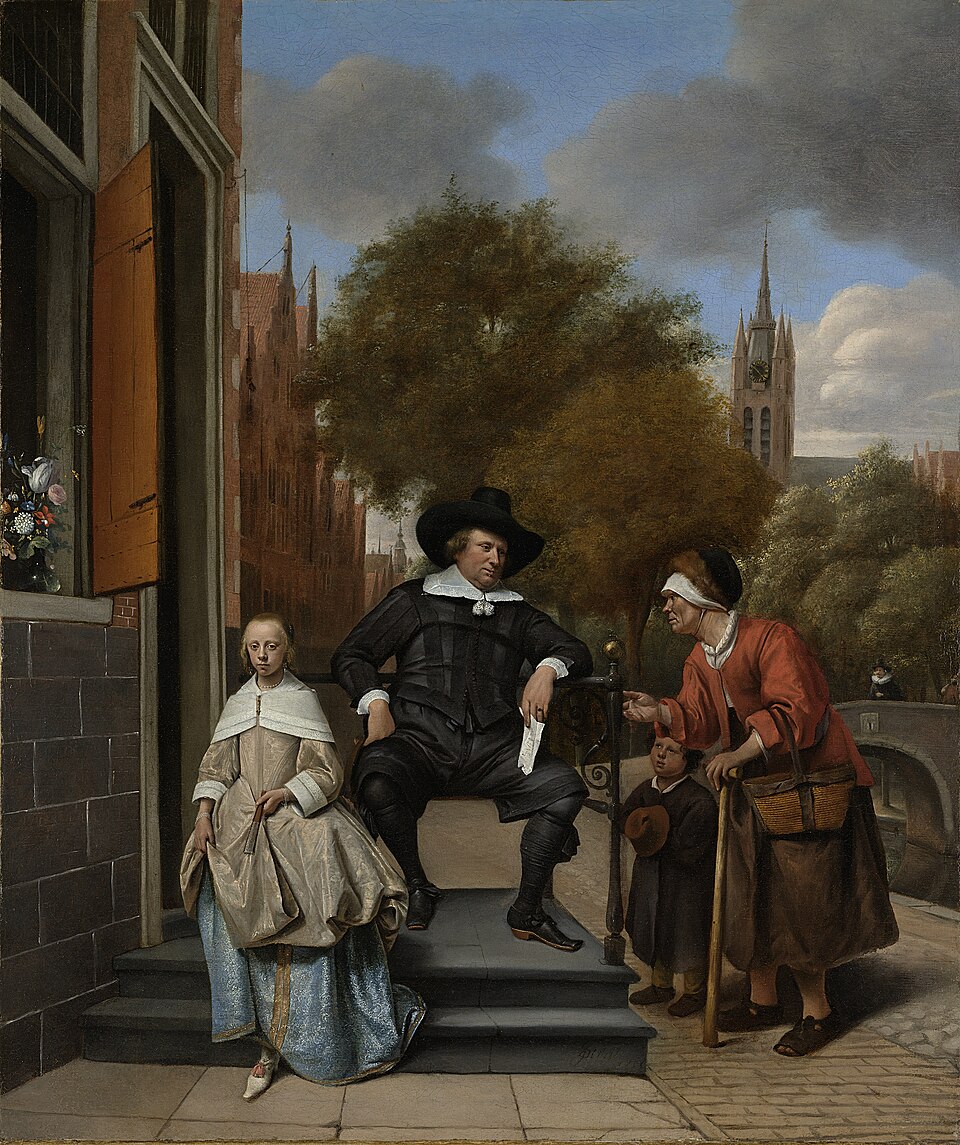
A man in black sits on his doorstep beside a canal in Delft, his daughter stepping down beside him, while a beggar woman asks for help. For two centuries he was called the mayor of Delft. He was not.
The story behind the painting
Jan Steen signed this painting in full on the edge of a step and dated it 1655. It is an oil on canvas of about 82.5 by 68.7 cm. Since a sale of 1808 it was known as The Burgomaster of Delft and his Daughter, and tradition named the sitters as Geraldo Briel van Welhoeck and his daughter Anna. But for over a century it had been assumed the man was not the mayor. In 2006, research on the Delft cityscape and the people shown led to a new title: a double portrait of Adolf Croeser and his daughter Catharina Croeser.
What to look for
The man, dressed in black, sits on the steps in front of his house holding a sheet of paper. His daughter comes down two steps toward us, in a blue skirt and greyish-purple gown. From the right, a beggar woman in red, with a boy, speaks to him. In the distance rises the tower of the Oude Kerk, and a stone bridge bearing the town's arms crosses the Oude Delft canal. In the window of the house a bouquet of flowers stands in a glass, and tree foliage hangs over part of the scene.
Meaning and intent
The picture sets comfort and need side by side: a well-dressed citizen and his daughter on their own steps, and a poor woman and child asking at the threshold. Hofstede de Groot, cataloguing it in 1910, called it authentic but not a masterpiece, and thought the man's head too large compared to the girl. Yet its everyday view of wealth in a Dutch city made it a fitting cover for Simon Schama's 1987 book The Embarrassment of Riches, about Dutch culture in the Golden Age.
Legacy
The painting passed through sales in Amsterdam in 1808 and London in 1811, and was bought by Edward, Lord Penrhyn, from the dealer Nieuwenhuys. It was shown at the Royal Academy Winter Exhibition in London in 1882. After more than a century at Penrhyn Castle in Wales, it went to the Rijksmuseum in 2004, the most expensive purchase in the museum's history. The British government first delayed the export licence so that British institutions could try to keep it, but the only interested party withdrew and the licence was granted.
Le saviez-vous ?
- Signed and dated 1655 by Jan Steen.
- Since 2006 identified as Adolf Croeser and his daughter Catharina.
- Cover image of Simon Schama's The Embarrassment of Riches (1987).
- Moved from Penrhyn Castle to the Rijksmuseum in 2004.
À propos de l'artiste
Jan Steen (1626-1679)
Autres œuvres de Jan Steen
 La Fête de la Saint-Nicolas - Jan Steen (1660s)
 La Mangeuse d'huîtres - Jan Steen (1658)
 Beware of Luxury - Jan Steen (1663)
 Ce que chantent les vieux, les jeunes le fredonnent - Jan Steen (1665)
 Buveurs - Jan Steen (1660s)
 Le Couple dansant - Jan Steen (1663)
 Joyeuse compagnie sur une terrasse - Jan Steen (1670)
 The prayer before the meal - Jan Steen (1660)
Œuvres d'artistes liés
 La Ronde de nuit - Rembrandt van Rijn (1642)
 Autoportrait - Rembrandt van Rijn (1659)
 La Jeune Fille à la perle - Johannes Vermeer (1665)
 La Laitière - Johannes Vermeer (c. 1658)
 Le Joyeux Buveur - Frans Hals (1620s)
 Le Cavalier riant - Frans Hals (1624)
 Le Moulin près de Wijk bij Duurstede - Jacob van Ruisdael (1670)
 Le Cimetière juif - Jacob van Ruisdael (1650s)
 La Cour d'une maison à Delft - Pieter de Hooch (1658)
 La Peleuse de pommes - Pieter de Hooch (1663)